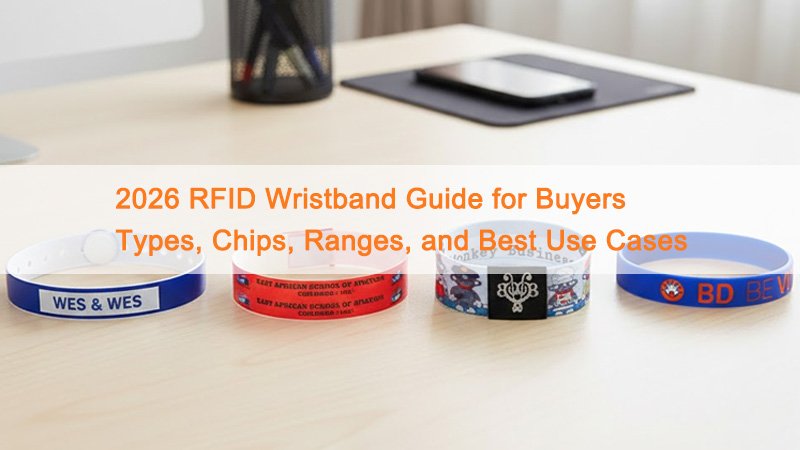
Confused about RFID wristband options? Your rollout can fail if the wristband, chip, frequency, and reader setup don’t match your real-world workflow.
RFID wristbands come in different materials, chip types, frequencies, and read behaviors. The right choice depends on your use case (access, cashless, tracking), environment (water/metal/crowds), security level, and how people will actually use the wristband.
The RFID wristband market has never offered more options—but more choice also means more ways to choose wrong. The best buying decisions don’t start with product features. They start with a clear map of your application requirements and the real-world constraints at gates, POS, and entry points. This guide shows how to match types, chips, frequencies, and ranges to the best use cases—the way experienced B2B buyers do.
Start With the Use Case: A Simple Mapping Framework
Don’t let product features drive your RFID wristband decision. Start with your workflow and risk level first—then select technology that fits.
A successful RFID deployment begins with defined use cases, throughput expectations, environment constraints, and security requirements—before comparing wristband types or chip models.
Before you request quotes from an RFID wristband manufacturer or supplier, document what “success” looks like in your specific operation. Use the framework below to translate business needs into technical requirements:
Use case → tech requirements mapping
-
Interaction style: Tap-to-use (intentional) vs hands-free reads (automatic)
-
Throughput: People per minute at gates / POS
-
Environment: Water, sweat, sunscreen, rain, UV, metal turnstiles, dense crowds
-
Lifecycle: Single-day disposable vs multi-day re-entry vs season pass / membership
-
Security risk: Low (admission only) vs medium/high (cashless, VIP, staff access)
Quick mapping cheat-sheet
-
If you need controlled actions (entry validation, cashless payment): start with HF/NFC.
-
If you need faster flow-through and longer read distances (portal reading): consider UHF/RAIN, then validate with field testing.
-
If the wristband is worn in water-heavy environments: prioritize material + sealing + durability as much as RFID specs.
Match Wristband Type and Material to Wear Time and Environment
The wrong material can break your deployment—literally. Choose wristband materials based on wear time, comfort expectations, and environmental stress.
Material determines durability, user comfort, print longevity, tamper resistance, and failure rates. The best material is the one that maintains performance for the full wear period in your environment.
From a buyer’s perspective, material selection is often the fastest way to reduce operational headaches (breakage, re-issuance, complaints) without changing your RFID system.
Common wristband materials and best fit
-
Tyvek / paper-like (disposable): Best for single-day events and fast distribution; lowest cost; limited durability.
-
Vinyl / PVC (disposable + tougher): Better for multi-day or high-wear situations than Tyvek; still cost-effective.
-
Fabric / woven / sublimation (reusable-feel): Ideal for festivals and multi-day wear; high branding impact; comfortable.
-
Silicone (reusable): Best for waterparks, resorts, gyms; durable, washable, long-wear; strong perceived value.
Buyer insight: If you’re seeing high replacement rates, don’t immediately blame “RFID range.” In many deployments, strap durability, closure design, and print abrasion are the real failure points.
Understand Frequency and “Real-World” Read Range
Datasheet range numbers don’t tell the whole story. Real-world read performance depends heavily on people, placement, and the environment.
In 2026, most wristband deployments use HF/NFC (13.56 MHz) or UHF/RAIN (860–960 MHz). Each behaves differently in crowds, around metal, and near water—so you must select based on how the wristband will be used.
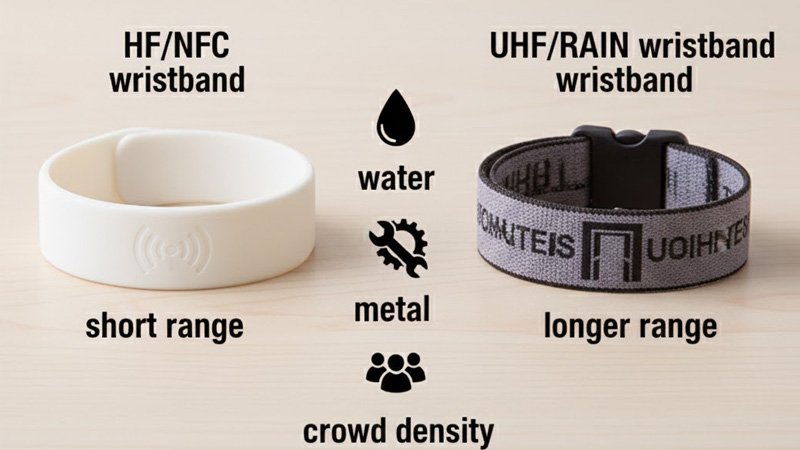
A practical way to think about “range” is not maximum distance in a lab, but typical operating behavior in your venue.
Frequency comparison table (buyer-friendly)
| Frequency | Common Name | Typical Interaction | Typical Range (Real Use) | Best For | Watch Outs |
|---|---|---|---|---|---|
| HF (13.56 MHz) | NFC / HF RFID | Tap (intentional) | Short range (cm-level, close proximity) | Access control, ticketing, lockers, cashless | Slower if users don’t present correctly; needs clear tap UX |
| UHF (860–960 MHz) | RAIN RFID / UHF | Hands-free (portal/zone) | Longer range (can be meters with the right setup) | Fast throughput, zone/portal reading, some tracking workflows | Sensitive to water/metal; requires careful reader/antenna design |
| LF (125–134 kHz) | LF RFID | Tap (very short) | Very short | Niche compatibility cases | Less common for wristbands; often limited ecosystem |
Reality check for buyers: Human bodies are mostly water, and venues often contain metal structures (turnstiles, barriers). Both can reduce effective read reliability—especially in UHF setups. Always validate with sample testing at your actual gates and POS.
Choose Chips Based on Risk and Security Requirements
Chip choice isn’t just “which one reads.” It determines security, compatibility, and how future-proof your system is.
Buyers should choose chips based on the risk profile of the application (admission vs VIP vs cashless), required standards compatibility, and whether data must be securely authenticated.
For most deployments, wristbands act as a credential that links to a backend record. That means the biggest chip decision is often security level, not memory size.
Chip selection in plain buyer language
-
Basic ID / UID-only: Good for low-risk use cases (simple admission, attendance). The wristband acts as a unique identifier.
-
Secure authentication (recommended for higher-risk): Best for cashless, VIP zones, staff access, multi-venue privileges. Helps reduce cloning and unauthorized use.
-
Writable / data-on-tag (sometimes needed): Useful when you need offline data or controlled updates—more common in specialized workflows.
What to specify (so suppliers quote accurately)
Include these in your RFQ so a manufacturer can match the right chip and encoding method:
-
Frequency: HF/NFC or UHF/RAIN
-
Standard/protocol: e.g., ISO 14443 / ISO 15693 (HF) or EPC Gen2 / ISO 18000-63 (UHF)
-
Security level: basic UID vs secure authentication/encryption
-
Encoding: pre-encoded, serial ranges, locked memory sectors (if needed)
-
Print and personalization: logo method, numbering, QR/barcode pairing
-
Compatibility: your existing reader/POS models (if any)
Best Use Cases: Recommended Combinations (2026)
The “best” wristband is the one that fits your workflow with the lowest operational risk—not the one with the most features.
Use case mapping should end with a recommended combination of material + frequency + security level that matches how people enter, pay, and move through your venue.
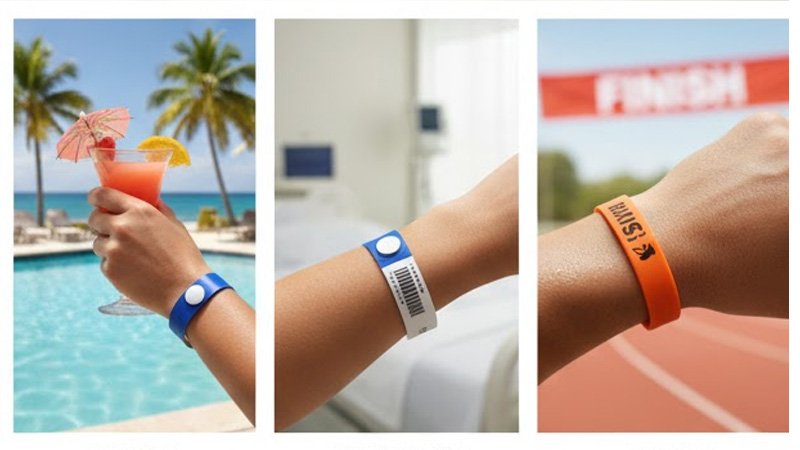
Here are common buyer scenarios and reliable starting points:
-
Single-day events (admission only)
-
Material: Tyvek / Vinyl
-
Frequency: HF/NFC (tap)
-
Security: Basic ID often sufficient
-
Why: lowest cost + simple operations
-
-
Festivals (multi-day + brand + re-entry)
-
Material: Fabric/woven/sublimation
-
Frequency: HF/NFC (tap)
-
Security: Consider secure authentication if VIP/staff tiers exist
-
Why: comfort + durability + controlled interactions
-
-
Stadiums / high-throughput venues
-
Material: Vinyl or durable fabric
-
Frequency: HF/NFC for controlled entry and POS; UHF only if you truly need portal reads
-
Security: Medium/high depending on privileges
-
Why: throughput depends more on reader placement + user flow than theoretical range
-
-
Waterparks / resorts / hotels (lockers + cashless)
-
Material: Silicone (waterproof + durable)
-
Frequency: HF/NFC
-
Security: Strongly recommended for cashless/room charge workflows
-
Why: consistent user experience when wet
-
-
Healthcare (patient ID, hygiene, controlled access)
-
Material: Durable, sanitization-friendly (often disposable or sealed solutions)
-
Frequency: HF/NFC
-
Security: Depends on policy; prioritize compliance and workflow safety
-
Why: reliability + hygiene + controlled touchpoints
-
Plan for Hidden Performance Factors Beyond Datasheets
Many RFID issues are caused by deployment conditions—not the wristband itself.
Real performance depends on user behavior, reader placement, environmental interference, encoding quality, and quality control. These factors must be designed and tested before mass production.
To reduce rework and costly delays, plan for these factors early:
-
Reader placement and angle: A few centimeters or degrees can change read reliability at speed.
-
Crowd behavior: People don’t always “tap correctly”—design signage and physical guidance.
-
Metal and water effects: Turnstiles, rails, wet hands, and pools can reduce performance.
-
Wrist orientation: Some wristbands read best when presented in a specific way—validate with real users.
-
Encoding + QA: Mis-encoding looks like “RFID doesn’t work.” Require encoding reports and spot checks.
-
Durability: Strap strength, closure design, waterproof sealing, and print abrasion matter in multi-day wear.
End With a Practical Procurement Checklist (Plus RFQ Template)
A structured procurement process helps you compare suppliers fairly and avoid surprises during deployment.
The best buyers validate compatibility, security needs, encoding capability, QC standards, and lead times—then confirm with samples and field testing.
Use this checklist when sourcing from an RFID wristband supplier, manufacturer, or factory-direct exporter:
Procurement checklist
-
Can the supplier recommend HF/NFC vs UHF based on your workflow (not just price)?
-
Do they support pre-encoding, serialization, locked memory, and provide an encoding report?
-
Can they deliver samples fast for testing with your actual readers and gate/POS setup?
-
What are the MOQ, lead time, and reorder consistency (color matching, logo clarity, material consistency)?
-
What QC tests are standard (read-rate checks, strap pull strength, waterproof sealing, abrasion resistance)?
-
Can they meet packaging needs (individual packing, barcode labels, SKU labeling, export cartons)?
Copy-paste RFQ template
Project: RFID Wristbands for [Event/Venue]
Use cases: [Entry / Cashless / Lockers / VIP / Staff]
Wear time: [1 day / 3 days / season pass]
Environment: [Outdoor / Water exposure / Metal turnstiles / Crowded gates]
Frequency: [HF/NFC 13.56 MHz / UHF 860–960 MHz]
Security: [UID-only / Secure authentication required]
Personalization: [Logo method, numbering, QR/barcode pairing]
Encoding: [Pre-encoded IDs + report / Locked memory]
Quantity: [X pcs] + expected reorders
Lead time: [Sample deadline + mass production deadline]
Packaging: [Individual pack / size label / carton marking]
Conclusion
The right RFID wristband choice comes from matching use case + environment + security to the correct material + frequency + chip + validation plan. Start with your workflow, test in real conditions, and use a structured procurement checklist to select a supplier that can deliver consistent performance at scale.