Margins don’t disappear because a supplier “overcharged.” They disappear because many lanyard orders are priced with incomplete assumptions—then real-world fees show up later: packaging add-ons, destination charges, brokerage, duties, and last-mile delivery.
Your true landed cost is the total cost per usable lanyard after you include manufacturing, packaging, freight, insurance, duties/taxes, customs clearance, destination handling, and local delivery. It’s the number that tells you whether the order is actually profitable.
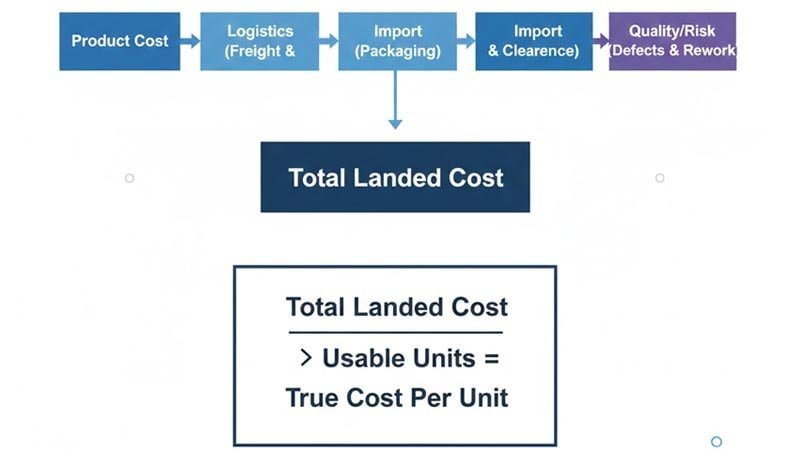
(Replace the placeholder image with a simple “Cost Stack” graphic: unit → packaging → freight → import → delivery → quality.)
If you want predictable costs and no invoice surprises, you need a repeatable landed-cost model. Once you break the order into the right buckets, the “hidden” fees stop being hidden.
What Is the Real Definition of “True Landed Cost”?
Many buyers calculate “unit price + shipping” and assume they’re done—until the first freight invoice and brokerage statement arrives.
True landed cost is the sum of product cost + logistics cost + import cost + quality/risk cost, divided by usable units (not just ordered units). It’s the final, door-to-inventory cost per lanyard.
A practical definition looks like this:
-
Product cost: factory unit price + printing/weaving setup fees + accessory upgrades + packaging/labeling + any tooling (if applicable).
-
Logistics cost: origin charges + international freight + cargo insurance + destination charges + last-mile delivery.
-
Import cost: duties/taxes + customs/brokerage fees + compliance/testing if required.
-
Quality/risk cost: inspections + expected defects/shortages + rework/replacement + expedite risk when timelines slip.
Key point: the “true” number is per usable lanyard. If 2% are defective or missing parts, your real per-unit cost rises immediately.
Hidden Cost Categories That Hit Lanyard Projects Specifically
Lanyards look simple, but the cost drivers hide in the details: decoration method, hardware, packaging, and how the shipment is charged.
Common hidden lanyard costs include decoration setup, color complexity, hardware upgrades, attachments, packaging/labeling, overage/shortage variance, inspections, destination charges, dimensional weight, and delay-driven expedite costs.
Here are the categories that most often surprise buyers:
-
Decoration setup & process differences
-
Screen printing, heat transfer, dye sublimation, and jacquard weaving each have different setup fees and tolerance risks.
-
More colors and tighter alignment standards increase scrap and rework.
-
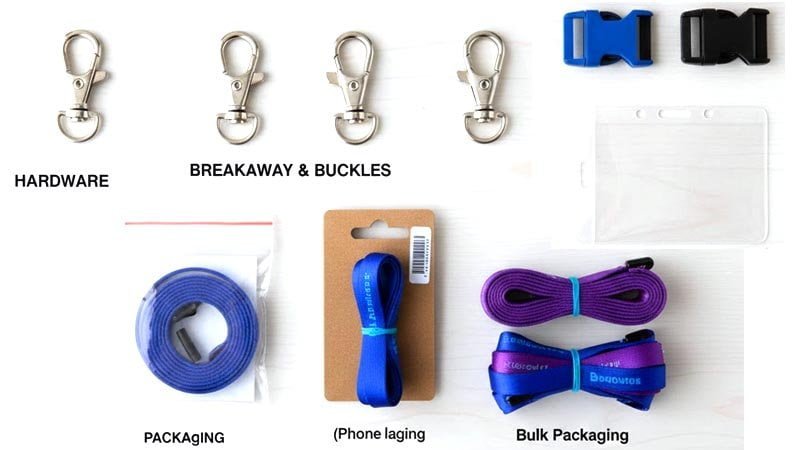
Hardware and assembly adders
-
Breakaway, detachable buckle, swivel hook grade, and custom metal parts can materially change unit cost.
-
Stitching methods (box stitch, bar tack, reinforced sewing) increase labor.
-
Packaging that increases both unit cost and freight
-
Individual polybag, header card, barcode labeling, and inserts add cents per unit—then add carton volume, which drives freight and storage.
-
Dimensional weight (DIM) risk—especially for air
-
Lanyards are lightweight, so carriers often charge by volume, not weight. Retail-ready packaging can spike DIM cost.
-
Destination charges & “port fees”
-
Terminal handling, documentation, appointment fees, demurrage/detention, and local drayage can dwarf the savings from a slightly cheaper unit price.
-
Quality costs beyond inspection
-
The expensive part is not the inspection fee—it’s the replacement units + emergency shipping + missed event dates when something fails.
A Clean Landed Cost Formula You Can Publish
A good model must be simple enough to share—and precise enough to prevent surprises.
Use a two-level approach: a simple checklist formula for quick comparisons and a full model for purchase approval.
Simple checklist formula (quick comparison)
True Landed Cost = Unit Cost + Packaging + Freight + Insurance + Duties/Taxes + Brokerage + Destination Handling + Local Delivery
Full model (purchase approval)
Total Landed Cost = Product Cost + Logistics Cost + Import Cost + Quality/Risk Cost
True Landed Unit Price = Total Landed Cost ÷ Usable Units
Where:
Usable Units = Received Units − Defects − Shortages − Damage
Worked Example
Assume an order of 10,000 lanyards:
Product cost
-
Factory unit price: $0.32 × 10,000 = $3,200
-
Decoration setup: $80
-
Packaging (individual polybag + barcode label): $0.03 × 10,000 = $300
Product cost subtotal = $3,580
Logistics cost
-
International freight + origin/destination charges: $450
-
Cargo insurance: $35
-
Local delivery (port to warehouse): $160
Logistics subtotal = $645
Import cost
-
Brokerage/customs clearance: $120
-
Duty rate: 5% (apply to dutiable value—use your broker’s method)
Estimated duty: $3,200 × 5% = $160
Import subtotal = $280
Quality/risk cost
-
Pre-shipment inspection: $150
-
Expected defects: 2% (usable units = 9,800)
Quality subtotal = $150
Total landed cost = $3,580 + $645 + $280 + $150 = $4,655
True landed unit price = $4,655 ÷ 9,800 = $0.475 (≈ $0.48 per usable lanyard)
Why this matters: if you incorrectly divide by 10,000, you report $0.47 instead of the true $0.48, and the gap widens as defects, packaging volume, or destination charges increase.
What to Request From Suppliers to Avoid Surprise Costs
Cost control starts before the PO—by forcing a complete quote and aligning terms and specs.
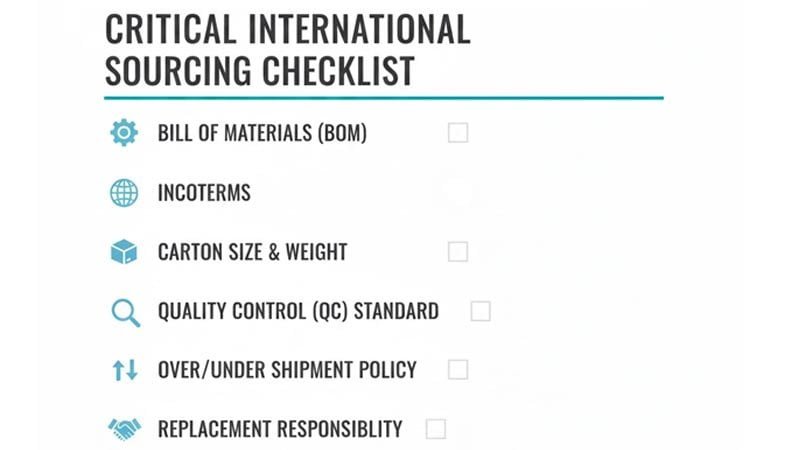
Ask for a BOM-based quote, confirm Incoterms, and require packaging/carton data. Then validate QC standards and replacement responsibility.
Use this checklist:
-
Full BOM quote: webbing type, width, thickness, decoration method, number of colors, accessory specs, stitching method
-
Packaging details: individual pack, label/barcode format, carton pack qty, carton size/weight, carton markings
-
Incoterms: confirm exactly what’s included under FOB/CIF/DDP (and what is not)
-
Lead time & buffer: production schedule + ship date + solution for delays
-
QC standard: AQL level, tensile strength requirement, color fastness expectations
-
Overage/underage policy: allowable variance and how shortages are handled
-
Defect/replacement policy: who pays replacement freight if defects are supplier-caused
-
Shipping options: sea/air quotes, DIM assumptions, and destination charges estimate where possible
Common Mistakes to Call Out
-
Comparing quotes with different Incoterms (FOB vs DDP)
-
Ignoring packaging-driven dimensional weight
-
Treating destination charges as “included” without proof
-
Skipping HS classification and duty planning (always confirm with a broker)
-
Not amortizing setup/tooling across volume
-
Dividing by ordered units instead of usable units
-
Skipping inspection on high-visibility, deadline-driven orders (events, campuses, conferences)
Conclusion
True landed cost is not complicated—it’s just complete. When you price lanyards with a full cost model (and divide by usable units), you can compare suppliers fairly, protect margin, and avoid urgent surprises right before delivery.