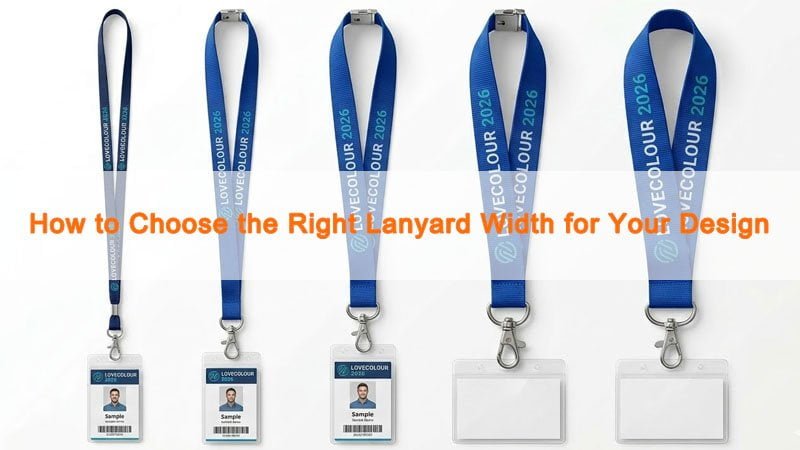
Choosing the right lanyard width has a direct impact on logo visibility, wearing comfort, print clarity and overall appearance. A narrow lanyard creates a lightweight, low-profile look, while a wide lanyard provides more space for logos, text and detailed artwork.
Standard custom lanyard widths commonly range from 5mm to 25mm, with 10mm, 15mm, 20mm and 25mm among the most frequently used options. In practical terms, buyers may describe these styles as thin, standard, wide or extra-wide lanyards depending on the application.
The best width depends on your logo complexity, printing method, badge weight and where the lanyard will be used. This guide compares narrow and wide lanyards, explains standard sizes, and helps you choose the right option before sampling or bulk production.
Quick Answer: What Lanyard Width Should I Choose?
| Width | Approx. Inch Size | Common Description | Best For |
|---|---|---|---|
| 5mm | 3/16″ | Very Narrow / Thin | Simple branding, lightweight use |
| 10mm | 3/8″ | Narrow Lanyard | Basic logos, IDs, promotions |
| 15mm | 5/8″ | Standard Lanyard | Corporate IDs, daily wear |
| 20mm | 3/4″ | Wide Lanyard | Events, trade shows, detailed logos |
| 25mm | 1″ | Extra Wide Lanyard | Large logos, sponsor branding, high visibility |
For most custom lanyard projects, 15mm and 20mm are practical all-round choices. A 15mm lanyard is suitable for everyday staff IDs, simple logos and lightweight badges, while a 20mm wide lanyard provides more branding space for corporate events, trade shows and detailed artwork.
Choose a narrow lanyard such as 5mm or 10mm when lightweight wear and minimal branding are more important. Choose a 25mm extra-wide lanyard when large logos, sponsor branding or maximum visual impact are the priority.
Why Lanyard Width Matters
Lanyard width influences much more than appearance. It affects how clearly a logo can be reproduced, how the strap feels around the neck, and how well it supports badge holders, keys or other accessories.
Narrow lanyards are lightweight and visually discreet, making them suitable for simple logos and light credentials. Wider lanyards provide a larger branding area and are usually a better choice when artwork includes detailed text, repeated logos or stronger visual branding.
The goal is not simply to choose the widest lanyard available. The correct width should balance branding, comfort, function and cost.
A very narrow lanyard can be lightweight and cost-effective, but it offers limited print space and may not feel ideal for heavier items. A wider lanyard creates a stronger visual impact and often feels more secure, especially when used for long periods or with larger attachments. However, if the width is too large for the application, it may feel bulky or unnecessary.
In practical terms, width should always be selected with four factors in mind: branding, comfort, function, and durability. For example, a lightweight visitor badge with a simple one-color logo may only need a narrow strap. A trade show badge with detailed full-color artwork usually benefits from a wider option. By choosing the correct width from the start, buyers can improve user experience, reduce design issues, and avoid costly adjustments before mass production.
tandard Lanyard Widths: From Narrow to Extra Wide
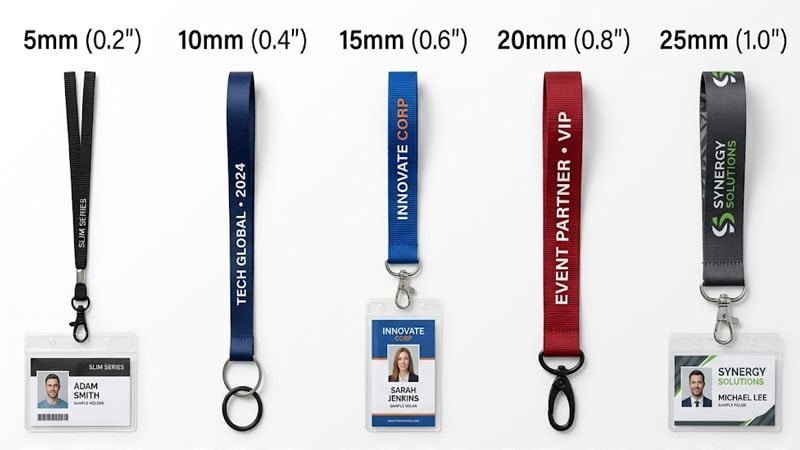
Most custom lanyards are produced in a few standard widths. The most common options include 5 mm, 10 mm, 15 mm, 20 mm, and 25 mm. Each width serves a different purpose depending on logo size, attachment weight, and usage environment.
5mm Thin Lanyard
Best for: lightweight badges, minimal branding, simple text and promotional giveaways.
A 5mm lanyard is one of the narrowest options used for custom neck straps. Its slim appearance keeps the product lightweight and discreet, but the limited printable area means logos should remain simple. Fine text, complex artwork and long company names are generally better suited to a wider lanyard.
10mm Narrow Lanyard / 3/8 Inch Lanyard
Best for: office badges, school IDs, lightweight credentials and simple promotional branding.
A 10mm narrow lanyard, approximately 3/8 inch wide, offers more branding space than ultra-thin cord styles while maintaining a lightweight feel. It works well for compact logos, short text and everyday ID applications.
If the artwork contains very small lettering, detailed graphics or multiple design elements, moving up to 15mm or 20mm can improve readability.
15mm Standard Lanyard / 5/8 Inch Lanyard
Best for: corporate IDs, conferences, staff badges and everyday use.
A 15mm lanyard offers a practical balance between comfort and available branding space. It is wide enough for most standard company logos and repeated text while remaining relatively lightweight for daily wear.
Buyers who feel a 10mm narrow lanyard is too small but do not need the stronger visual impact of a 20mm wide lanyard often choose 15mm as the middle option.
20mm Wide Lanyard / 3/4 Inch Lanyard
Best for: corporate events, trade shows, exhibitions, detailed logos and stronger branding.
A 20mm wide lanyard, approximately 3/4 inch wide, provides noticeably more printable or woven branding space than 10mm and 15mm styles. It works particularly well for repeated logos, event names, sponsor branding and artwork containing smaller details.
For many event and corporate projects, 20mm offers a strong balance between logo visibility and everyday wearability.
25mm Extra Wide Lanyard / 1 Inch Lanyard
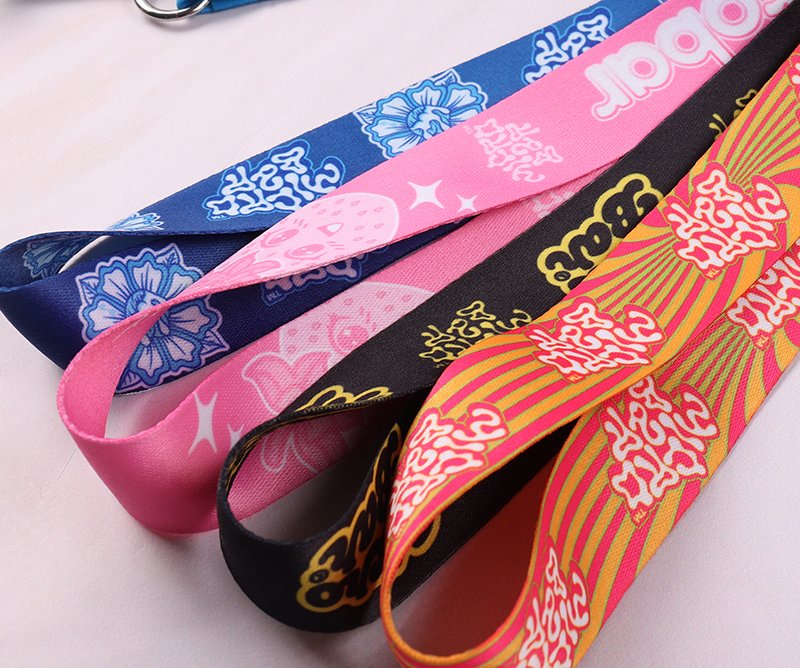
Best for: large logos, sponsor branding, VIP events, festivals, sports events and high-visibility promotions.
A 25mm extra-wide lanyard, approximately 1 inch wide, creates a large branding area for bold text, full-color graphics and highly visible logos.
Extra-wide lanyards are particularly useful when the strap itself is an important part of the promotional design. They can also support larger badge setups, although buyers should consider comfort and overall product weight before automatically choosing the widest size.
Quick comparison table
| Width | Buyer Description | Logo Space | Recommended Use |
|---|---|---|---|
| 5mm | Very narrow / thin | Very limited | Simple giveaways |
| 10mm / 3/8″ | Narrow lanyard | Limited | IDs, schools, simple logos |
| 15mm / 5/8″ | Standard lanyard | Medium | Staff IDs, corporate use |
| 20mm / 3/4″ | Wide lanyard | High | Events, trade shows, branding |
| 25mm / 1″ | Extra wide lanyard | Very high | Large logos, sponsors, premium events |
Narrow vs Wide Lanyards: Which Should You Choose?
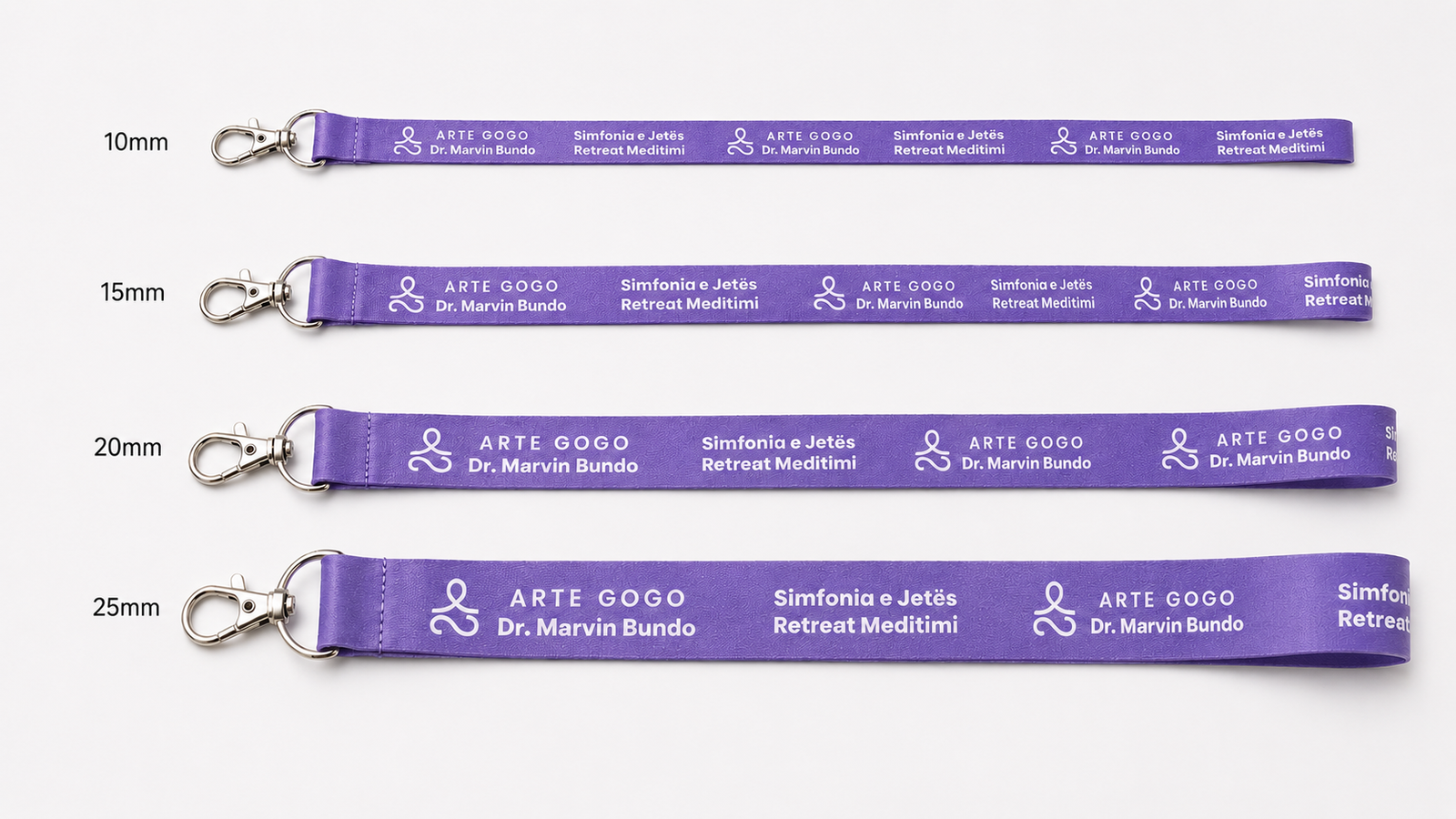
The difference between a narrow lanyard and a wide lanyard is not only visual. Width changes how much branding space is available, how the strap supports accessories and how prominent the finished product looks.
Choose a narrow lanyard when:
- the logo is simple and compact;
- the badge or attachment is lightweight;
- you want a subtle, low-profile appearance;
- budget and material usage are important.
Choose a wide lanyard when:
- the artwork contains detailed logos or longer text;
- sponsor branding needs to remain visible;
- the lanyard will be used at conferences or trade shows;
- the badge holder or attachment is relatively large;
- the strap itself is part of the promotional design.
There is no single width that is best for every project. In many cases, 15mm works well as a balanced standard size, while 20mm provides more room for branding. A 25mm extra-wide lanyard is usually selected when visibility is more important than maintaining a minimal appearance.
How Does Lanyard Width Affect Logo Detail?
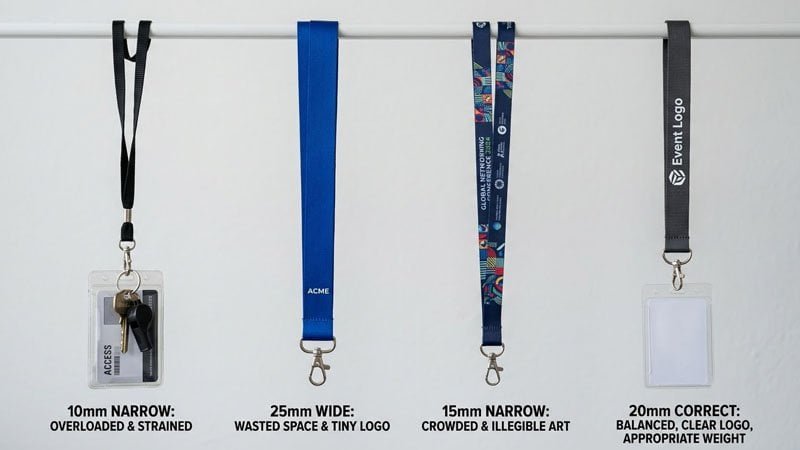
The wider the lanyard, the more usable space is available for logos, text and graphic details. A narrow lanyard can reproduce simple artwork very well, but complex logos may become crowded when reduced to a small print area.
For logos containing fine lines, small letters, multiple colors or repeated graphics, a 20mm or 25mm wide lanyard normally gives the artwork more room to remain readable.
For simple designs, such as a one-color logo or short brand name, narrow widths like 5 mm or 10 mm may be enough. These widths keep the lanyard lightweight and economical while still delivering a clean branded look.
For moderately detailed designs, such as repeated logos, dual-color graphics, or slightly longer text, 15 mm often provides better balance. It gives the artwork more room without making the lanyard feel too wide.
For complex designs, wider widths such as 20 mm or 25 mm are usually the better choice. These widths help preserve legibility, especially when the design includes small letters, fine outlines, or full-color elements. Narrow widths can make detailed artwork look crowded or unclear, even when high-quality printing is used.
As a general rule, buyers should evaluate the following before choosing width:
-
logo size
-
amount of text
-
color complexity
-
repeat pattern
-
required readability from a distance
If the artwork needs to be seen clearly and quickly, wider lanyards usually offer better visual performance.
Logo Detail by Lanyard Width
| Width | Recommended Artwork |
|---|---|
| 5–10mm | Simple icons, short names, basic logos |
| 15mm | Standard logos, repeated branding, short text |
| 20mm | Detailed logos, event names, multi-color artwork |
| 25mm | Large logos, sponsor graphics, complex branding |
Best Lanyard Width by Printing Method
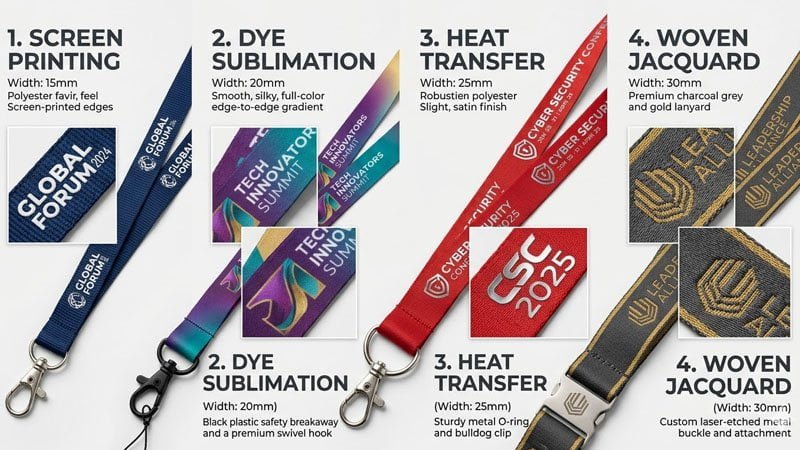
Lanyard width should always be evaluated together with the branding method. Screen printing, dye sublimation and woven lanyards each reproduce artwork differently, so the same logo may require a different width depending on how it is produced.
Screen printing
Screen printing works well for simple logos, bold text, and limited-color designs. It performs best on 10 mm to 20 mm widths, where the artwork has enough space to remain clear. On very narrow lanyards, the design may need to be simplified to maintain legibility.
Dye sublimation
Dye sublimation is ideal for full-color printing, gradients, and complex branding. It generally performs better on 15 mm to 25 mm widths because wider surfaces allow detailed artwork to display more clearly. While sublimation can be used on narrower lanyards in some cases, intricate designs often benefit from more print area.
Heat transfer printing
Heat transfer is suitable for detailed logos and vivid color reproduction. It can work across multiple widths, but results depend on material, artwork, and production setup. Testing is especially important when applying detailed graphics to narrow lanyards.
Jacquard woven lanyards
Woven lanyards create the logo directly in the fabric. Because woven detail has physical limitations, wider widths are often recommended for better readability. If the logo contains small letters or fine shapes, a narrow woven lanyard may not display them clearly.
In custom production, width and print method should always be evaluated together. A design that looks good in digital artwork may still need adjustment when transferred to fabric.
Flat vs Round Lanyards: Does Width Mean the Same Thing?
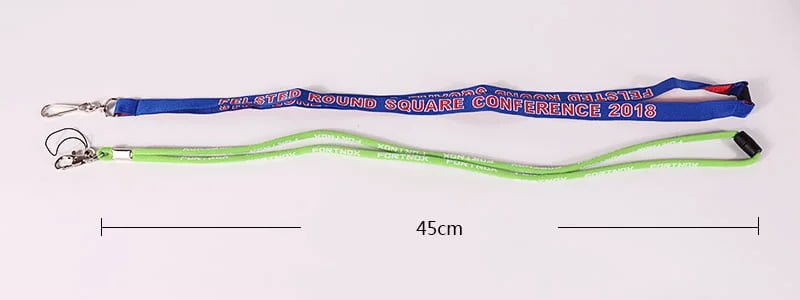
Most of the sizes in this guide refer to flat lanyards, where width is measured across the surface of the webbing. These styles provide a flat area for printing, sublimation or woven logos.
A round lanyard, also commonly described as a tubular lanyard or cord lanyard, has a rounded construction instead of a broad flat surface. Because of this structure, its sizing and usable branding area are different from a standard flat 15mm, 20mm or 25mm lanyard.
Round and tubular lanyards are useful when buyers prefer a lightweight, simple and comfortable neck strap. However, when large logos, repeated text or detailed full-color artwork are required, a wider flat lanyard usually provides more usable branding space.
When choosing between a flat and round lanyard, consider both the strap construction and the logo method—not only the nominal size.
Best Lanyard Width by Application
Different industries prioritize different things. Some need comfort for all-day wear, while others need high visibility or stronger branding.
Corporate Offices and Staff ID Lanyards
For everyday employee IDs and access cards, 15mm standard lanyards are a practical choice when comfort and professional appearance are both important. A 10mm narrow lanyard can work for lighter credentials and simple logos, while a 20mm wide lanyard provides greater logo visibility for stronger corporate branding.
Trade Show and Exhibition Lanyards
or exhibitions, conferences and trade shows, 15mm to 20mm lanyards are commonly selected because they provide enough room for event logos and sponsor branding without becoming excessively bulky.
A 20mm wide lanyard is particularly useful when the design includes repeated logos, event names or sponsor graphics. For VIP credentials or campaigns where the lanyard itself is an important advertising surface, a 25mm extra-wide lanyard can provide even more visual impact.
Schools and universities
For student IDs and campus access cards, 10 mm to 15 mm is a practical choice. It balances comfort, cost, and clear identification.
Hospitals and healthcare
Healthcare environments often prioritize comfort, safety, and easy movement. 10 mm is commonly used for lightweight badge wear, especially when combined with breakaway features or practical attachments.
Sports events and festivals
For bold visual branding and larger printed graphics, 20 mm to 25 mm is a strong option. These widths stand out well and support event-focused designs.
Promotional giveaways
For budget-driven campaigns, 5 mm to 10 mm may be enough, especially when the design is simple and the lanyard is intended for short-term use.
The best width depends on how long the lanyard will be worn, what it needs to carry, and how important the branding is to the project.
What Is the Most Common Lanyard Width for Corporate Events?
For corporate events, conferences and trade shows, 20mm (approximately 3/4 inch) is one of the most frequently selected widths when logo visibility is important. It provides enough space for company logos, event names and repeated branding while remaining suitable for everyday event wear.
A 15mm lanyard can be a better option for simple staff identification or a lighter appearance. For premium events, large sponsor logos or highly visible credentials, 25mm extra-wide lanyards provide additional branding space.
The final choice should depend on logo size, badge weight, wearing time and the overall visual importance of the lanyard.
Common Mistakes to Avoid
Selecting the wrong lanyard width can lead to design problems, user complaints, and unnecessary production costs. Here are some of the most common mistakes buyers should avoid.
Choosing a width based on price alone
A narrower lanyard may reduce material cost, but it may also limit design quality and comfort. Width should be selected based on performance, not only budget.
Using a Narrow Lanyard for Heavy Attachments
Heavy badge holders, keys, or multiple accessories need better support. A width that is too narrow may feel uncomfortable or less durable in daily use.
Choosing an Extra-Wide Lanyard When It Is Not Needed
If the artwork is minimal and the use is light, an extra-wide lanyard may add cost and bulk without improving the final result.
Ignoring print method limitations
Some artwork looks fine on screen but loses clarity on fabric. Width and printing method must be considered together before production.
Skipping sample approval
A physical sample helps confirm print clarity, width comfort, accessory fit, and overall appearance. This step is especially important for bulk orders.
Forgetting accessory compatibility
The width of the lanyard should work well with hooks, buckles, badge reels, and holders. A mismatch can affect both appearance and usability.
Factory Recommendation: Choose Width Before Sampling
From a manufacturing point of view, we normally review the logo size, smallest text, printing method and attachment weight before recommending a lanyard width.
A design may look clear on a large computer screen but become difficult to reproduce once reduced to a narrow 10mm or 15mm strap. Before bulk production, artwork should be checked at actual size. Depending on the result, we may recommend simplifying small details, increasing the lanyard width or changing the branding method.
For custom orders, the best width is therefore not always the smallest or largest available option. It is the width that allows the artwork, material and accessories to work together correctly.
Final Checklist Before Ordering Custom Lanyards
Before placing a bulk order for custom lanyards with logo, confirm the following:
Before placing a bulk order, it is worth reviewing a few practical points:
-
- Confirm lanyard width: narrow, standard, wide or extra wide
- Check logo size and smallest text
- Confirm printing or weaving method
- Check badge holder and attachment weight
- Confirm flat, tubular or round construction
- Approve artwork at actual size
- Request a physical sample when required
- Confirm bulk quantity, packaging and delivery requirements
A good lanyard should not only look attractive in artwork approval. It should also perform well in real use.
Conclusion
hoosing the right lanyard width is about balancing branding, comfort and function. Narrow lanyards such as 5mm and 10mm work well for simple logos and lightweight applications, while 20mm wide lanyards provide more room for detailed artwork, events and corporate branding. 25mm extra-wide lanyards are ideal when maximum logo visibility is the priority.
Buyers should also consider construction. A flat lanyard provides more usable branding area, while a round or tubular lanyard creates a lighter and more minimal appearance.
If you are unsure which width suits your artwork, send us your logo, required quantity, badge type and application. Our team can review the design and recommend a suitable width, material, printing method and attachment before production.
FAQ
What is the most common lanyard width?
Common custom lanyard widths include 10mm, 15mm, 20mm and 25mm. A 15mm lanyard is a versatile option for general IDs and daily corporate use, while 20mm is widely used when stronger logo visibility is required for events, exhibitions and branded programs.
What is considered a narrow lanyard?
A narrow lanyard usually refers to a slim strap with limited branding space, such as approximately 5mm to 10mm depending on the construction. Narrow lanyards work best for lightweight badges, simple logos and low-profile applications.
What is considered a wide lanyard?
A 20mm lanyard is commonly treated as a wide custom lanyard because it provides more surface area for logos and text than 10mm or 15mm styles. Wider lanyards are popular for events, exhibitions and stronger corporate branding.
What is an extra-wide lanyard?
A 25mm or approximately 1-inch strap is often described as an extra-wide lanyard. It is suitable for large logos, sponsor branding, premium credentials and other applications where the lanyard needs to be highly visible.
What is the best lanyard width for a logo?
Simple logos can work well on 10mm or 15mm lanyards. More detailed logos, small text or repeated branding usually benefit from a 20mm or 25mm width because the larger surface area gives the artwork more room to remain clear.
How does lanyard width affect logo detail?
Wider lanyards provide more usable branding space for fine text, complex logos and multi-color graphics. Narrow lanyards can reproduce simple artwork effectively, but detailed designs may need to be simplified when the printable area is limited.
What is the best lanyard width for corporate events?
For many corporate events and trade shows, 15mm to 20mm is a practical range. A 20mm wide lanyard is especially useful when event names, sponsor logos or repeated branding need stronger visibility.
What is the difference between a flat lanyard and a round lanyard?
Flat lanyards have a broad webbing surface that provides more room for printing or woven logos. Round lanyards, also called tubular or cord lanyards, have a rounded construction and usually provide less continuous flat branding area. The best option depends on logo requirements, comfort and end use.
Does lanyard width affect production time?
Standard widths such as 10mm, 15mm, 20mm and 25mm normally do not create a major difference in production time when standard materials are used. Custom widths, special woven structures, unusual accessories or complex artwork may require additional sampling or setup time.