Why Global Lanyard Consistency Matters More Than Most Teams Expect
In global organizations, lanyards are one of the most visible “everyday brand assets.” When each office uses different colors, materials, attachments, or logo layouts, the brand looks fragmented—especially at customer sites, audits, recruiting events, and global meetings. A corporate lanyard standard prevents this drift by defining what must stay consistent everywhere, while still allowing practical localization where it is genuinely required.
A mature standard also reduces operational drag: fewer SKUs, fewer rush orders, fewer exceptions, and fewer arguments between brand, security, HR, and regional admins.
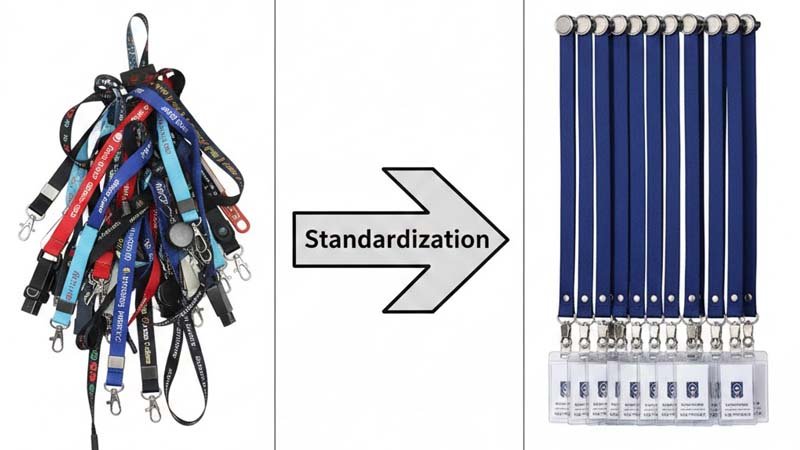
What a Corporate Lanyard Standard Includes
A corporate lanyard standard is a controlled specification for lanyards and related badge-carrying components used across all offices and sites. It typically covers:
-
Brand rules: logo placement, artwork file requirements, approved color references
-
Product rules: widths, lengths, materials, printing methods, finishing
-
Hardware rules: hooks, buckles, D-rings, detachable features, badge holders
-
Safety controls: breakaway/quick-release use policies and risk-based guidance
-
Compliance controls: chemical restrictions, metal contact considerations, RFID regulatory pathways
-
Quality controls: color management, acceptance criteria, sampling, and audits
-
Governance: ownership, approvals, version control, and change management
The Scalable Model: Core Standard + Local Variants
The most reliable approach is to standardize using Core + Local Variants.
Core
These elements are fixed worldwide because they drive immediate brand recognition and predictable procurement:
-
Primary logo usage (position, clear space, minimum size)
-
Corporate color palette references (Pantone/CMYK/RGB + physical swatch control)
-
Approved lanyard widths (usually 1–2 choices)
-
Approved webbing material families (and minimum performance requirements)
-
Approved printing methods (by use case)
-
Approved hardware set (restricted options)
-
Global QC acceptance criteria and inspection sampling rules
Local variants (allowed within defined boundaries)
These are permitted when they do not dilute brand recognition and they solve legitimate regional needs:
-
Language (local script + English, where appropriate)
-
Local emergency contact text inserts
-
Climate-driven substitutions (e.g., quick-dry preference in humid regions)
-
Site-level security overlays (e.g., additional ID coding formats)
-
Event-specific additions (temporary accent stripe, not a redesign)
This model prevents the two classic failures: “one-size-fits-all rigidity” and “everyone does their own thing.”
Step 1: Build a Use-Case Matrix and Reduce to 2–4 Global SKUs
Global programs fail when they try to enforce one lanyard for every context. Instead, build a matrix that maps lanyard requirements to real operational categories, then standardize a small set of global SKUs (often 2–4) to cover most needs.
| Use Case | Primary Requirements | Typical Global SKU Outcome |
|---|---|---|
| Employee (daily wear) | Comfort, durability, brand fidelity | Standard employee lanyard |
| Visitors/contractors | High-visibility ID differentiation, easy issuance | Visitor lanyard (color-coded) |
| High-security areas | Controlled hardware options, tamper resistance | Security lanyard (restricted features) |
| Events/conferences | Fast lead times, high brand impact | Event lanyard (approved seasonal variant) |
This matrix approach reduces SKU sprawl and creates procurement leverage.
Step 2: Convert Brand Guidelines into Procurement-Ready Specs
Most brand guides are not written in a way factories or procurement can execute. Convert “look and feel” into measurable specification fields.
Core specification fields (recommended baseline)
| Spec Category | What to Specify (Procurement-Ready) |
|---|---|
| Dimensions | Width(s): e.g., 15/20/25 mm (choose 1–2). Finished length tolerance (±). |
| Webbing | Material family (polyester/nylon/rPET/jacquard), thickness, weave type, hand-feel requirement. |
| Color | Pantone reference + physical signed swatch; batch control method; re-approval triggers. |
| Artwork | Vector file format, minimum line weight, repeat pattern rules, clear space rules. |
| Printing | Allowed methods by SKU (sublimation, screen, jacquard weave, heat transfer). |
| Hardware | Allowed hook types; hardware material; finish; corrosion expectations if relevant. |
| Safety | Breakaway/quick-release policy by site type; allowable buckle styles. |
| Packaging | Unit packing, labeling fields (SKU, lot/batch), carton marks, barcodes if used. |
| QC | Sampling method, acceptance criteria, defect classification, rework/replace policy. |
Step 3: Choose Materials and Printing Methods Based on Brand and Environment
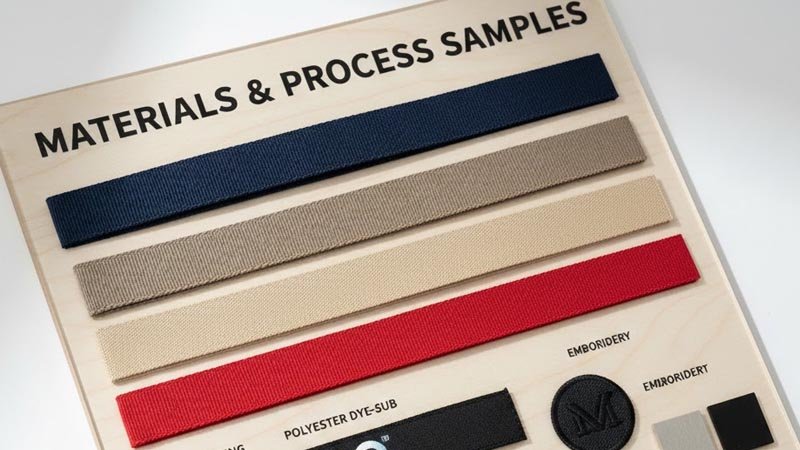
Material and printing are where global consistency often breaks. Standardize by use case + durability expectations, not by “what one office likes.”
Common decision logic
-
Polyester + dye sublimation: strong for full-color, gradients, high logo clarity; good for most employee/event SKUs.
-
Nylon + screen printing: strong for sharp solid logos; good durability and a slightly premium sheen.
-
Jacquard weaving: premium texture and durability; ideal for executive, flagship offices, or long-life SKUs.
-
Recycled PET (rPET): supports sustainability messaging; validate color and hand-feel consistency across batches.
| Material | Best-fit Printing | Strengths | Watch-outs |
|---|---|---|---|
| Polyester | Sublimation | Full-color, vivid detail | Requires strict color control across batches |
| Nylon | Screen/heat transfer | Premium sheen, strong webbing | Color matching differs from polyester; align references |
| Jacquard | Woven logo | Premium + durable | Longer lead time; fewer color/gradient options |
| rPET | Sublimation/transfer | Sustainability story | Recycled content variability; require tighter QC |
Step 4: Safety and Compliance—Write Policy Carefully and Factually
4.1 Safety: Breakaway and entanglement risk controls
Neck-worn lanyards can present snagging and strangulation hazards in certain environments (e.g., machinery, moving equipment, crowded access points). Many organizations mitigate this with breakaway/quick-release features based on site risk assessment and role-based policy, not aesthetics. One OSHA accident report notes an employer changed lanyard configuration specifically to control a strangulation hazard, illustrating that the risk is real and managed operationally.
4.2 Do not confuse “badge lanyards” with “fall protection lanyards”
In regulatory language, “lanyards” often refer to personal fall arrest system lanyards with defined strength/performance requirements. For example, OSHA’s construction fall protection framework discusses lanyard systems and testing guidance in fall arrest contexts. Those rules are not automatically applicable to neck-worn badge lanyards, but they matter if you are standardizing safety equipment terminology internally.
4.3 Chemical and metal contact compliance (EU example)
If your lanyard program includes metal hooks, clips, or badge frames that contact skin or are used in consumer-like contexts, EU chemical restrictions can become relevant. ECHA maintains the restriction list (REACH Annex XVII) and related guidance for restricted substances. For nickel release compliance, industry practice often references standardized test methods aligned to the REACH restriction entry on nickel release.
4.4 RFID-enabled lanyards: regulatory and standards alignment
If lanyards include RFID/NFC components (badge integration, embedded chips, etc.), your program should separate:
-
Radio regulatory compliance (e.g., FCC Part 15 in the US for unlicensed RF devices)
-
EU market access (Radio Equipment Directive / RED framework for radio equipment)
-
Interoperability standards (for UHF passive RFID, ISO/IEC 18000-63 is a common air-interface reference in industry)
This structure keeps your compliance section accurate and enterprise-grade.
Step 5: Standardize Accessories Without Killing Local Usability
Accessories are where “hidden inconsistency” shows up: different hooks, different buckles, different badge holders—creating different security behaviors and user experiences.
Split accessories into two tiers
Tier 1 (global standard set):
-
Hook type(s) (limit choices)
-
Breakaway buckle style(s) and pull-force behavior (policy-driven)
-
D-ring configuration
-
Badge holder orientation and size range
Tier 2 (local add-ons within rules):
-
Local emergency contact inserts (standard template)
-
Region/site coding (stripe, secondary text line, local language)
-
Site-required security accessories (approved list)
| Component | Global Standard (Recommended) | Local Flexibility |
|---|---|---|
| Hook | 1–2 approved types | Only if required by local access devices |
| Breakaway | Policy-driven approved set | Allowed only with documented risk need |
| Badge holders | Approved sizes and orientations | Language inserts, local contact content |
| Add-ons | Restricted list | Event overlays within brand boundaries |
Step 6: Quality Control and Color Management (Where Most Programs Fail)
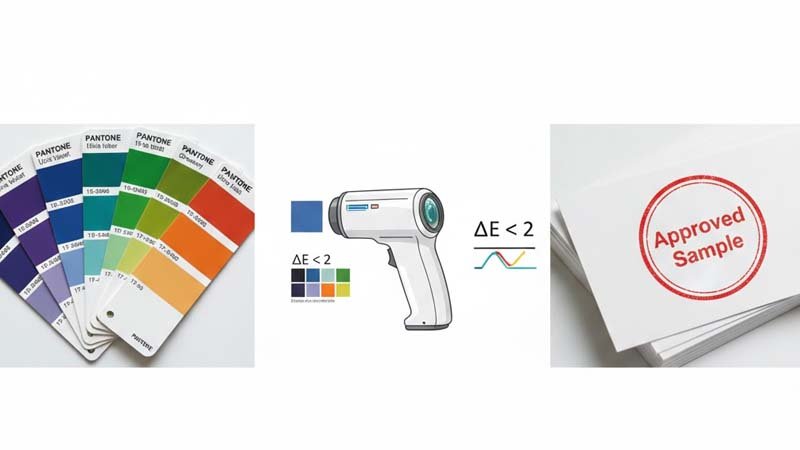
Color drift and inconsistent finishing are the fastest ways to damage brand integrity. Treat color as a quality system, not a design decision.
Minimum QC controls to specify
-
Signed physical color swatch approval (not only digital proof)
-
Incoming batch checks (webbing lot tracking)
-
In-process checks for print clarity and alignment
-
Final AQL sampling and defect classification
-
Re-approval triggers: new material lot, new print method, or new factory line
A practical acceptance table you can include in the standard:
| QC Item | Acceptance Standard | Verification |
|---|---|---|
| Color match | Match to approved reference under defined viewing condition | Swatch comparison + recorded result |
| Logo clarity | Minimum line thickness / readable text size | Visual inspection against reference |
| Dimensional tolerances | Width/length within tolerance | Measurement sampling |
| Hardware integrity | No deformation under normal load | Pull test / functional check |
| Stitching/finishing | No fraying; consistent edge finish | Visual + handling inspection |
Step 7: Governance, Approvals, and Version Control (The Missing “Enterprise Layer”)
Without governance, standards degrade into suggestions.
Recommended ownership model (RACI-style)
-
Owner (Accountable): Global Procurement or Brand Operations
-
Approvers: Brand (visual), Security (policy), EHS (safety), Compliance (materials/RF)
-
Consulted: Regional ops leads, Facilities, HR onboarding
-
Informed: Office admins, event teams, suppliers
Version control and change management
-
Establish V1.0 baseline with locked “core” rules
-
Define a quarterly or semiannual review cadence
-
Require a change ticket for any variation request (reason, site, duration, impact)
-
Create an end-of-life policy for old designs (cutover window + depletion plan)
This is the difference between “a document” and “a standard.”
Step 8: Procurement and Rollout Plan That Actually Works
A workable rollout is phased, measurable, and designed to make compliance easier than exceptions.
Recommended phases
-
Planning (2–4 weeks): finalize specs + governance, shortlist suppliers
-
Sampling (2–4 weeks): physical samples, signed swatch, QC checklist validation
-
Pilot (4–8 weeks): 3–5 sites across climates/security levels
-
Global rollout (3–12 months): staged by region, with inventory planning
-
Operations (ongoing): audits, reorder rules, and continuous improvement
Success metrics
-
SKU count reduction
-
On-time delivery and lead-time variance
-
Color/quality defect rate
-
Adoption rate by site
-
Exception requests trend (should fall over time)
Common Mistakes to Avoid
-
Over-standardizing and triggering local resistance (no variants allowed)
-
Under-specifying (brand intent not converted into measurable requirements)
-
Skipping pilots across different climates and site types
-
No governance (no owner, no version control, no change management)
-
No ongoing QC (quality declines slowly until it becomes visible)
A 30-Day Build Plan
| Week | Focus | Deliverables |
|---|---|---|
| Week 1 | Requirements + stakeholder alignment | Use-case matrix + program charter |
| Week 2 | Specs + governance | V1.0 draft standard + RACI + approved SKUs |
| Week 3 | Sampling + QC definition | Physical sample plan + acceptance checklist |
| Week 4 | Pilot setup + rollout plan | Pilot sites, ordering process, training notes |
Conclusion

A global corporate lanyard standard is a brand control system, a security support tool, and a procurement efficiency lever. Build it around Core + Local Variants, keep SKUs intentionally small through a use-case matrix, and protect brand integrity with measurable specifications, disciplined QC, and governance that survives personnel changes.