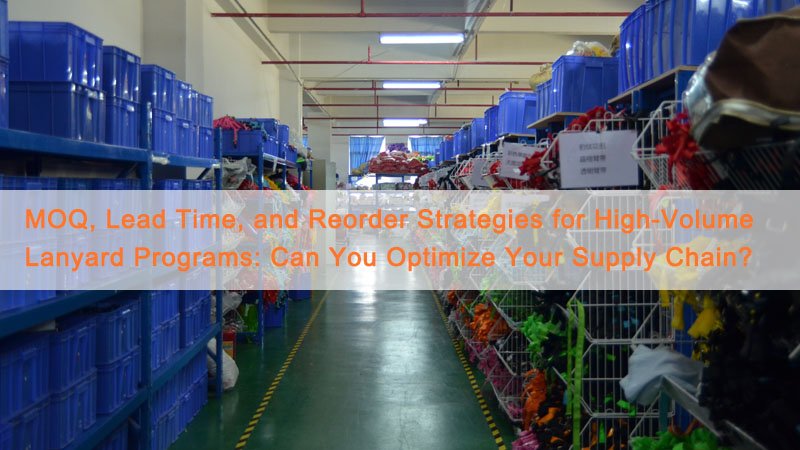
Struggling with high MOQs and long lead times for custom lanyards? With the right planning framework, you can reduce total landed cost, prevent stockouts, and avoid expensive rush freight—without sacrificing brand consistency.
Effective MOQ management translates minimum order quantities into meaningful business units (SKUs, sites, and consumption cycles). Accurate lead time planning requires separating approval, production, and logistics phases. Strong reorder strategies transform lanyards from one-off promo items into managed supply chain SKUs—reducing surprises, rush fees, and operational noise.
In high-volume merchandise and ID-access programs, lanyards behave less like “promotional giveaways” and more like consumables. Procurement teams often focus on unit price while overlooking the bigger cost drivers: approval delays, SKU sprawl, inconsistent reorder timing, and expedited shipping. Managing MOQ, lead time, and reordering as one system can meaningfully improve cost control and service levels.
What Does MOQ Really Mean for High-Volume Lanyard Programs?
Minimum order quantities can make or break your budget and your inventory plan. Understanding MOQ beyond a single number is critical for program stability.
MOQ is the minimum production run a manufacturer can efficiently accept, balancing setup costs and material batching. Higher MOQs can reduce unit costs but may increase inventory carrying risk. Strategic MOQ management considers production economics and real usage patterns across sites and events.
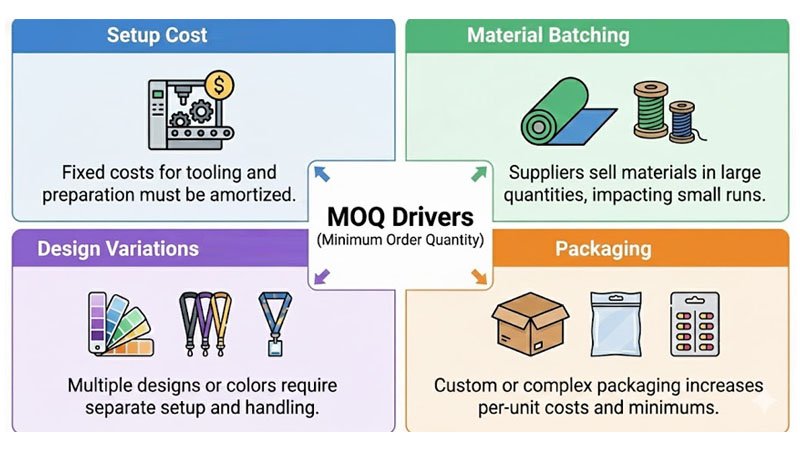
For custom lanyards, MOQ is typically driven by setup and batching realities—rather than arbitrary policy. Typical “MOQ drivers” include:
-
Process setup: machine calibration, print setup, stitching/assembly line changes
-
Material batching: dyed webbing lots, accessory supplier pack sizes
-
Design variability: each colorway, logo file, or attachment option can behave like a separate MOQ
-
Packaging requirements: barcodes, inserts, kitting, individual bagging can create packaging-related minimums
A more useful way to view MOQ is by its cost trade-offs:
| Cost Component | Low MOQ Impact | High MOQ Impact |
|---|---|---|
| Setup costs per unit | Higher | Lower |
| Material efficiency / waste | Less efficient (higher waste) | More efficient (lower waste) |
| Inventory carrying cost | Lower | Higher |
| Production efficiency | Lower | Higher |
Practical optimization insight: MOQs are often more flexible when you (1) keep specifications standardized, (2) repeat approved artwork, and/or (3) commit to forecasted annual volume. Rather than pushing for the absolute lowest MOQ, many high-volume programs get better results by consolidating SKUs and reducing variations (fewer unique colors, attachments, packaging formats) so each production run becomes larger and more economical.
Key takeaway: Don’t negotiate MOQ in isolation—negotiate it as part of a program design that reduces SKU fragmentation.
How to Break Down Lead Times for Lanyard Programs: Don’t Underestimate Approval Time
Lead time can make or break launches, onboarding cycles, and event readiness. The biggest source of delay is often approval time—not production time.
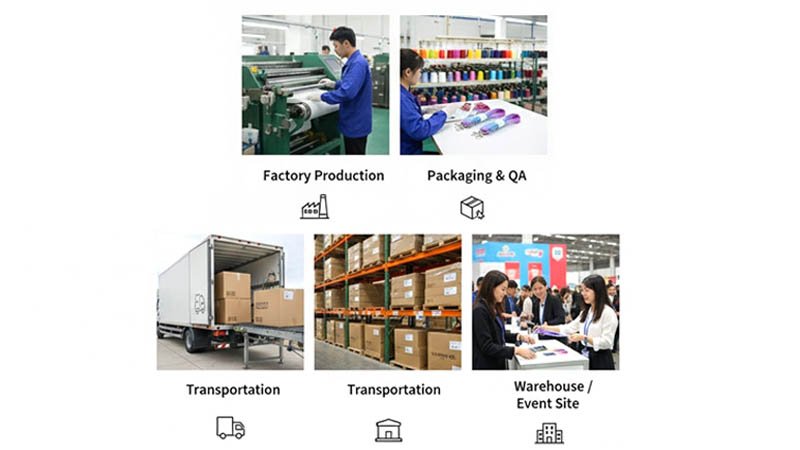
Custom lanyard lead time includes internal approvals, pre-production, manufacturing, and logistics (plus customs when applicable). Approval cycles frequently consume a meaningful share of the total timeline. Accurate phase-based planning reduces rush fees and last-minute rework.
A reliable lead-time plan should separate phases that are inside your organization from phases that are inside the supplier’s factory and inside the logistics chain.
Typical lead time phases (illustrative ranges):
-
Approval & Pre-production (often the hidden critical path)
-
artwork finalization, proof confirmation
-
spec lock (webbing, width, printing method, attachments, packaging)
-
sample approval if required (physical sample adds time)
-
Production
-
material prep (webbing/printing readiness)
-
printing/weaving + sewing/assembly
-
QC + packaging
-
Logistics
-
export handling / consolidation
-
shipping (air/sea/courier)
-
customs clearance + last-mile delivery
What drives lead time variance most often:
-
number of stakeholders in approval
-
whether physical samples are mandatory for every run
-
packaging complexity (kitting, barcodes, inserts)
-
peak season capacity constraints
-
destination customs and documentation readiness
Key takeaway: Track lead time variance (how consistent delivery is), not only “average lead time.” Consistency enables lower safety stock and fewer emergency orders.
Reorder Strategies: Should You Treat Lanyards Like Supply Chain SKUs or Promotional Items?
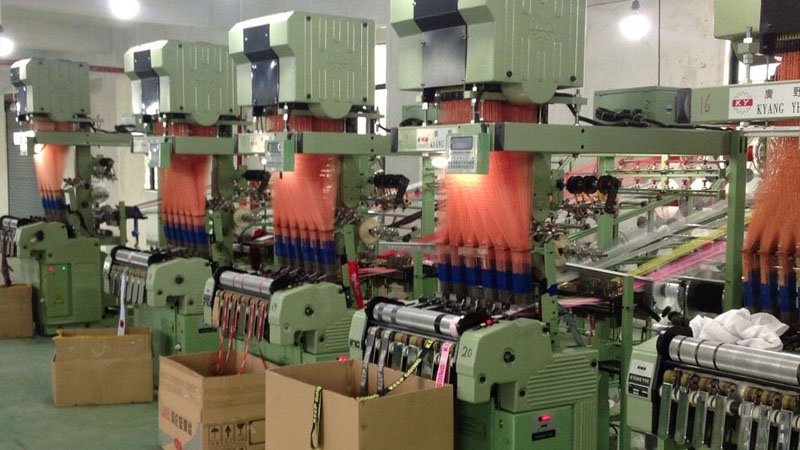
Treating lanyards as one-time promotional items creates rework, inconsistent branding, and avoidable rush costs. A SKU-based approach builds control.
Managing lanyards as supply chain SKUs enables standardized specs, faster reorders, and lower total cost over time. Procurement gains predictability through approved masters, consumption tracking, and reorder triggers.
Here’s the operational difference:
| Aspect | Promotional Item Approach | Supply Chain SKU Approach |
|---|---|---|
| Ordering | Event-by-event | Scheduled replenishment |
| Specs | Frequently reinvented | Standardized “masters” |
| Cost | Higher (rush fees, rework) | Lower (repeatable runs) |
| Inventory | Reactive | Planned safety stock |
| Supplier relationship | Transactional | Program partnership |
Add a simple, procurement-friendly reorder model (high impact)
A basic reorder point model makes your program measurable:
Reorder Point (ROP) = Average Daily Usage × Lead Time (days) + Safety Stock
-
Average Daily Usage: derived from historical consumption (by site or event type)
-
Lead Time: your phase-based plan (approval + production + logistics)
-
Safety Stock: buffer for demand spikes and lead time variance
Key takeaway: If stockouts disrupt onboarding or access control, safety stock should be sized for service level—not just storage comfort.
Program Design Decisions That Reduce MOQ Pressure and Shorten Lead Time: What Works?
Program design can remove friction before negotiation even starts. Standardization and consolidation often reduce both MOQ pressure and lead time.
Effective levers include standardized materials, consolidated order windows, phase ordering aligned to event calendars, and pre-approved masters. These changes frequently reduce MOQ pressure and shorten cycle time by eliminating rework and repeated RFQs.
High-volume programs tend to improve when they standardize what doesn’t need to be custom:
-
Standardize 70–80% of specs: webbing width, material, base colors, attachment types
-
Limit variations: reduce the number of unique SKUs
-
Create “master” configurations: pre-approved artwork + packaging templates
-
Consolidate demand: quarterly ordering windows across departments/sites
-
Use phase ordering: lock core specs early; finalize variable details later (within a controlled window)
Why this works: Most MOQ and lead-time problems are actually variation problems. Reducing variation increases run size, stabilizes production planning, and accelerates approvals.
Key takeaway: SKU rationalization is often the fastest path to lower MOQs, shorter lead times, and fewer mistakes.
Reorder Risk Management: How to Avoid the “Rush Shipment Tax” in Lanyard Programs
Rush fees can materially increase total landed cost. A simple risk framework helps avoid last-minute production and air freight.
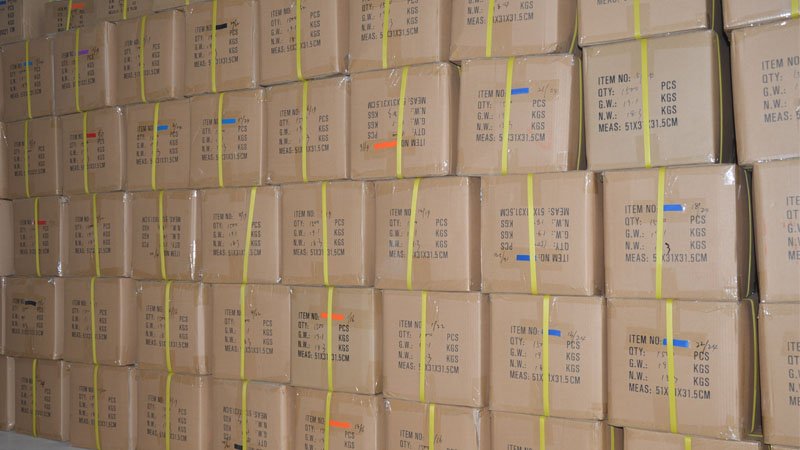
The “rush shipment tax” includes expedited manufacturing charges, premium shipping, and increased error risk under compressed timelines. Avoid it using reorder triggers, buffer policies, and a production calendar aligned with peak seasons.
Rush costs usually come from:
-
Expedite production surcharges (when capacity is tight)
-
Air freight premiums (often multiples of standard shipping)
-
Operational risk (less time available for QC and rework)
A practical prevention toolkit:
-
Trigger-based reordering: reorder based on ROP, not “when someone notices stock is low”
-
Buffer inventory policy: set by service criticality and lead-time variance
-
Calendar planning: place larger builds in off-peak windows when possible
-
Visibility dashboard: inventory vs. upcoming events/onboarding forecasts
Key takeaway: Most rush shipments are planning failures, not supplier failures. Use triggers and calendars to keep orders inside normal cycles.
What to Measure in Lanyard Programs: Key Metrics That Build Procurement Trust
Procurement stakeholders trust programs that measure outcomes beyond unit price.
Track total cost of ownership, lead-time consistency, reorder cycle health, and quality performance. These metrics prove program value and reduce procurement risk.
Recommended KPI set:
-
Total Cost of Ownership (TCO)
Include unit price + setup/art charges + storage/handling + obsolescence + rush freight + rework/returns. -
On-time delivery rate (OTD)
Measures supplier reliability in real operations. -
Lead time average + variance
Lower variance enables lower safety stock. -
Rush freight rate (% of spend)
A direct indicator of planning maturity. -
Quality metrics
Defect/rejection rate, packaging accuracy, attachment failure rate (if relevant). -
SKU count vs. annual volume per SKU
Highlights SKU sprawl and consolidation opportunities.
Key takeaway: The strongest optimization wins usually come from reducing variance and rush spend—not only negotiating cents off unit price.
Conclusion
High-volume lanyard programs improve dramatically when MOQ, lead time, and reordering are managed as one supply system. By standardizing specs, simplifying SKUs, measuring lead-time variance, and applying reorder triggers (ROP + safety stock), organizations can reduce total landed cost, avoid rush shipment penalties, and maintain consistent branding across sites and events.