Why rPET lanyards are “taking over” in 2026
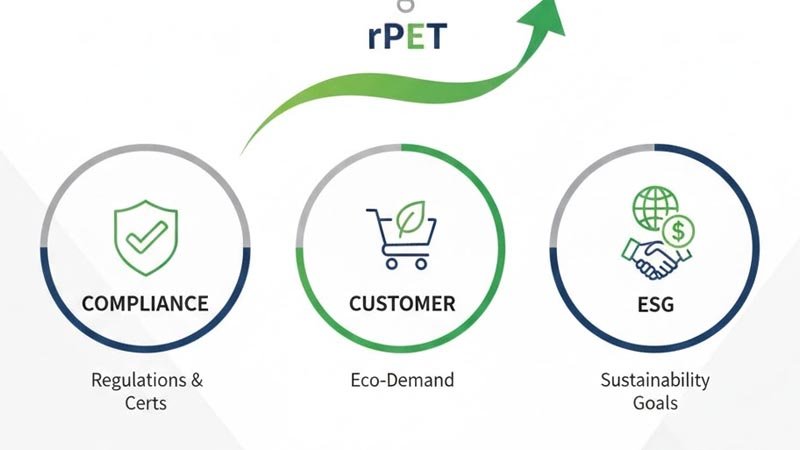
Three forces are converging—and lanyards are no longer a “small item” that escapes scrutiny:
1 Compliance pressure is rising
More organizations now require promotional items and uniform accessories to meet verifiable sustainability standards. That means documentation (not slogans): recycled content proof, traceability, and responsible chemical standards.
2 Customers expect proof, not vibes
A lanyard is worn all day at events, offices, and campuses. It’s a high-visibility item, and buyers increasingly want a straightforward story they can defend: recycled bottles → recycled yarn → finished strap.
3 ESG reporting needs numbers and paperwork
Even when budgets are tight, procurement teams prefer switches that are low-risk operationally but helpful for reporting. rPET lanyards can provide measurable inputs (e.g., recycled content %, certification scope, traceability paperwork) without changing the whole supply chain.
Bottom line: In 2026, “eco-friendly” means documented. rPET is popular because it’s one of the easiest materials to document at scale.
What is rPET—and why it scales so well?
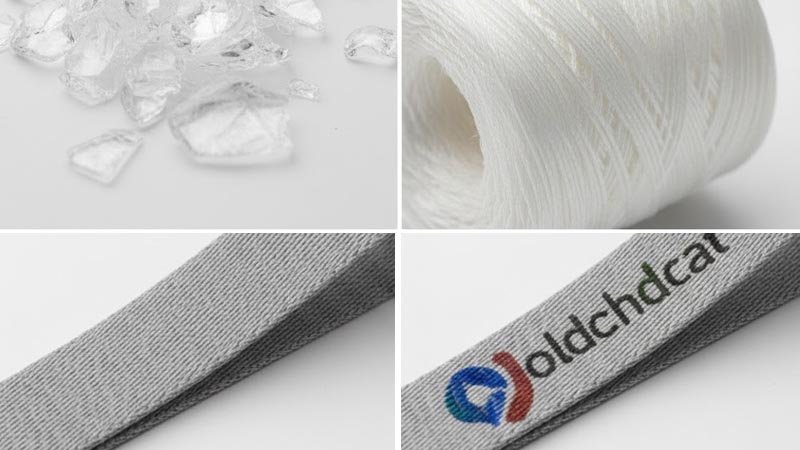
rPET stands for recycled polyethylene terephthalate. It’s typically produced from post-consumer PET bottles that are collected, cleaned, processed into pellets, spun into yarn, and woven into webbing.
Why it scales
-
PET bottle recovery is a large, established stream in many markets.
-
The yarn and webbing can be produced using standard textile equipment.
-
Many factories can integrate rPET yarn into existing lanyard manufacturing workflows.
A practical note on “carbon savings”
You’ll often see statements like “up to ~60% lower emissions.” In practice, impact varies based on recycled feedstock, regional energy mix, logistics, and the LCA boundary. If carbon reduction is important for your project, ask suppliers for:
-
an LCA summary (where available), or
-
a recycled content declaration plus certification documentation (GRS/traceability), which supports credible sustainability claims.
rPET vs other lanyard materials (quick comparison)
Use this table to guide early-stage selection. Final choice should still be validated by samples and documentation.
| Material | Durability | Print Quality | Sustainability Proof | Typical Use Cases | Watch-outs |
|---|---|---|---|---|---|
| rPET (recycled polyester) | High | High | Strong (when certified) | Events, corporate IDs, schools, industrial badges | Verify recycled content + chain-of-custody |
| Virgin polyester | High | High | Weak (new plastic) | Cost-driven orders | Harder to support sustainability reporting |
| Cotton | Medium | Medium | Mixed | “Natural” look, retail | Can stain/soil; proof depends on sourcing |
| Bamboo viscose (rayon) | Medium | Medium | Mixed | Soft feel, lifestyle brands | “Bamboo” claims often misunderstood—verify processing |
If your priority is: “eco + durable + easy to print + easy to document,” rPET is usually the most straightforward choice.
The 5 decision factors buyers use
A fast way to evaluate suppliers without getting lost in marketing claims:
1 Price
-
Compare apples to apples (width, thickness, print method, hardware, packaging).
-
rPET pricing is often close to standard polyester for common specs, but the real swing factors are print complexity, hardware, and packaging.
2 Proof
This is where good suppliers stand out. Ask for:
-
GRS Scope Certificate (what the certification covers)
-
Transaction Certificate (TC) or batch-level traceability evidence (when applicable)
-
Recycled content declaration / spec sheet
-
Any relevant chemical safety standard documentation (if requested by your buyers)
3 Performance
Look for measurable specs:
-
Webbing tensile strength / break load
-
Stitch reinforcement (especially around the clip area)
-
Abrasion resistance (real-world wear)
-
Color fastness expectations tied to a test standard (when required)
4 Print
Confirm which method best fits your design:
-
Dye-sublimation / heat transfer: best for gradients and full-color artwork
-
Silk screen: cost-effective for simpler 1–2 color logos
-
Woven / jacquard: premium, textured logo look (excellent longevity)
5 Procurement
This is where projects succeed or fail:
-
Sample lead time + revision cycle
-
Production lead time
-
QC checkpoints (pre-production sample, in-line inspection, final inspection)
-
Packaging options that match your sustainability goals
Copy-paste scorecard (0–5)
-
Price: __ /5
-
Proof (GRS/TC/docs): __ /5
-
Performance (tests/QC): __ /5
-
Print (clarity/color control): __ /5
-
Procurement (lead time/reliability): __ /5

Top rPET lanyard applications in 2026
Events & conferences
-
High visibility; easy “eco” storytelling
-
Works well with full-color branding and sponsor logos
Best pick: sublimation/heat transfer + recycled or compostable packaging
Corporate badges & staff IDs
-
Consistent brand colors and durable wear
Best pick: polyester-like handfeel + metal swivel hook + breakaway option (if needed)
Schools & campuses
-
Tough daily use; easier cleaning than many “natural” fibers
Best pick: reinforced stitching + comfortable width (15–20 mm) + safety breakaway where required
Industrial sites
-
Durability and safety are primary; chemical/grease environments may matter
Best pick: stronger webbing + robust hardware + clear compliance labeling

How to specify rPET lanyards
Below is a vendor-ready specification template you can paste into an RFQ email or purchase order.
rPET Lanyard Specification Template (copy/paste)
Material & recycled content
-
Webbing material: rPET (recycled polyester)
-
Recycled content: ___% (post-consumer preferred)
-
Certification required: □ GRS Scope □ TC / batch traceability □ Other: ___
Size & construction
-
Width: ___ mm (common: 10 / 15 / 20 / 25 mm)
-
Thickness: ___ mm (or “standard factory spec”)
-
Length: ___ cm (or “standard adult length”)
-
Stitching: □ standard □ reinforced clip area □ box-stitch
Printing & color
-
Print method: □ sublimation □ heat transfer □ silk screen □ woven/jacquard
-
Artwork: □ vector required □ PMS/Pantone: ___ □ color sample match required
-
Print sides: □ single □ double
-
Background: □ solid □ gradient □ full-color
Hardware & safety
-
Hook type: □ metal swivel hook □ bulldog clip □ other: ___
-
Hardware material: □ zinc alloy □ iron □ stainless steel □ plastic
-
Safety breakaway: □ yes □ no (location: ___)
-
Accessory: □ badge reel □ buckle □ phone loop □ other: ___
Packaging
-
Packaging: □ bulk □ recycled paper band □ recycled paper bag □ compostable bag
-
Avoid single-use plastic: □ required □ not required
-
Outer carton marks/barcodes: □ required □ not required
Quality & delivery
-
Pre-production sample approval: □ required □ not required
-
QC standard: ___ (e.g., AQL level if you use one)
-
Sample lead time: ___ days
-
Mass production lead time: ___ days
-
Shipping term: □ EXW □ FOB □ DDP (destination: ___)
Common myths & procurement mistakes (and how to avoid them)
Myth 1: “rPET is weaker than virgin polyester”
In many commercial webbing applications, rPET can meet the same performance requirements when yarn quality and process control are consistent. Don’t rely on claims—request test expectations and confirm with a sample.
Myth 2: “All eco claims are greenwashing”
Greenwashing exists, but it’s avoidable. Require third-party proof (e.g., GRS scope + traceability documentation) and match it to your exact product.
Myth 3: “Eco packaging isn’t realistic”
It’s realistic—but must be specified. If you don’t ask, suppliers may default to polybags. Put packaging into your RFQ and approve it at sample stage.
Common mistake: verifying only the certificate, not the product
A certificate alone doesn’t guarantee your batch is covered. Ask how the supplier links your order to certification documentation (scope, traceability, batch evidence).
FAQ
Are rPET lanyards suitable for full-color logos?
Yes. rPET webbing commonly supports sublimation or heat transfer, which is ideal for gradients, photos, and multi-color artwork.
What recycled content percentage should we request?
Many buyers target high recycled content, but the “right” number depends on availability and compliance needs. If you have strict sustainability reporting requirements, specify the % clearly and require documentation.
Do we need GRS or OEKO-TEX?
They solve different problems:
-
GRS helps validate recycled content and chain-of-custody (and includes social/environmental criteria).
-
OEKO-TEX focuses more on chemical safety.
Many buyers prioritize GRS for recycled claims, and add chemical standards if their policy requires it.
Can we match Pantone colors with rPET?
Often yes, but color matching depends on print method, artwork, and material base. Provide Pantone references and request a pre-production sample.
What’s the most common “eco fail” with lanyards?
Using rPET straps but shipping them in unnecessary single-use plastic. If sustainability matters, specify packaging as part of the product.
Conclusion: rPET is the practical eco upgrade for 2026
rPET lanyards combine three things procurement cares about: documentable sustainability, durability, and strong branding performance. If you’re planning 2026 events, staff programs, or school rollouts, rPET is one of the lowest-friction switches you can make—especially when you lock in proof and specs up front.