Struggling to stand out at trade shows? Custom lanyards can be a simple, high-leverage visibility play—especially when your booth has limited “radius.”
Custom lanyards function as wearable brand placements. Because attendees wear them across registration, sessions, networking areas, and hallways, lanyards can extend exposure far beyond your booth and support measurable outcomes like increased booth visits, QR scans, and meeting bookings.
Trade shows are crowded environments with intense competition for attention. Even well-designed booths often rely on passersby proximity, which limits impression volume and repeat exposure. A lanyard program solves a different problem: it places your brand into the venue flow—where attendees spend most of their time—helping you maximize both visibility and ROI.
Why Are Lanyards the Ultimate Trade Show Promotional Tool?
Wondering why lanyards outperform many other trade show giveaways?
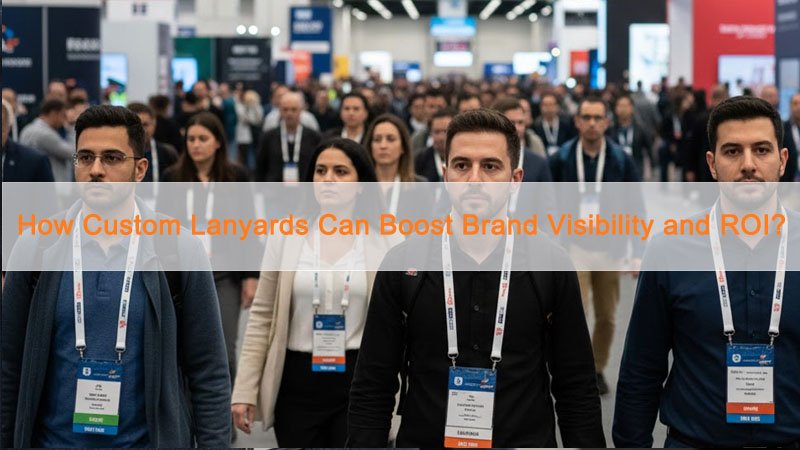
Lanyards deliver repeated, high-frequency exposure because they’re worn continuously during the event—often in high-traffic, high-interaction moments like registration, networking, and session transitions.

From a B2B marketing perspective, lanyards work because they combine placement + duration + visibility. Unlike brochures (often discarded) or small items (often pocketed), lanyards stay at chest level—frequently within conversational sightlines. This is also why “official lanyard” sponsorships are marketed as premium inventory: organizers often describe them as worn by every attendee, positioning the sponsor logo as front-and-center throughout the event day.
lanyards don’t just attract attention at the booth; they create continuous brand presence across the venue.
What Is the 300% Model for Maximizing Lanyard Impact?
How can lanyards help you target a 3× visibility uplift (and stronger ROI)?
A practical way to explain “up to 300%” impact is a simple multiplier framework: Reach × Frequency × Readability. When lanyards move your brand from booth-only exposure to venue-wide exposure, the total number of quality impressions can increase dramatically—especially if distribution is broad and design is highly readable.
Here’s the model in a B2B-friendly way:
-
Reach = how many people carry your logo (e.g., all attendees vs. only booth visitors)
-
Frequency = how often your logo is seen during natural movement and interactions
-
Readability = how quickly and clearly the brand is recognized (contrast, logo repetition, print quality)
If your booth graphics are seen by a subset of attendees a few times, but a lanyard is worn across the entire venue for the full event day, your Reach and Frequency can move from “localized” to “event-wide.” That shift alone can create a 2–3× lift in total impressions—without increasing booth footprint.
To support the “recall” component of the model, you can reference broader promo-product research: ASI reports high advertiser recall for certain promotional categories (e.g., apparel), and notes promotional products are generally well-regarded as advertising.
The key takeaway: the 300% claim is best presented as an achievable outcome under the right distribution + design conditions, not a guaranteed universal result.
What Are the Best Strategies for Deploying Lanyards at Trade Shows?
Should you sponsor, give away, or segment with lanyards?
There are three high-performing deployment options: official sponsor distribution for maximum reach, booth distribution for lead-driven interactions, and segmented/VIP designs for high-value conversations. The best choice depends on your objective: awareness, pipeline, or account-based engagement.

1 Official sponsor lanyards (maximum reach):
If your goal is brand visibility, official lanyards are often the strongest play—organizers position them as worn throughout the venue by attendees.
2 Booth-only lanyards (lead quality focus):
This approach prioritizes direct interaction: “Get a premium lanyard at our booth” can be tied to a demo, scan, or meeting booking. You trade broad reach for higher-intent engagement.
3 Segmented/VIP lanyards (ABM + relationship building):
Different materials, colors, or co-branded versions for buyers, VIPs, speakers, or partners can create social signals and conversation triggers—useful for enterprise sales motions.
Some sponsorship listings explicitly state that production is not included—meaning you may pay the sponsorship fee and still be responsible for manufacturing and delivery.
Including this detail builds credibility and helps readers avoid budget surprises.
How Can You Design Lanyards That Actually Get Worn and Noticed?
What makes a lanyard design “wearable” and brand-effective?
Effective lanyards balance comfort, durability, and fast brand recognition. A lanyard that feels good stays on longer—directly increasing impressions. A design that reads instantly increases recall.

In B2B event environments, wear-rate is your real KPI. To maximize it:
-
Prioritize comfort: soft material, smooth edges, and quality finishing reduce “take it off” behavior.
-
Improve usability: quick-release buckle, safety breakaway, and reliable hardware keep the lanyard practical in crowded venues.
-
Design for readability at motion speed: high contrast, repeating logo pattern, and double-sided print (lanyards flip during wear).
-
Keep messaging minimal: logo + short URL/QR prompt often outperforms dense text.
If you want lanyards to drive action (not just awareness), add a small CTA such as “Scan for show pricing” or “Book a demo,” paired with a QR code and tracking parameters.
What Metrics Should You Track to Measure Lanyard ROI?
How do you prove lanyards contribute to pipeline, not just “nice branding”?
Track outcomes tied to the funnel: QR scans, landing-page sessions (UTM), lead capture rate, and meeting bookings. These create an attribution trail from physical impressions to measurable business results.
A practical measurement stack:
-
QR code + UTM link: track sessions, conversions, and meeting requests attributable to the lanyard campaign.
-
Scan-to-lead flow: QR → landing page → form → scheduler (one clear CTA).
-
“Scans per 100 lanyards distributed”: a normalized KPI that helps compare events and designs.
-
Sales alignment metrics: meetings booked, opportunities created, and influenced pipeline.
For broader sponsorship ROI measurement best practices, industry research emphasizes standardized processes and financially linked metrics—yet many organizations still lack consistent measurement, which is why a simple attribution setup can differentiate your program.
What Common Pitfalls Should You Avoid When Ordering Trade Show Lanyards?
How can a lanyard program fail—even if the idea is good?
Most failures come down to execution: low wear-rate from poor comfort, missed deadlines from late ordering, quantity miscalculations, and misalignment between sponsorship terms and what’s actually included.
Common pitfalls to address proactively:
-
Choosing price over wearability: if the lanyard feels cheap or uncomfortable, it won’t stay on—reducing impressions.
-
Underestimating lead time: build buffer time for sampling, proofing, production, and shipping.
-
Ordering the wrong quantity: plan around attendance, exhibitor staffing needs, and distribution method.
-
Assuming sponsorship includes production: confirm whether the package includes the physical lanyards or only the branding rights—some sponsor listings state production is not included.
-
Inconsistent branding: keep typography, logo spacing, and color standards consistent across versions (standard/VIP/sponsor).
How Should You Think About Lanyards Beyond the Trade Show?
What happens when your lanyards keep working after the event ends?
Lanyards often continue generating exposure after the show because attendees reuse them at work, future events, or daily life—extending brand presence beyond the trade show floor.

From an ROI lens, post-event use matters because it lengthens the “impression lifespan” of the investment. A lanyard that remains in circulation becomes a durable brand touchpoint that can surface in new contexts—offices, other conferences, community events, and everyday credential environments. To capture this value, add a light post-show measurement step: ask new leads, “Where did you first notice us at the event?” and monitor branded search, direct traffic, and follow-up conversion rates in the weeks after the show.
Conclusion:
Lanyards are more than swag—they’re a scalable visibility asset and a measurable pipeline tool when deployed strategically, designed for wear, and tracked with simple attribution.