When developing a custom fabric key tag, one of the first production decisions is whether the logo should be embroidered or woven.
At first glance, the two products can look very similar. Both use textile construction, both can carry a custom logo on the front and back, and both are commonly used for motorcycle keys, car keys, racing merchandise, clubs and promotional products.
But embroidery and weaving create the artwork in different ways—and those differences directly affect small text, fine lines, logo clarity, surface texture, thickness and the overall character of the finished key tag.
For brands, promotional product distributors, automotive merchandise sellers and wholesale buyers, the correct decision should therefore be based on the actual artwork and target application rather than simply asking:
“Which one is better?”
This guide compares embroidered vs woven key tags from a manufacturing and B2B sourcing perspective and explains when each process makes more sense.
If you are developing this exact product style, you can also view our
Custom Embroidered & Woven Motorcycle Key Tags.
Embroidered vs Woven Key Tags: Quick Comparison
| Feature | Embroidered Key Tag | Woven Key Tag |
|---|---|---|
| Surface | Raised and textured | Flat and smooth |
| Thread / Yarn | Thicker embroidery thread | Finer woven yarn |
| Bold Logos | Excellent | Excellent |
| Small Text | More limited | Generally better |
| Fine Lines | May need simplification | Better suited to fine detail |
| Texture | Strong tactile effect | Finer textile surface |
| Visual Character | Bold, classic, dimensional | Clean, precise, refined |
| Good For | Racing logos, club names, bold lettering | Detailed logos, smaller text, complex artwork |
The key point is simple:
Embroidery is usually selected for texture and visual depth. Woven construction is usually selected when artwork detail and smaller elements are more important.
However, this is only a starting point. Finished size, logo proportions and actual artwork should always be reviewed before production.
What Is an Embroidered Key Tag?
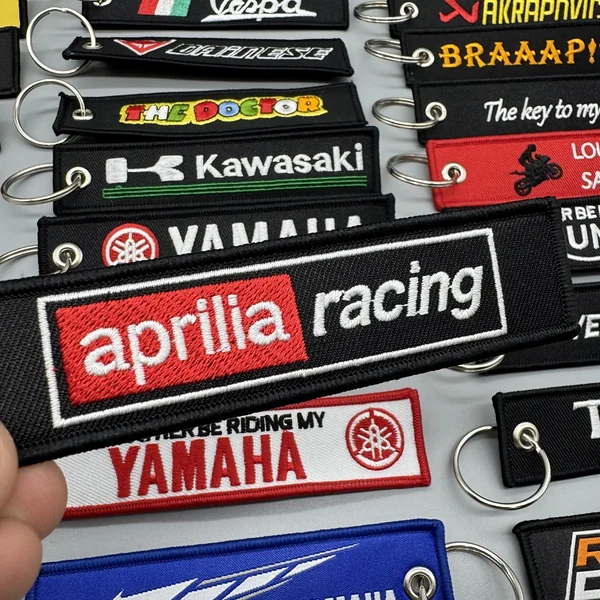
An embroidered key tag uses embroidery thread to stitch the logo, lettering or graphic into a textile base.
Because embroidery thread has physical thickness, the stitches sit above the surface and create a noticeable tactile effect.
This raised construction is one reason embroidered motorcycle key tags are commonly associated with racing, motorsport, aviation-inspired and club merchandise.
Embroidery Works Especially Well for Bold Artwork
Typical designs that work well with embroidery include:
- Bold brand names
- Large letters
- Racing numbers
- Motorcycle club names
- Simple automotive logos
- Short slogans
- Strong geometric symbols
- High-contrast graphics
When the artwork has enough space around each element, the raised stitches can make the product feel more dimensional and visually distinctive.
Why Embroidery Has Detail Limitations
Embroidery does not reproduce artwork in the same way as digital printing.
Every letter, line and curve must be physically formed by stitches. If several details are packed into a very small area, the thread can begin to visually merge.
This is particularly important for:
- Very small text
- Thin outlines
- Tiny gaps between letters
- Small registered trademark symbols
- Complicated crests
- Highly detailed automotive graphics
In these cases, increasing the product size, simplifying the artwork or switching to woven construction may produce a cleaner result.
What Is a Woven Key Tag?
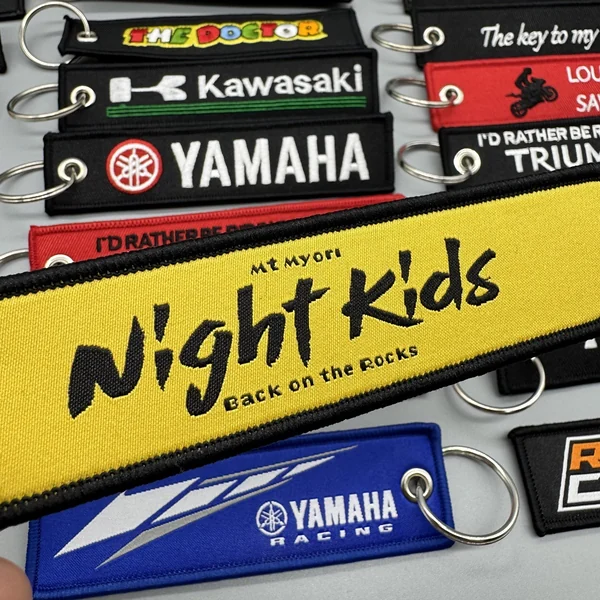
A woven key tag creates the design using finer yarns integrated into the textile structure.
Compared with embroidery, the surface is generally flatter and the yarns can form smaller visual details.
This makes woven construction particularly useful when the logo contains information that would become difficult to reproduce with thicker embroidery stitches.
Woven Works Especially Well for Detailed Artwork
A woven key tag should be considered when the artwork contains:
- Small lettering
- Fine lines
- Detailed logos
- Compact graphic elements
- Several words in a limited area
- Complex automotive symbols
- Cleaner flat branding
The finer yarn structure can preserve more detail at the same finished size.
Woven Does Not Mean Printed
This distinction is important for buyers.
A woven key tag is still a textile product. The artwork is created through yarn structure rather than being printed onto the surface like an ink-based graphic.
This means it retains the appearance and feel of a textile product while providing finer logo resolution than conventional embroidery in many designs.
The Biggest Difference: Thread Thickness and Artwork Resolution
The easiest way to understand embroidered vs woven key tags is to think about the physical size of the material creating the artwork.
Embroidery uses relatively thicker stitches.
Woven designs use finer yarns.
That difference affects how much visual information can fit into the same area.
A Practical Example
Imagine a motorcycle club logo that contains:
- A large four-letter club name
- A simple icon
- Two bold colors
Embroidery may work very well because the artwork is simple and bold.
Now imagine another design containing:
- A small company name
- A detailed emblem
- A URL
- A thin outline
- Several compact graphic elements
Trying to reproduce all of this with thick embroidery stitches may reduce clarity.
A woven construction can often preserve more of the original detail without increasing the size of the key tag.
Small Text: One of the Most Important Decisions
For B2B custom orders, the smallest text is often more important than the largest logo.
A buyer may focus on the main brand name while overlooking secondary information such as:
- Website addresses
- Model names
- Club chapters
- Short slogans
- Racing team divisions
- Registered marks
These elements may determine whether embroidery is practical.
Do Not Judge Text Size Only on a Computer Screen
A design can appear perfectly clear when enlarged on a monitor but become much harder to reproduce once reduced to a key tag approximately 30 mm wide.
The artwork should therefore be reviewed at the actual finished product size.
This is one of the main reasons an experienced custom key tag manufacturer should evaluate artwork before quoting only on the basis of a reference image.
Embroidery Creates More Texture
Texture is where embroidery has a strong visual advantage.
The thread sits above the fabric surface and creates a more pronounced dimensional appearance.
For designs inspired by:
- Motorsport
- Motorcycle culture
- Racing teams
- Car clubs
- Performance brands
- Streetwear merchandise
that visible thread structure can become part of the product design itself.
If the buyer wants the logo to feel tactile rather than completely flat, embroidery deserves serious consideration.
Woven Produces a Cleaner, Flatter Surface
Woven construction offers a different type of premium appearance.
Instead of emphasizing raised texture, it emphasizes:
- Fine detail
- Cleaner lines
- More compact lettering
- A flatter profile
- Precise textile graphics
For brands with detailed identity systems or logos containing several small elements, woven construction may look more faithful to the original artwork.
Which Is Better for a Motorcycle Key Tag?
Both can work extremely well.
The choice should depend on the design.
Consider Embroidery If:
- The logo is bold
- The lettering is relatively large
- You want visible thread texture
- The design has a classic racing or club style
- The product should have a more dimensional appearance
Consider Woven If:
- The logo contains smaller lettering
- Fine lines are important
- The artwork contains more detail
- You prefer a flatter surface
- You want to maintain more detail without increasing the tag size
Which Is Better for Automotive Brand Merchandise?
For an automotive brand, the decision often depends on brand identity rather than product category.
A bold performance-style wordmark may look excellent in embroidery.
A complex automotive logo with fine lettering may benefit from woven construction.
For OEM merchandise programs, it can be useful to request visual artwork simulations of both methods before sampling.
The goal should be to reproduce the brand identity correctly—not to select a process simply because it is more familiar.
Front and Back Design: Do They Need to Be the Same?
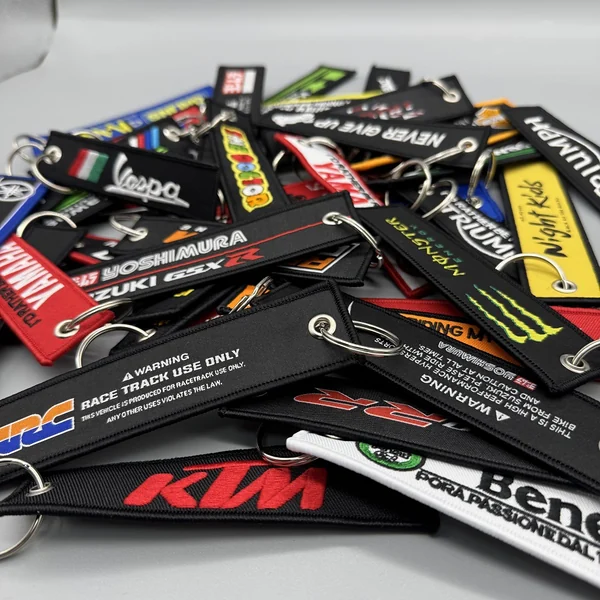
No.
Both sides of a fabric key tag can become part of the design.
For example:
| Front | Back |
|---|---|
| Brand Logo | Brand Name |
| Racing Team | Racing Number |
| Motorcycle Club Logo | Club Chapter |
| Company Logo | Website |
| Product Line | Short Slogan |
Using two sides effectively provides more branding space without making the key tag physically larger.
Key Tag Size Affects Logo Quality
The manufacturing method and finished size cannot be separated.
A logo that is difficult to embroider at 25 mm high may become perfectly practical at 35 mm high.
Likewise, a very simple woven design may not need a large product at all.
When choosing the finished dimensions, consider:
- Logo proportions
- Number of letters
- Smallest text
- Number of graphic elements
- Eyelet position
- Front and back artwork
- Desired pocket size
For motorcycle and automotive key tags, one common format is approximately 13 × 3 cm, but custom dimensions can be developed according to the artwork.
Do Not Forget the Metal Eyelet and Key Ring
The textile artwork receives most of the attention, but the metal components are also part of the final product.
A typical flat fabric key tag uses:
- Metal eyelet
- Split key ring
The eyelet reinforces the connection area and prevents the ring from being attached directly through an unprotected textile opening.
Artwork Should Leave Space for the Eyelet
A frequent artwork problem is placing important text or graphics too close to the metal eyelet.
The eyelet position should therefore be included during artwork preparation—not added after the logo layout is already finalized.
Embroidery vs Woven Color Selection
Both methods use physical textile colors, so screen colors should not be treated as perfect representations of the finished product.
For important brand projects, buyers can provide:
- Pantone references
- Approved physical samples
- Previous production samples
- Reference products
The manufacturer can then select the closest practical thread or yarn option according to the production method.
Slight visual differences can occur because embroidery thread, woven yarn and other textile components reflect light differently.
For color-sensitive projects, a physical sample is more useful than relying only on a phone or computer screen.
Does Embroidery Cost More Than Woven?
There is no universal answer.
The quotation can be affected by:
- Finished size
- Quantity
- Number of colors
- Embroidery coverage
- Artwork complexity
- Front and back construction
- Metal hardware
- Packaging
- Sampling requirements
This is why comparing two products only by asking for a “price per piece” can be misleading.
For an accurate B2B comparison, the supplier should quote against the same:
- Artwork
- Dimensions
- Quantity
- Hardware
- Packaging specification
For Wholesale Buyers, Artwork Suitability Matters More Than Unit Price Alone
A small unit-price difference becomes less important if the finished logo is difficult to read or does not match the intended brand appearance.
For a distributor ordering several thousand pieces, changing from embroidery to woven may make sense if it significantly improves small-text clarity.
Conversely, changing a bold embroidered racing logo to woven simply to save a small amount may remove the raised texture that gives the product its character.
A good purchasing decision should therefore consider:
- Logo result
- Target market
- Quantity
- Retail positioning
- Target cost
- Repeat-order potential
Stock Key Tags vs Custom OEM Production
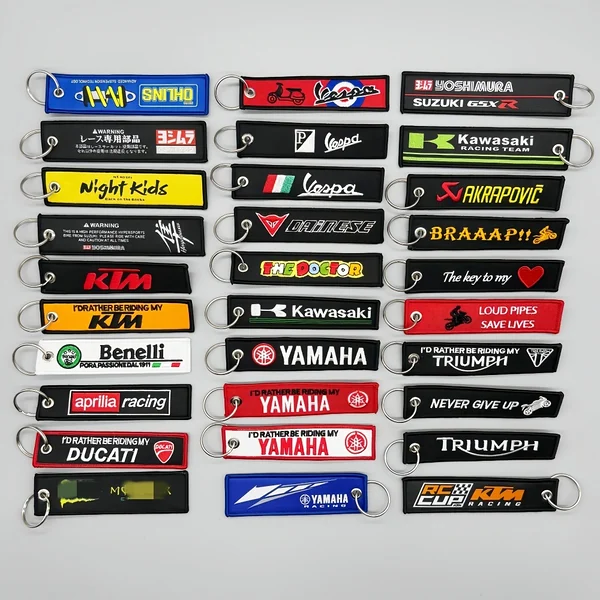
B2B buyers generally have two sourcing routes.
Stock Key Tags
Stock products may be appropriate when:
- Delivery speed is the priority
- Existing designs fit the target market
- The buyer wants to test a product category
- Custom branding is not required
- A smaller replenishment order is needed
Custom OEM Key Tags
Custom production makes more sense when:
- Your own logo is required
- Brand colors matter
- The product will be sold under your own brand
- You need custom front and back artwork
- A specific size is required
- Packaging must match a retail program
For OEM projects, send the artwork before finalizing the manufacturing method. The supplier can evaluate whether embroidery or woven production is more appropriate.
What Should B2B Buyers Ask a China Key Tag Manufacturer?
When sourcing custom key tags from China, the lowest quotation should not be the only selection criterion.
A reliable China embroidered key tag factory or woven key tag manufacturer should be able to explain how the artwork will translate into textile production rather than simply confirming that “any logo is possible.”
Before placing a bulk order, ask the supplier the following questions.
1. Can You Review My Artwork Before Quoting?
This is important because the smallest lettering and finest details can determine the correct production process.
2. Is This Artwork Better for Embroidery or Woven?
A manufacturer should be able to explain why one method is more suitable rather than recommending a process without reference to the artwork.
3. What Is the Recommended Finished Size?
Product dimensions should be selected together with the logo.
4. Can the Front and Back Be Different?
Confirm this before artwork preparation so both sides are included in the quotation and sampling process.
5. What Hardware Is Included?
Check the:
- Eyelet
- Split key ring
- Metal finish
- Ring diameter
6. Can I Approve a Sample Before Bulk Production?
Sampling is especially useful for new artwork, important colors and retail merchandise programs.
7. How Is Bulk Quality Inspected?
Ask what the factory checks for:
- Logo clarity
- Color consistency
- Dimensions
- Edge finishing
- Eyelet installation
- Key ring assembly
- Loose threads
- Packaging
Sourcing from a Guangzhou Key Tag Supplier: Manufacturer or Trading Company?
When international buyers search for a Guangzhou key tag supplier, China custom keychain manufacturer or motorcycle key tag factory, search results may include both manufacturers and trading companies.
Neither business model is automatically unsuitable, but buyers should understand who is actually responsible for production.
If direct manufacturing is important to your project, ask:
- Where is production carried out?
- Which processes are handled in-house?
- Can the supplier provide production photos or videos?
- Who reviews embroidery or woven artwork?
- Who manages sampling?
- Who performs final QC?
- Can approved specifications be retained for repeat orders?
These questions are often more useful than simply asking whether the company is a “factory.”
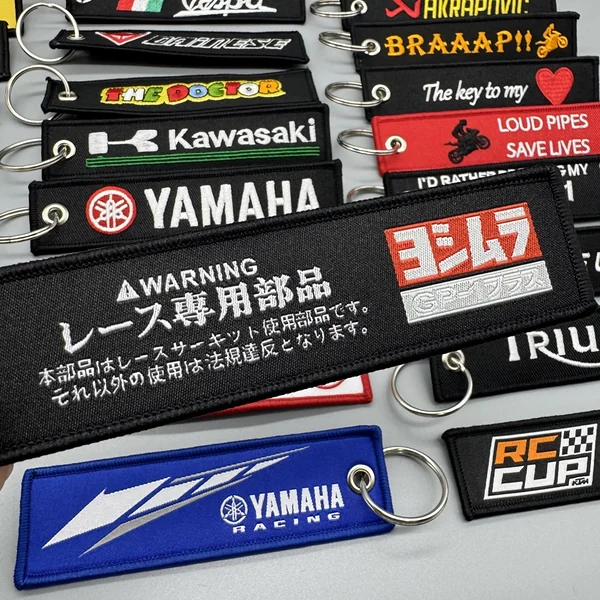
Why Source Fabric Key Tags from Guangzhou, China?
Guangzhou and the wider Guangdong manufacturing region have a large supply ecosystem for garment accessories, textile branding, promotional products, metal accessories and packaging.
For international B2B buyers, this can make it practical to develop a complete product—including textile logo production, sewing, metal hardware and packaging—within one regional supply chain.
LOVECOLOUR is a Guangzhou-based custom key tag and lanyard manufacturer in China, supporting OEM/ODM projects for brands, promotional product companies, automotive merchandise sellers, clubs and global buyers.
Our product development approach begins with the artwork. We review the design, target size, logo detail and application before recommending embroidery, woven construction or another suitable branding method.
For more information about our overall manufacturing capabilities, visit our
Custom Lanyard Manufacturer in Guangzhou, China
page.
What Information Should You Send a Guangzhou Key Tag Manufacturer for a Quote?
Whether you are contacting a Guangzhou embroidered key tag supplier, a China woven keychain factory or another OEM manufacturer, a structured RFQ makes the quotation faster and more accurate.
| RFQ Item | What to Send |
|---|---|
| Artwork | AI, EPS, SVG, PDF or highest-resolution artwork available |
| Quantity | Required order quantity and estimated repeat quantity if known |
| Size | Preferred dimensions or ask the factory for a recommendation |
| Logo Method | Embroidery, woven or ask the manufacturer to evaluate |
| Front / Back | Same artwork or different designs |
| Colors | Pantone references or brand color information |
| Hardware | Eyelet, key ring size and preferred metal finish |
| Packaging | Bulk, individual bag, backing card, barcode or retail packaging |
| Deadline | Required delivery or launch date |
| Destination | Country and postal code if shipping quotation is required |
If you do not yet know every specification, the most useful starting information is:
Logo + quantity + target use + required delivery date.
How a Custom Embroidered or Woven Key Tag Is Developed
A typical OEM project moves through the following stages.
Step 1 – Artwork Review
The logo is checked for small text, thin lines, proportions and overall suitability for textile production.
Step 2 – Select Embroidery or Woven
The production method is chosen according to artwork detail and required visual appearance.
Step 3 – Confirm Size and Colors
The manufacturer confirms finished dimensions, thread or yarn colors and front/back design.
Step 4 – Confirm Eyelet and Key Ring
Hardware specifications are included in the product layout.
Step 5 – Digital Artwork Approval
A layout can be reviewed before physical production.
Step 6 – Physical Sample When Required
A sample allows the buyer to check actual textile texture, logo clarity, dimensions, colors and hardware.
Step 7 – Bulk Production
Production begins after the confirmed artwork and specifications are approved.
Step 8 – Quality Inspection
Finished products are checked before packaging and shipment.
For a broader view of our production workflow, read our
Visual Guide to Custom Lanyard Manufacturing.
What Should Be Checked Before Bulk Shipment?
A B2B order should be evaluated against approved specifications rather than simply checking whether the carton contains the correct quantity.
For embroidered and woven fabric key tags, common inspection points include:
- Finished dimensions
- Logo clarity
- Small-text readability
- Color consistency
- Front/back artwork orientation
- Edge shape
- Loose thread control
- Eyelet location
- Eyelet installation
- Key ring assembly
- Overall product shape
- Packaging accuracy
Which Method Is Better for Wholesale and Private-Label Orders?
For wholesale key tags, private-label programs and repeat OEM orders, neither method should be selected automatically.
Use embroidery when the target product depends on:
- Strong textile texture
- Bold branding
- Classic racing styling
- Large lettering
Use woven construction when the target product depends more on:
- Logo detail
- Small text
- Fine graphic elements
- A flatter premium surface
For large programs, requesting the factory to review the artwork before pricing can prevent having to redesign the product after sampling.
Can You Use Both Embroidery and Woven Products in One Merchandise Program?
Yes.
A brand does not need to choose one technique for every product.
For example, a motorcycle merchandise collection could use:
- Embroidered key tags for bold racing designs
- Woven key tags for detailed logos
- Short nylon key straps for functional key accessories
- Long printed lanyards for events and club programs
The products can share the same brand colors and visual identity while using the manufacturing process best suited to each design.
If you are comparing different key strap structures, read:
Long Lanyard vs Short Key Strap vs Fabric Key Tag.
Frequently Asked Questions About Embroidered vs Woven Key Tags
Embroidery uses thicker stitches to create a more raised, textured logo. Woven construction uses finer yarns and normally creates a flatter surface with greater ability to reproduce small text and fine details.
Is woven better than embroidery?
Not universally. Woven is often better for detailed artwork and small text, while embroidery is often preferred when a strong thread texture and dimensional appearance are important.
Which is better for small lettering?
Woven construction is generally more suitable for smaller lettering because finer yarns can reproduce more detail within a limited area. The actual artwork should still be reviewed at finished size.
Which is better for a bold motorcycle logo?
Embroidery can work very well for bold logos, large lettering and racing-style graphics where visible stitch texture complements the design.
Can the front and back have different designs?
Yes. Different text, logos or color combinations can be developed on the two sides depending on the construction and artwork.
Yes. Custom woven motorcycle and automotive key tags can be developed according to the customer’s authorized logo, size, colors, quantity and packaging requirements.
Yes. Computer embroidery is suitable for many bold motorcycle, automotive, racing and club designs.
What artwork format should I send?
Vector files such as AI, EPS, SVG or print-ready PDF are preferred. High-resolution PNG or JPG files can also be reviewed when vector files are unavailable.
Can a China key tag manufacturer help modify the artwork?
A manufacturer can normally review production-related issues such as text size, line thickness, logo dimensions and eyelet position and recommend practical adjustments before sampling. Major changes to brand identity should still be approved by the buyer.
Should I request a sample before a bulk order?
A physical sample is particularly useful for new artwork, color-sensitive branding, retail merchandise or large orders where the textile appearance should be confirmed before mass production.
Yes. Both constructions are suitable for bulk and wholesale programs for brands, automotive accessory sellers, motorcycle merchandise companies, clubs, promotional product distributors and other B2B buyers.
Yes. Logo, artwork, dimensions, colors, front/back design, hardware and packaging can be developed according to the customer’s project requirements.
Can you manufacture products with an automotive or motorcycle brand logo?
Production can be based on customer-supplied artwork. Buyers should ensure they have the necessary authorization or intellectual property rights when using third-party trademarks, copyrighted artwork or registered brand logos.
Embroidery or Woven? Let the Artwork Decide
There is no need to classify embroidery as the “premium” option and woven as the “economical” option—or the other way around.
They are different textile manufacturing methods designed to solve different artwork requirements.
A practical decision process is:
- Check the finished key tag size.
- Identify the smallest text and finest lines.
- Decide whether texture or fine detail is more important.
- Review the front and back artwork.
- Confirm the eyelet and key ring position.
- Evaluate colors at actual production conditions.
- Sample the product when the project requires physical approval.
For bold logos and a stronger thread texture, embroidery may be the right direction.
For detailed logos, smaller text and a flatter surface, woven construction may provide a cleaner result.
If the answer is still unclear, send the artwork to the manufacturer instead of guessing.
Looking for a Custom Embroidered or Woven Key Tag Manufacturer in China?
LOVECOLOUR is a custom lanyard, key strap and fabric key tag manufacturer based in Guangzhou, China, supporting OEM and ODM production for international brands, promotional product distributors, automotive merchandise businesses, clubs and wholesale buyers.
For a custom project, send us:
- Your logo or artwork
- Required quantity
- Preferred size
- Embroidery or woven preference, if known
- Front and back design requirements
- Packaging requirements
- Target delivery date
If you are not sure whether your artwork is better suited to embroidery or woven production, that decision does not need to be made before contacting us.
We can review the logo detail, text size, product dimensions and intended application and recommend a suitable production method.
Explore our
custom manufacturing and branding options
or our complete
custom lanyard and key strap range.