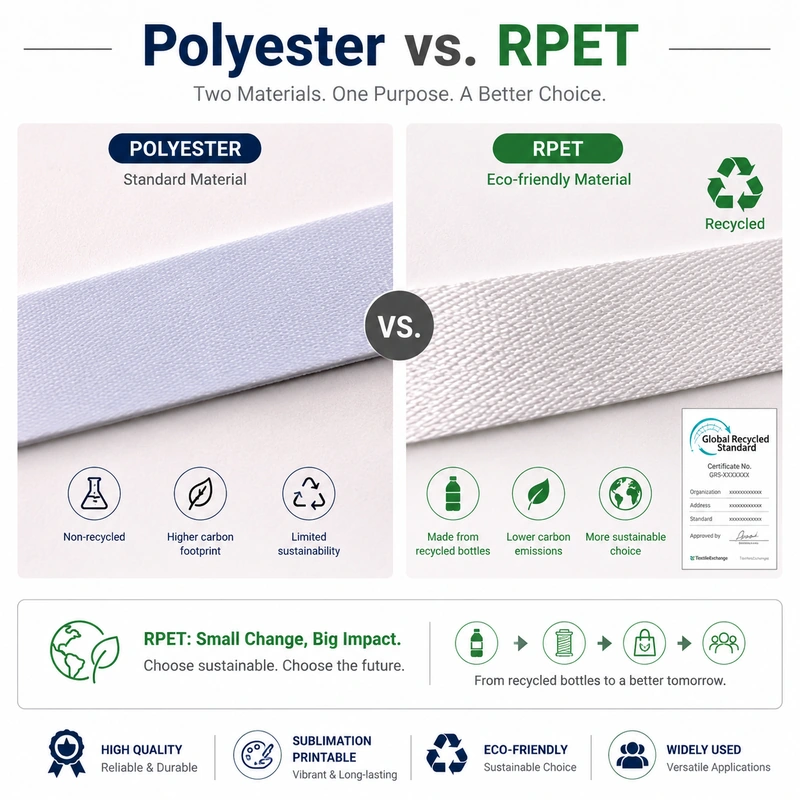
Should you choose conventional polyester webbing or recycled polyester (RPET) webbing for your next sublimation lanyard project? The answer depends on more than price. Buyers should compare the material sourcing requirements, printing compatibility, dimensional stability, roll quality, recycled-content documentation and total production cost.
Both conventional polyester and RPET can be suitable for producing full-color sublimation lanyards, wristlet keychains and printed promotional straps. However, they should not automatically be treated as identical materials simply because they belong to the polyester family.
This guide compares the two options from the perspective of professional printing companies, promotional merchandise buyers and wholesale webbing importers. It also shares relevant manufacturing considerations from Guangzhou Lovecolour Garment Accessories Co., Ltd., a China-based supplier involved in webbing weaving, sublimation printing, sewing and lanyard assembly.
Quick Answer: Which Webbing Should You Choose?
Choose conventional polyester webbing when your priority is an approved standard material specification, cost control and reliable printing performance without a recycled-content requirement. Choose RPET webbing when your customer or procurement program requires recycled polyester, provided the material documentation and printing performance meet the project requirements. Neither material is automatically stronger, more durable, easier to print or more economical in every situation. Test both under the same conditions before making a technical comparison.
1. Polyester vs. RPET Webbing: Key Differences at a Glance
Conventional polyester webbing and recycled polyester webbing can look remarkably similar, particularly when both are white and have comparable weave structures. The main difference is the sourcing of the polyester feedstock, while performance differences depend on the actual manufacturing specifications.
| Comparison | Conventional Polyester Webbing | RPET Webbing |
|---|---|---|
| Material | Conventionally sourced polyester | Recycled polyester / recycled PET |
| Main Procurement Requirement | Technical quality, supply consistency and cost | Technical quality, recycled-content evidence and cost |
| Dye Sublimation | Possible with suitable construction and settings | Possible with suitable construction and settings |
| Printing Quality | Depends on webbing and printing process | Depends on webbing and printing process |
| Strength and Durability | Requires specification-based testing | Requires specification-based testing |
| Heat-Related Shrinkage | Must be measured under actual conditions | Must be measured under actual conditions |
| Recycled-Content Claims | Not applicable to conventional material without recycled content | Must be supported by appropriate evidence |
| GRS / RCS | Not relevant to a fully conventional input | Potentially relevant when required and appropriately documented |
| Price | Depends on specifications and quantity | Depends on recycled inputs, specifications and documentation requirements |
| Suitable Buyers | Printers, lanyard manufacturers and distributors | The same buyers plus sourcing programs requiring recycled polyester |
Buyer takeaway: Do not choose either material based on its name alone. First confirm the customer’s material requirement, then evaluate the actual printing and manufacturing specifications.
2. What Is the Difference Between Polyester and RPET?
Polyester is a family of synthetic polymers. In the textile industry, polyethylene terephthalate (PET) is a common polyester used to manufacture fibers, yarns, straps and webbing.
Conventional polyester is generally produced using conventionally sourced petrochemical feedstock. RPET uses recycled PET as an input, which can be processed into polyester material suitable for textile manufacturing.
Recycled PET may originate from different eligible recovered material streams. Post-consumer PET bottles are one possible input, but buyers should not assume all RPET webbing comes exclusively from recycled bottles unless this is supported by evidence.
The recycled source is important for material traceability and procurement claims, but the finished webbing’s performance also depends on yarn quality, weave construction, finishing and production controls.
Is RPET Still Polyester?
Yes. RPET is recycled polyester, not a completely separate fiber family. This is why both conventional polyester and appropriately manufactured RPET can be considered for dye sublimation printing.
Does RPET Automatically Have a Different Appearance?
No. White RPET and white conventional polyester webbing may have very similar visible appearances. A buyer should not rely on color, texture or product photographs to establish recycled content. Material documentation and an appropriate verification process are needed.
3. Which Material Gives Better Sublimation Printing Results?
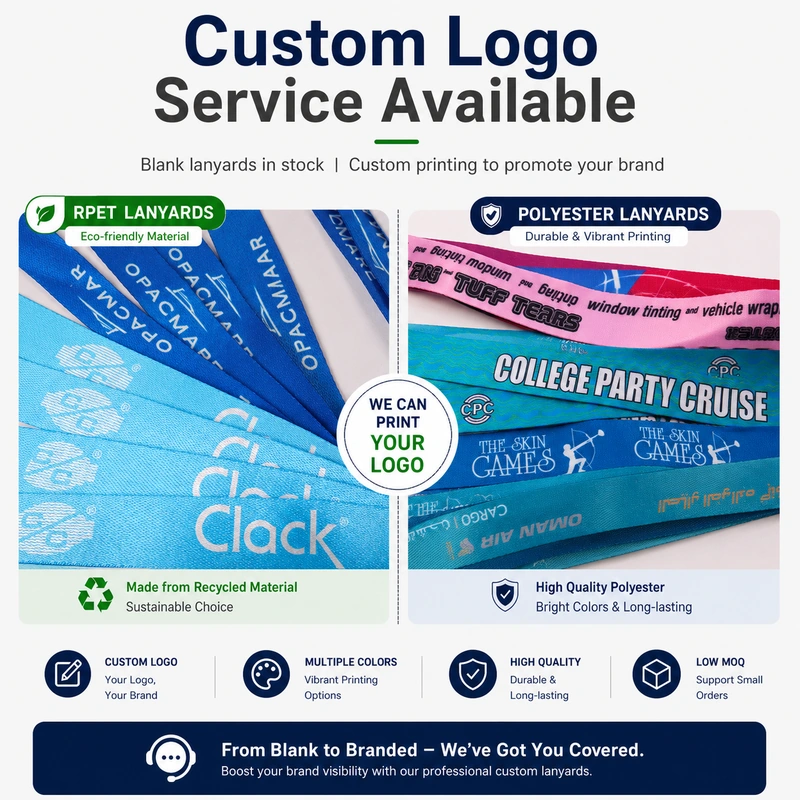
For lanyard manufacturers, printing performance is one of the most important factors in material selection. Both conventional polyester and RPET can receive dye sublimation printing when the materials and equipment are suitable.
Because both materials are polyester-based, recycled content alone does not establish which one will have brighter colors, sharper graphics or better transfer results.
Printing outcomes depend on the yarn, textile structure, surface condition, ink, transfer paper, heat, pressure, time and machine control. Two webbing samples with the same nominal thickness may behave differently if their construction or finishing differs.
Compare Both Materials Using the Same Artwork
To make a reliable decision, print the same design onto comparable polyester and RPET samples. Include solid color blocks, small text, gradients, narrow lines and repeated logos. This makes it easier to observe differences in sharpness, transfer uniformity and appearance.
Use the same relevant equipment and controlled processing conditions during the initial comparison. If either material requires adjusted settings for optimal results, record those settings and compare the final approved outcomes as well.
Check Printing Performance After Cooling
Inspect the material after the transfer process and an appropriate cooling period. Look for changes in width, length, appearance, flatness and print registration. For finished lanyards, evaluate cutting, folding, sewing and attachment compatibility too.
A printing result that looks acceptable immediately after transfer may still require dimensional checks before bulk production.
Are the Heat Press Settings the Same?
Not necessarily. Both materials may be compatible with similar dye sublimation methods, but final production settings should be validated separately. Do not assume that conventional polyester and RPET webbing require identical temperatures, processing times or tension settings.
General polyester heat press guides can provide starting references, but they do not replace testing on narrow woven webbing or industrial continuous transfer equipment.
For general technical reference, see Sawgrass Sublimation Heat Press Settings.
4. Do Polyester and RPET Webbing Have Different Shrinkage Rates?
Heat-related dimensional changes can affect artwork registration, finished lanyard length and cutting accuracy. This issue is particularly important for companies using roll-to-roll sublimation printing equipment.
It would be incorrect to claim that all RPET webbing shrinks more than conventional polyester, or that every conventionally sourced polyester webbing is shrink-free. Dimensional stability depends on the specific yarn, weave, finishing, heat history, tension and operating conditions.
For an accurate comparison, measure both materials using a consistent method before and after the intended heat transfer process.
Simple Shrinkage Comparison Procedure
- Select representative samples of polyester and RPET webbing with comparable width and construction.
- Mark and measure the same starting length on both samples.
- Run the intended heat transfer process under recorded conditions.
- Allow both samples to cool and relax consistently.
- Measure the marked length again.
- Calculate the percentage change for each sample.
- Repeat the measurement if the application requires tighter tolerances.
Dimensional change (%) = (Final measured length – Initial measured length) / Initial measured length × 100.
If a sample changes from 1,000mm to 995mm, the measured length change is -0.5%. This is only an example of the calculation, not a measured result for either LOVECOLOUR material.
For large-volume orders, define an agreed shrinkage test procedure and an acceptable result instead of relying on broad descriptions such as “zero shrinkage.”
5. What About Thickness, Strength and Durability?
Buyers sometimes assume that matching width and thickness means two webbing materials have identical strength and durability. This is not necessarily correct.
Mechanical performance can depend on yarn characteristics, weave construction, yarn density, finishing, stitching and how the finished product is assembled.
Both conventional polyester and RPET webbing should be evaluated according to the requirements of the final product. For an identification lanyard, the relevant considerations may include comfort, edge quality, printing, stitching and attachment compatibility. For a luggage strap or other load-bearing product, tensile performance and appropriate end-use testing become more important.
At LOVECOLOUR, our regular white polyester and RPET sublimation webbing ranges are offered in the same seven commonly stocked widths with an approximately 0.6mm standard thickness. These shared dimensions do not constitute a claim that the two materials have identical mechanical properties.
6. Available Webbing Widths: Polyester vs. RPET
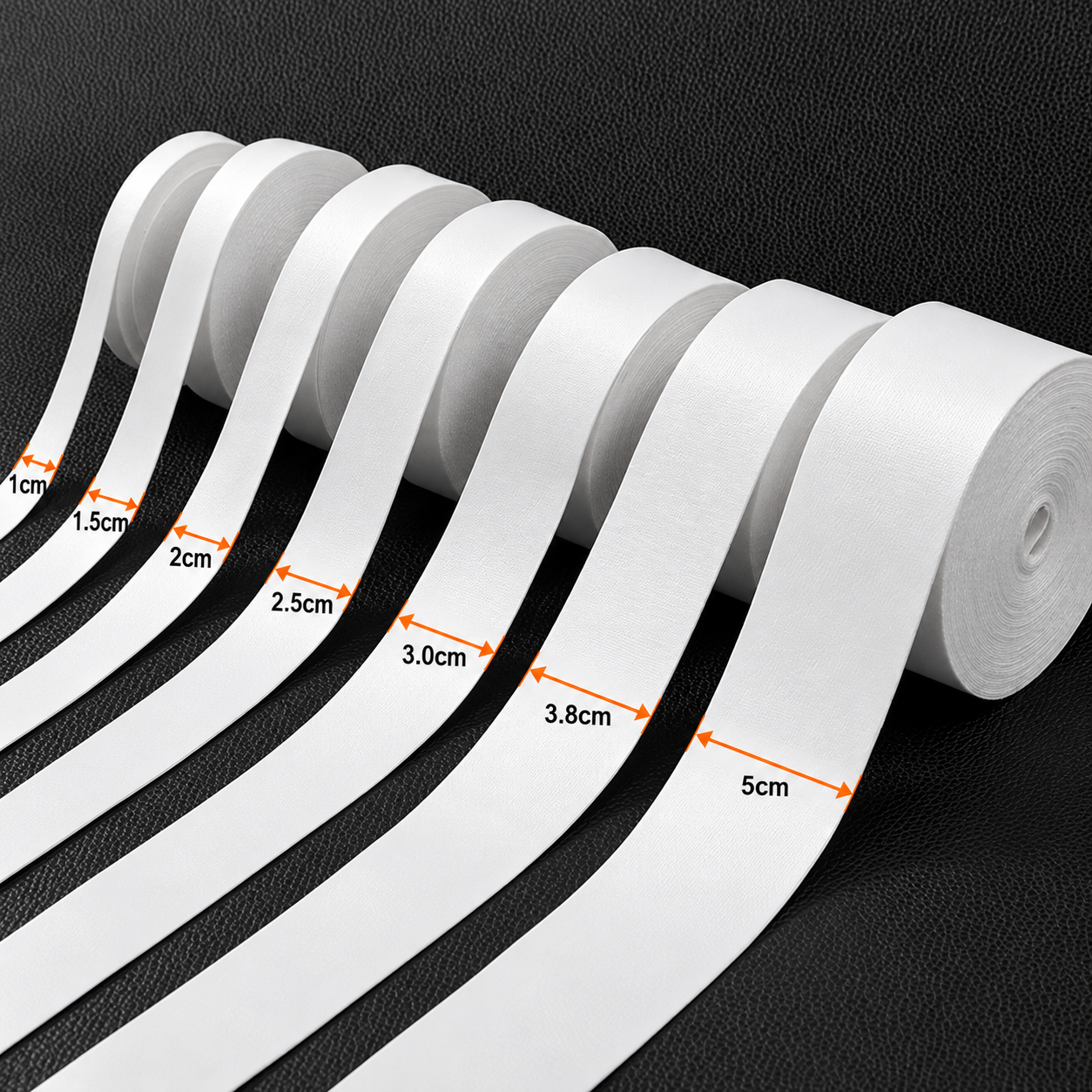
For buyers seeking blank sublimation webbing in bulk, selecting standardized widths can simplify purchasing, printing equipment setup, cutting and hardware selection.
LOVECOLOUR maintains regular stock of both conventional polyester and RPET white webbing in seven widths: 10mm, 15mm, 20mm, 25mm, 30mm, 38mm and 50mm.
| Width | Polyester Stock Range | RPET Stock Range | Possible Application |
|---|---|---|---|
| 10mm | Regular | Regular | Narrow straps and small accessories |
| 15mm | Regular | Regular | Slim promotional lanyards |
| 20mm | Regular | Regular | ID and event lanyards |
| 25mm | Regular | Regular | Wide custom printed lanyards |
| 30mm | Regular | Regular | Printed promotional straps |
| 38mm | Regular | Regular | Wide branded textile straps |
| 50mm | Regular | Regular | Wide printed straps and suitable luggage accessories |
The regular thickness for both ranges is approximately 0.6mm. Standard packing options include 100 yards per roll and 100 meters per roll, with alternative packaging arrangements available for review.
These similarities allow buyers to compare the two material choices using comparable commercial specifications. Live stock availability, tolerances and material evidence should still be confirmed when placing an order.
Explore the LOVECOLOUR webbing product range or request material samples for comparison.
7. Is RPET Webbing Always More Expensive?
No. RPET webbing may carry a price premium in some sourcing programs, but it is not possible to assume a universal price difference between conventional polyester and recycled polyester.
Prices depend on yarn sourcing, material composition, production quantity, webbing width, weave construction, thickness, inventory conditions, documentation requirements, packaging and market conditions.
Where a buyer requires transaction-level certification or additional documentation, the full procurement process may involve requirements beyond the material itself. These should be clarified before comparing supplier quotations.
Compare Prices Using the Same Specification
A meaningful quotation comparison should use the same width, thickness target, roll length, total ordered quantity, packing and delivery terms. If one supplier quotes per meter and another quotes per yard, convert both to the same unit before comparing prices.
One yard equals exactly 0.9144 meters. A 100-yard roll contains 91.44 meters, while a 100-meter roll contains approximately 109.36 yards.
Compare Cost per Usable Meter
Professional printing companies should consider material loss caused by joints, visible defects, printing problems and unusable sections.
Effective material cost per usable meter = Total purchased material cost / Total usable material length.
For example, suppose a conventional polyester order costs $1,000 for 10,000 meters. If 9,700 meters are usable, the effective material cost is approximately $0.1031 per usable meter.
Suppose an RPET order costs $1,080 for 10,000 meters. If 9,900 meters are usable, the effective cost is approximately $0.1091 per usable meter.
These figures are hypothetical examples used to demonstrate the calculation. They are not actual LOVECOLOUR prices, measured quality rates or evidence that one material consistently produces less waste.
In real purchasing, compare supplier-specific usable yields, printing consumables, machine downtime, documentation, freight and quality-related costs.
8. GRS and RCS Certification: Why RPET Procurement Is Different
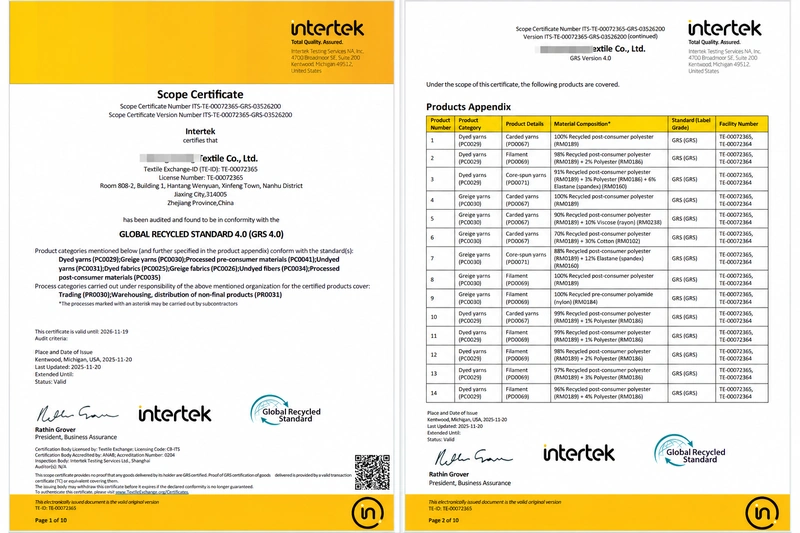
One of the main differences between conventional polyester and RPET purchasing is the potential need to support recycled-content claims.
When the customer simply requires a functional polyester strap, material specifications and sample approval may be sufficient for the purchasing decision. When a brand specifies recycled polyester or certified recycled content, additional documentary checks may be necessary.
What Are GRS and RCS?
The Global Recycled Standard (GRS) and Recycled Claim Standard (RCS) are Textile Exchange standards that address recycled material verification and chain of custody. GRS additionally includes specified social, environmental and chemical processing requirements.
The applicable standard, version, content thresholds and certification conditions must be checked against current Textile Exchange requirements and the buyer’s intended product claim.
Does an RPET Raw Material Certificate Certify the Finished Webbing?
Not automatically. A document covering recycled yarn or other upstream input does not by itself establish that every downstream webbing product and transaction can be represented as certified.
Buyers should verify the certification holder, facility and product scope, validity, relevant supply chain and whether transaction-specific evidence is required.
Scope Certificate vs. Transaction Certificate
A Scope Certificate identifies the certified organization and applicable activities or products within its certification scope. A Transaction Certificate is used to document eligible certified goods for a particular transaction under the relevant chain-of-custody system.
These documents are related but serve different purposes. The presence of an upstream certificate should never be used as a substitute for verification of the final product claim.
Changes to Recycled Material Standards
Textile Exchange has announced a transition toward the Materials Matter Standard. Buyers sourcing certified recycled content should check current standard versions, transition dates and chain-of-custody requirements rather than relying indefinitely on older guidance.
For authoritative information, consult Textile Exchange’s GRS and RCS guidance and official standards updates.
LOVECOLOUR has RPET material documentation available for review. The exact certification type, material coverage and ability to support a certified finished-product claim must be confirmed for the order. We do not recommend assuming that a general RPET material certificate means every completed lanyard is GRS certified.
9. Is RPET Webbing More Environmentally Friendly?

RPET uses recycled polyester feedstock and can help meet sourcing programs intended to increase the use of recycled materials. However, whether a specific RPET product has a lower environmental impact than a comparable conventional polyester product depends on the full context.
Raw material source, recycling technology, energy use, dyeing or printing, transportation, durability and end-of-life management may all affect the environmental profile.
Recycled content alone does not prove that a product is carbon neutral, biodegradable, fully recyclable or environmentally superior in every impact category.
For brands making environmental marketing claims, it is more accurate to state the verified recycled-material composition and supported certification status than to rely on broad claims such as “zero pollution,” “100% eco-friendly” or “planet-safe.”
Can an RPET Lanyard Be Recycled Again?
Potential recyclability depends on the final product design, material combinations, available collection systems and processing infrastructure. A completed lanyard may contain metal clips, plastic buckles, stitching and printed components. It should not be advertised as readily recyclable in every market without assessing the finished product and realistic recycling routes.
10. Which Material Should Different Buyers Choose?
For Sublimation Printing Companies
Start with printing performance, roll quality and processing efficiency. If the end customer does not require recycled content, conventional polyester may be a suitable choice. If recycled content is required, test RPET using the same equipment and obtain the necessary material evidence.
For Lanyard Manufacturers
Evaluate the entire production process: webbing width, surface quality, printing, cutting, folding, sewing and compatible hardware. Compare material specifications and repeat-order consistency rather than choosing based only on material names.
For Promotional Product Distributors
Offer both materials when appropriate. Conventional polyester may suit standard programs, while RPET provides an option for clients requesting recycled polyester. Make sure quotations and product descriptions accurately distinguish the materials and any supported claims.
For Corporate Procurement and Brand Sourcing Teams
Begin with the required recycled-content percentage, accepted certification system and supply-chain documentation. Confirm the intended finished-product claims before approving RPET material or packaging artwork.
For Wholesale Webbing Importers
Consider stocking both materials when demand supports it. Compare inventory turnover, customer requirements, pricing, documentation, packing and the manufacturer’s ability to maintain stable specifications for repeat orders.
Practical Buying Recommendation
If recycled content is not specified, choose between available polyester options based on approved technical performance, total cost and supplier reliability. If recycled content is mandatory, evaluate RPET, verify the required evidence and confirm that the material performs adequately in the intended application. When in doubt, request both samples and make a side-by-side production comparison.
11. How a China Webbing Manufacturer Can Supply Both Materials
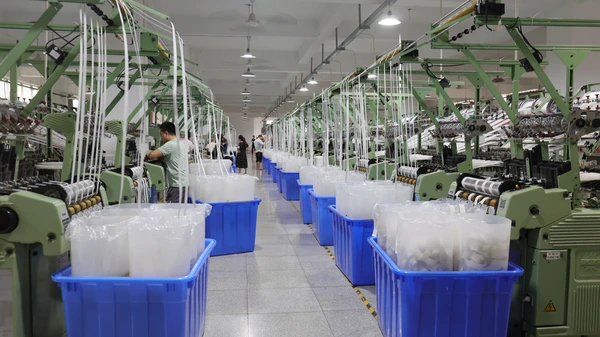
A manufacturer that supplies both conventional polyester and RPET webbing can help buyers compare material choices without changing every other part of their purchasing process.
Guangzhou Lovecolour Garment Accessories Co., Ltd. operates more than 50 webbing weaving machines across its manufacturing operations in Guangzhou, Guangdong, China. We maintain regular white polyester and RPET webbing stock in seven standard widths.
Our production workflow also covers sublimation transfer paper printing, heat transfer, cutting, sewing and lanyard hardware assembly. Customers can purchase blank rolls or discuss printed webbing, partially assembled straps and complete lanyards.
The factory pays attention to low-joint winding, clean white webbing surfaces and pre-ironing before roll packing to support efficient downstream printing and handling. Actual production acceptance criteria, including joint limits and dimensional tolerances, should be agreed for each order.
We can supply related metal and plastic lanyard accessories, including compatible hooks, clips, split rings, connectors and buckles. Buyers who operate their own printing or assembly lines can discuss purchasing webbing and hardware together.
Learn more about our Guangzhou factory and our OEM/ODM manufacturing services.
12. Worldwide Wholesale Supply: USA, UK, Australia, UAE and Other Markets
LOVECOLOUR has experience exporting white webbing and related lanyard accessories to customers in North America, Europe, the Middle East, Latin America, Asia, Australia and Africa.
Markets served by the company’s wider webbing business include the United States, Mexico, the United Kingdom, Spain, Poland, Saudi Arabia, the United Arab Emirates including Dubai, Australia, Brazil, Chile, Ecuador, the Philippines, India, Vietnam, Russia, Angola and the Dominican Republic.
For US buyers, we can discuss quantities in yards or meters and compare nominal widths in inches and millimeters. UK, European and Australian buyers can request metric roll packing and relevant documentation. Customers in the Middle East, Latin America and Asia can discuss bulk material, suitable lanyard accessories and applicable shipment arrangements.
These references describe our broader export experience; they do not mean that every listed market has purchased both polyester and RPET products specifically. Certification eligibility, freight, import rules and trade restrictions should be reviewed according to the actual order and destination.
13. How to Compare Polyester and RPET Webbing Samples
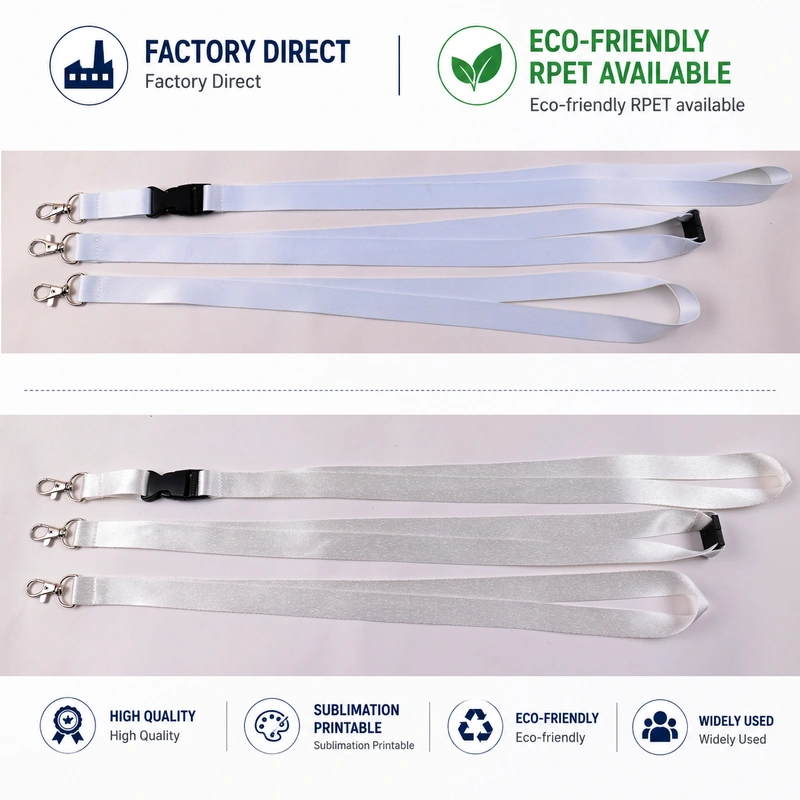
For professional buying decisions, a side-by-side comparison is often the most efficient way to confirm whether switching material is technically practical.
Recommended Sample Comparison Checklist
- Request conventional polyester and RPET samples in the same nominal width and comparable construction.
- Record the material description, sample source and any recycled-content documentation.
- Measure width, thickness and sample length using consistent methods.
- Inspect surface cleanliness, woven edges, appearance and visible defects.
- Check the condition of both rolls, including joint frequency and winding consistency when roll samples are available.
- Print identical artwork using controlled initial conditions.
- Compare print quality, dimensional changes and material behavior after cooling.
- Test cutting, sewing, folding and accessory attachment if the product requires assembly.
- Calculate the usable yield and identify any material-related waste.
- Approve the material that best meets the actual purchasing, performance and documentation requirements.
Keep records of printing settings and approved material samples. This helps suppliers investigate differences when repeat orders are manufactured or when sourcing programs change from conventional to recycled polyester.
14. RFQ Checklist for Wholesale Polyester and RPET Webbing
When requesting two comparable quotations, provide the same base specification for both materials and identify the additional recycled-content documents required for RPET.
- Material: Conventional polyester and/or recycled polyester (RPET).
- Recycled Content: Required percentage and source classification, if applicable.
- Certification: Required standard, document coverage and transaction requirements.
- Webbing Width: 10mm, 15mm, 20mm, 25mm, 30mm, 38mm, 50mm or custom.
- Thickness: Approximately 0.6mm or a specified alternative.
- Quantity: Total meters or yards for each material and width.
- Roll Packing: 100 yards, 100 meters or custom length.
- Quality Requirements: Surface cleanliness, acceptable joints and dimensional tolerances.
- Printing Method: Sublimation equipment and any required compatibility tests.
- Accessories: Hooks, buckles, clips, rings or additional components.
- Services: Blank webbing only, printing, cutting, sewing or complete assembly.
- Destination: Country, shipment quantity, delivery terms and required timing.
A standardized RFQ makes it easier to compare two genuine material alternatives rather than confusing differences in packing, quality, documentation or delivery with material price differences.
Request Comparable Polyester and RPET Webbing Quotes
15. Frequently Asked Questions
Is RPET webbing better than regular polyester webbing?
Not automatically. RPET is useful when verified recycled polyester content is required. Conventional polyester may be suitable when recycled content is not specified. Printing quality, strength, stability and total cost depend on the particular product and should be tested.
Is RPET the same as polyester?
RPET is recycled PET polyester. Both materials belong to the polyester family, but they differ in feedstock sourcing and may have different traceability requirements.
Which material is better for sublimation lanyards?
Both can work with compatible dye sublimation systems. The best option depends on the material construction, actual printing tests, customer requirements and documentation.
Does RPET produce brighter sublimation colors?
Recycled content alone does not prove brighter or duller colors. Test comparable materials using the same artwork, printing equipment and controlled processing conditions.
Does RPET shrink more than conventional polyester?
There is no universal rule that applies to all products. Shrinkage depends on yarn, construction, finishing, heat and tension. Test representative samples under the intended process.
Is RPET webbing always more expensive?
No fixed price relationship applies to every order. Costs depend on the material, specifications, supply conditions, certification documentation, quantity and market pricing.
Does RPET webbing require GRS certification?
Not every RPET purchase requires GRS certification. Whether it is needed depends on the buyer’s procurement requirements and intended claims. If certified products are required, the relevant chain-of-custody and transaction evidence should be verified.
Can a supplier claim GRS certification using only an upstream raw material certificate?
Not automatically. The certificate’s scope, certified organization, product coverage and applicable transaction requirements must be checked for the final goods and intended claim.
Can I buy both materials in the same shipment?
Mixed-material purchasing can be discussed based on the required widths, quantities, stock, packing and documentation. Buyers should identify and label both materials separately to prevent warehouse or production mix-ups.
What widths are available from LOVECOLOUR?
Our regular white polyester and RPET webbing ranges include 10mm, 15mm, 20mm, 25mm, 30mm, 38mm and 50mm, with approximately 0.6mm standard thickness.
Can I order 100-meter and 100-yard rolls?
Yes. Both are regular packing options. Remember that 100 yards equals 91.44 meters, so the two quantities should be clearly distinguished in purchasing documents.
Can you also print and assemble custom lanyards?
Yes. LOVECOLOUR supports transfer paper printing, sublimation heat transfer, cutting, sewing and compatible hardware assembly. We can review blank material orders or finished lanyard projects.
What should I test before switching to RPET?
Confirm material composition and documentation, compare surface quality, run printing and dimensional stability tests, check usable yield and validate any required cutting, sewing or hardware assembly.
16. Final Recommendation: Choose the Material That Meets the Actual Procurement Requirement
There is no universally superior choice between conventional polyester and RPET webbing. Both can be useful for sublimation lanyards and custom printed textile accessories, but the right purchasing decision depends on the customer’s goals.
When recycled content is not required, conventional polyester may provide an appropriate standard solution. When recycled content is required, RPET can be the appropriate material choice if its composition, available documentation, printing performance and supply conditions meet the project specification.
For long-term wholesale production, prioritize repeatable quality, accurate material identification, clean rolls, controlled joints, approved samples and reliable replenishment. A lower quoted price is not always the lowest manufacturing cost when material waste and processing interruptions are considered.
Guangzhou Lovecolour Garment Accessories Co., Ltd. supplies both blank white polyester and RPET webbing in seven regular widths, approximately 0.6mm thick, with 100-yard or 100-meter roll packing. Our Guangzhou manufacturing business also supports sublimation printing, cutting, sewing, lanyard hardware and completed custom products.
Not sure whether to choose polyester or RPET? Send us your required width, quantity, roll packing, printing conditions, destination and any recycled-content requirements. We can discuss both material options and arrange a quotation according to your project.
Compare Polyester and RPET Webbing – Request Samples and Wholesale Pricing
About This Comparison and Technical Sources
This comparison is prepared for professional textile and promotional product buyers by Guangzhou Lovecolour Garment Accessories Co., Ltd. Company-specific information is based on the factory’s stated webbing supply and production practices. The sample comparisons and pricing examples described above are purchasing methods and illustrative calculations, not unpublished test results or quotations.
Recycled material standards: Textile Exchange – Global Recycled Standard and Recycled Claim Standard.
Standards updates: Textile Exchange – Standards Policy and Transition Updates.
Heat transfer reference: Sawgrass – Sublimation Heat Press Settings.
Related LOVECOLOUR pages: Custom Webbing Products | Custom Lanyards | OEM/ODM Services | About Our Guangzhou Factory | Contact Our Team.