For a sublimation printing company, the cost of blank polyester webbing is only one part of the finished product cost. Excessive webbing splices, stains, heat-related shrinkage, blurry logos and printing interruptions can waste transfer paper, ink, labor and valuable machine time.
These problems become especially important when processing continuous webbing rolls for custom lanyards, wristlet keychains, promotional straps and other full-color printed textile products.
At Guangzhou Lovecolour Co., Ltd., our experience extends from webbing weaving and preparation to sublimation transfer paper printing, heat transfer, cutting, sewing and finished lanyard assembly. Working across these processes has taught us that the preparation and handling of blank webbing can have a significant impact on downstream manufacturing efficiency.
In this guide, we explain how to reduce avoidable sublimation webbing waste, why pre-ironing matters, what to do when webbing has been stored for a long period and how professional buyers can evaluate roll quality before placing bulk orders.
Quick Answer: How Can You Reduce Sublimation Webbing Waste?
Start with clean, low-splice polyester or RPET webbing that has been properly prepared and wound. Test dimensional stability before printing, especially if the material has been stored for an extended period. If the webbing shows changes in its relaxed dimensions or reacts noticeably to heat, a controlled pre-ironing pass before sublimation printing may help stabilize the material. Also check transfer paper alignment, machine tension, surface cleanliness and roll continuity. Finally, plan a reasonable material allowance for setup, cutting and processing losses.
1. Why Does Sublimation Webbing Waste Happen?
Blank white webbing passes through several operations before it becomes a finished printed lanyard. Depending on the customer’s equipment, these may include unwinding, tension control, heat transfer, cooling, cutting, sewing and hardware assembly.
Waste can arise at any stage. A joint may interrupt printing, a stain may spoil a finished logo, a dimensional change may affect image registration, or an incorrect cutting allowance may leave insufficient material for the planned quantity.
Some material loss is normal in manufacturing, but excessive loss should not be treated as unavoidable. By identifying the cause, printing companies can improve material utilization and reduce unnecessary production costs.
Common Sources of Webbing Waste
- Roll splices or joints: Connections within a roll may require the printing line to stop or sections to be removed.
- Heat-related dimensional changes: Webbing length or width changes during printing may affect pattern registration or cutting accuracy.
- Dirty or stained surfaces: Oil marks, dust or other contamination may make printed sections unacceptable.
- Ghosting and blurry prints: Material movement, misalignment or dimensional changes may reduce the sharpness of printed artwork.
- Wrinkles or uneven feeding: Poor roll preparation or tension control may affect heat transfer contact and material handling.
- Setup and cutting waste: Machine adjustments, test prints, trimming and assembly allowances consume material.
The best solution is to control both the raw material and the printing process. A clean, well-prepared roll cannot compensate for incorrect machine settings, but it gives the printing operator a better starting point.
2. Why Low-Splice Webbing Rolls Matter
One of the most important quality factors for continuous sublimation printing is roll continuity.
A webbing splice, also called a joint, connects separate lengths of material within a roll. While a joint may be acceptable for some applications, it can interrupt automated printing or require the affected section to be removed.
For a customer using a roll-to-roll printing system, fewer joints can mean fewer material interruptions, less handling and better production continuity.
Our Factory Experience: Many Rolls Are One Continuous Length
At LOVECOLOUR, we operate more than 50 webbing weaving machines across our manufacturing operations and maintain regular production of white polyester and RPET webbing. We pay particular attention to reducing unnecessary joints during production and winding.
In our regular production, many rolls can be supplied as one continuous length without a splice. Other rolls may contain a small number of joints depending on the production and winding circumstances.
Our goal is to provide clean, continuous material that customers can process efficiently rather than rolls containing frequent interruptions.
However, a generally low splice frequency is not the same as a guaranteed zero-splice specification. If your production equipment requires uninterrupted rolls, please specify that requirement before ordering so availability and acceptance conditions can be confirmed.
How Can Splices Increase Printing Costs?
When a joint reaches the printing or cutting area, the operator may need to stop the machine, remove the joint, adjust material alignment or discard a section that cannot be used in the final product.
One joint may create more waste than the physical length of the connection itself, depending on the equipment, print repeat, machine tension and restarting procedure.
For this reason, professional buyers should evaluate the actual continuity of a roll rather than comparing suppliers only by price per meter.
Questions to Ask Your Webbing Supplier
- Is each roll produced as one continuous length whenever possible?
- How often do splices occur in regular production?
- Can the maximum acceptable number of joints be agreed before ordering?
- Can joint-free rolls be arranged when the application specifically requires them?
- How are joint positions handled or identified when necessary?
For large-volume orders, clearly defining roll continuity is more useful than relying on general phrases such as “high-quality webbing.”
3. Why We Pre-Iron Blank Webbing Before Winding
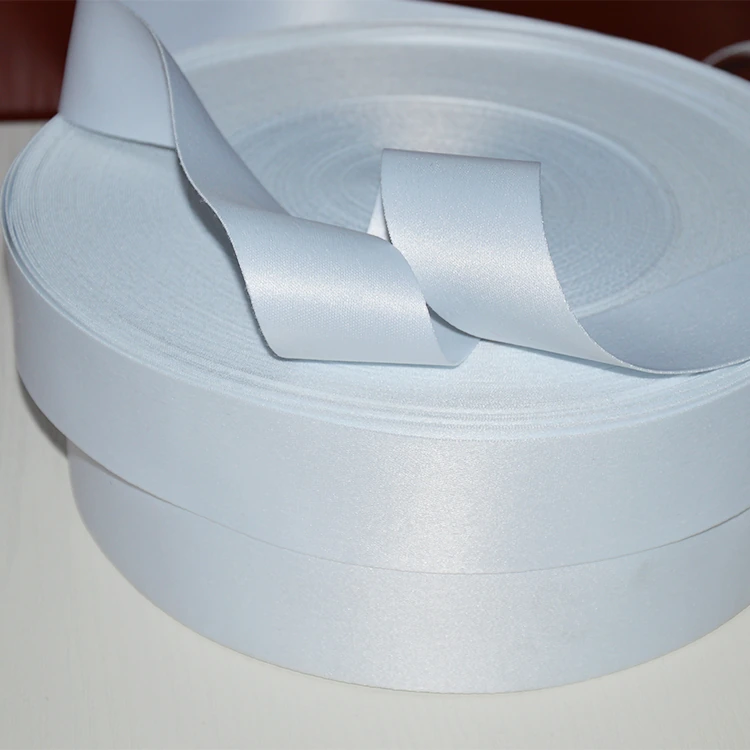
Pre-ironing is one of the practical preparation steps we use before winding regular blank white webbing into rolls.
During weaving, handling and processing, textile materials may develop residual tension, unevenness or other dimensional effects that influence how they behave when subsequently heated.
In our production experience, preparing and ironing webbing before winding helps flatten the material and reduces the tendency for noticeable dimensional changes during subsequent sublimation printing under our usual processing conditions.
This is important because heat-related webbing movement can affect the alignment between the textile and printed transfer paper.
How Pre-Ironing Helps Logo Clarity
During sublimation printing, the artwork on the transfer paper must remain correctly positioned relative to the webbing. If the textile changes dimensions or moves relative to the paper while the dye is transferring, fine details, narrow lines and lettering may lose their intended registration.
By preparing the webbing before printing, manufacturers can reduce some of the dimensional movement that may contribute to blurred edges, uneven repeated patterns and ghosting.
Our factory experience is that appropriately pre-ironed webbing can produce clearer and more consistent logo printing than poorly prepared material under comparable conditions.
However, blurred printing may also result from transfer paper movement, unsuitable pressure, inaccurate temperature control, ink-related issues or machine tension. Pre-ironing should be viewed as one part of a complete printing quality process, not a universal solution to every blurry image.
Pre-Ironing vs. Industrial Heat-Setting
These terms should not automatically be treated as interchangeable. Pre-ironing generally describes a preparatory heating and flattening operation, while industrial heat-setting can involve more precisely controlled thermal conditions intended to modify and stabilize textile properties.
The effect of either process depends on the actual equipment, temperature, contact time, tension and webbing construction.
At LOVECOLOUR, we describe our process as pre-ironing and preparation before winding. We do not treat that description alone as proof of a specific laboratory-certified shrinkage rate or universal zero-shrinkage performance.
4. What Happens When Blank Webbing Is Stored for a Long Time?
This is a practical issue that some printing companies may overlook.
Even if webbing has been prepared and ironed before shipment, its handling and dimensional behavior may change after extended storage, depending on the material, winding conditions and storage environment.
In our production experience, webbing kept in storage for a long time may sometimes show slight dimensional relaxation or apparent expansion compared with its condition immediately after preparation. When the material is subsequently heated during sublimation printing, some dimensional contraction may occur.
This effect can be especially noticeable when the printed design contains fine text, high-contrast edges, precise repeat spacing or other elements that are sensitive to registration changes.
Storage-related dimensional behavior should not be assumed to have one universal cause. Factors can include relaxation of residual textile tension, roll winding conditions, temperature, humidity and the material’s previous thermal processing history. Polyester itself has relatively low moisture absorption, so it would be inaccurate to claim that every stored polyester roll necessarily expands because of moisture.
Our Recommendation: Re-Iron Older Webbing Before Sublimation Printing
If your blank polyester or RPET webbing has been stored for an extended period, or if you notice dimensional changes when testing it, we recommend evaluating a controlled pre-ironing pass before applying the printed transfer design.
In our experience, re-ironing suitable webbing before printing can help stabilize its handling and reduce subsequent movement during the transfer process. This can improve logo registration and printing consistency.
The important point is to carry out the pre-ironing step separately from the final transfer process and to test the resulting webbing before beginning a full production run.
Recommended Procedure for Webbing That Has Been Stored for a Long Time
- Remove a representative section of webbing from the stored roll and inspect its surface condition.
- Allow the sample to reach the normal production-room conditions before testing.
- Measure a marked length and width so the starting dimensions are recorded.
- Run a controlled pre-ironing pass using settings suitable for the specific material and equipment.
- Allow the sample to cool and relax before taking a second measurement.
- Apply the intended sublimation transfer process to a prepared sample.
- Inspect logo sharpness, transfer registration, webbing flatness and dimensional changes.
- If the trial is successful, apply the approved preparation process to the production material as appropriate.
There is no universal storage period after which every polyester or RPET roll must be re-ironed. The decision should depend on storage history, material behavior, equipment requirements and sample results.
Should the Printing Company Increase Heat or Pressure Instead?
Not automatically. Increasing temperature, pressure or dwell time without testing may create new defects or damage the material. If stored webbing appears to change dimensions during printing, investigate material preparation and machine settings before making large process adjustments.
Always follow the heat transfer equipment manufacturer’s guidance and confirm the final procedure through a representative printing trial.
Factory Tip: Printing Webbing After Long-Term Storage
If a roll has been stored for a long time, do not assume it will behave exactly as it did immediately after manufacturing. Test the material first. Where appropriate, pre-iron and cool the webbing before sublimation printing. This extra preparation can reduce unexpected dimensional changes and improve the consistency of detailed logo printing.
5. How to Check Webbing Shrinkage Before Printing
Webbing shrinkage should be evaluated through measurement rather than visual judgment alone.
The most useful approach is to measure the same marked section before and after the intended heating process. This helps printing companies quantify dimensional change and determine whether it falls within the acceptable tolerance for their artwork and finished product.
Simple Dimensional Stability Test
- Choose a representative blank webbing sample and record its material and width.
- Mark two reference points at a known distance apart without stretching the material.
- Measure the starting distance between the reference points.
- Apply the intended pre-ironing or printing process under controlled conditions.
- Allow the material to cool and relax consistently.
- Measure the same reference points again.
- Calculate the percentage dimensional change and record the result.
Dimensional change (%) = (Length after processing – Length before processing) / Length before processing × 100.
For example, if a marked 1,000mm section measures 996mm after heating, the calculated dimensional change is -0.4%. This is an illustrative calculation, not an actual measured shrinkage result for LOVECOLOUR webbing.
For projects with strict pattern alignment, repeat the test on representative samples and check both lengthwise and widthwise behavior. A sample that performs acceptably in one direction may still require additional checks for the intended conversion process.
What Is an Acceptable Shrinkage Rate?
There is no single acceptable shrinkage percentage that applies to every sublimation webbing project. The tolerance depends on the artwork, repeated design spacing, cutting length, printing equipment and final product requirements.
For a simple repeating pattern, a small dimensional change may be manageable. For a precisely positioned logo or two-sided print, even minor changes may affect registration.
The best practice is to agree on a test procedure and acceptance criteria before mass production.
6. Why Webbing Cleanliness Matters for Full-Color Printing
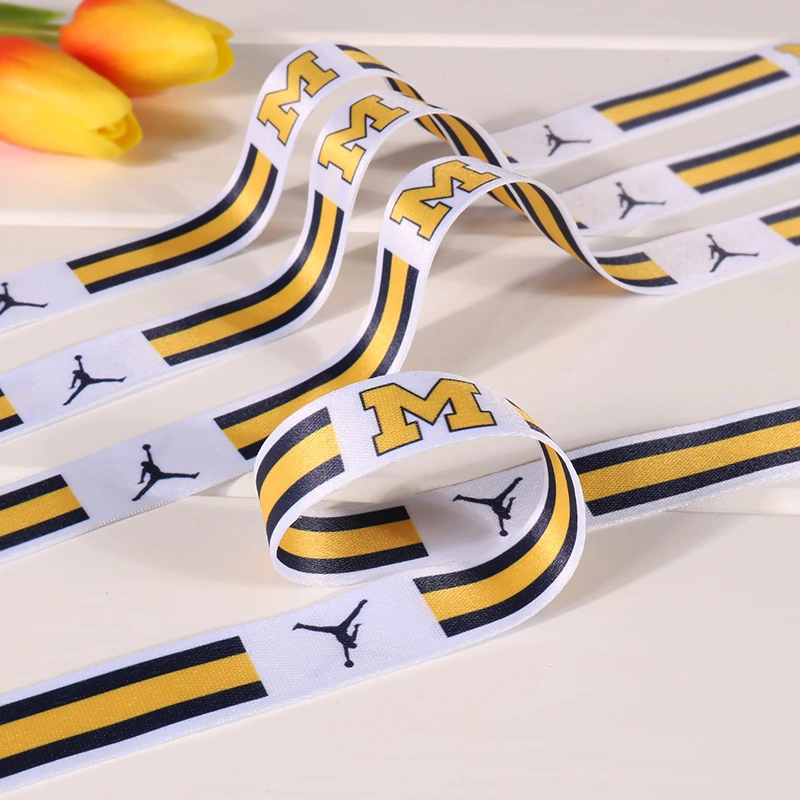
White polyester webbing is especially sensitive to visible contamination because stains and surface defects can remain noticeable after printing.
For a sublimation printing company, even a small oil mark or dirty patch may cause a printed section to be rejected. The resulting loss may include the webbing itself, printed transfer paper, ink, processing time and labor.
Cleanliness therefore begins before printing, during weaving, material transfer, storage and roll packing.
Our Factory’s Clean Webbing Handling Practices
At LOVECOLOUR, we maintain a clean and organized webbing production workshop. Material handling and housekeeping are important parts of our daily manufacturing practices.
We use containers or boxes to hold and move webbing between production stages rather than allowing the material to remain exposed on dirty surfaces. This helps protect white webbing from unnecessary contact with dust, oil and other contamination.
We also pay attention to the condition and cleanliness of the weaving equipment, including preventing machine oil contamination from reaching the material.
These practices help us supply clean white webbing that is suitable for downstream printing and finishing. Our objective is to minimize avoidable staining and reduce customer processing losses.
Why Clean Material Handling Is More Important Than a Final Visual Check Alone
Inspecting webbing before packing is useful, but preventing contamination during production is equally important. Once oil or staining has entered the material, cleaning or removing the affected section may create additional cost or waste.
A clean production environment, suitable material containers, organized roll handling and consistent equipment maintenance help reduce these risks before they become finished-product defects.
For buyers sourcing large quantities of white polyester or RPET webbing, factory housekeeping and material storage practices are useful factors to evaluate during supplier selection.
7. How to Prevent Blurry Logos and Ghosting During Sublimation Printing
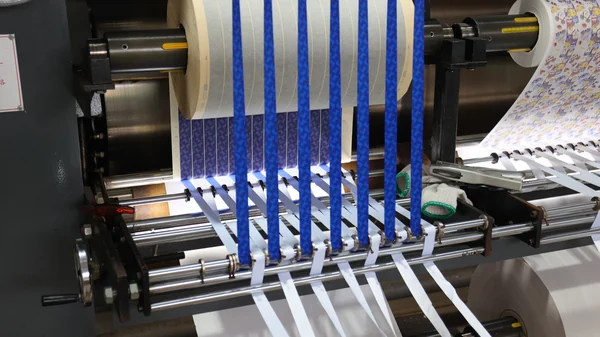
Clear logo printing is especially important for corporate lanyards, trade show lanyards, promotional straps and identification products where small lettering or repeated branding must remain readable.
Blurred edges and ghosting can have several possible causes. These include movement between the transfer paper and webbing, dimensional changes during heating, incorrect pressure, unstable machine tension or other process inconsistencies.
Use Properly Prepared Blank Webbing
Start with clean, flat material that has been prepared for the intended sublimation process. If the webbing has been stored for a long time, check its dimensional behavior before printing and consider a controlled pre-ironing pass.
Keep Transfer Paper and Webbing Aligned
The printed artwork must remain correctly positioned relative to the webbing during dye transfer. Unwanted movement can create doubled edges, especially around high-contrast text or narrow graphic details.
Control Machine Tension
In roll-to-roll production, tension affects how material moves through the equipment. Incorrect tension may stretch, distort or destabilize the webbing, making accurate printing and repeat positioning more difficult.
Validate Temperature, Time and Pressure
Do not assume that one set of sublimation conditions works for every polyester or RPET webbing construction. Equipment type, ink, transfer paper, heating system and material characteristics all influence the outcome.
Check for Ghosting After Cooling
Inspect fine lettering, logo edges and repeated patterns after the printed material has cooled. If defects occur, change one process variable at a time where practical so the root cause can be identified.
Differentiate Material Problems from Printing Problems
If multiple webbing batches show the same defect, investigate the printing system as well as the material. If the problem occurs only with a particular roll or after prolonged storage, material preparation and handling deserve closer attention.
Accurate troubleshooting is more valuable than automatically blaming the webbing or increasing transfer temperature.
8. How We Prepare and Pack Our White Webbing Rolls
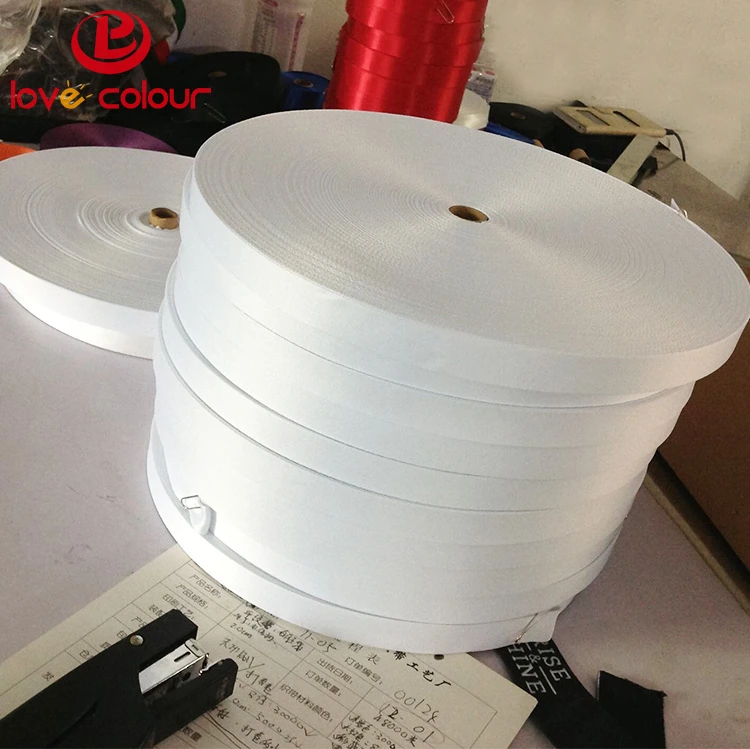
Our regular blank white polyester and RPET webbing is supplied in rolls for printing companies, lanyard manufacturers and wholesale material distributors.
We normally offer 100 yards per roll or 100 meters per roll. Other roll lengths and packing requirements can be discussed according to the customer’s production or distribution needs.
Continuous Material Where Possible
We aim to wind webbing in long, continuous lengths. Many of our regular rolls are one continuous piece without a splice, helping reduce interruption during downstream processing.
Pre-Ironing Before Winding
We iron and flatten regular webbing before roll packing to prepare the material for subsequent handling and heat transfer printing.
Clean Material Handling
Webbing moves through an organized workshop using containers and controlled handling practices intended to prevent unnecessary contamination.
Neat Roll Packing
Carefully prepared rolls help customers receive material that is easier to store, unwind and feed into their printing equipment.
Extra Material Allowance for Bulk Orders
For many bulk orders, we also include some extra webbing material as a practical allowance to help customers manage normal setup, cutting or processing losses.
The additional quantity is not a fixed universal percentage and should be confirmed when the order is quoted or finalized. Buyers should calculate their own required usable length and treat any extra material as an agreed allowance, not a replacement for proper production planning.
9. Why We Sometimes Include Extra Webbing in Bulk Orders
Even when the raw webbing is clean, continuous and correctly prepared, some material consumption is part of normal manufacturing.
For example, a printing company may need material for initial machine adjustment, sample transfer, cutting trials, print registration or sewing setup.
When customers order bulk white webbing, providing a reasonable additional allowance can help reduce the risk that a small amount of normal processing waste leaves them short of material.
Extra Material Is Not a Substitute for Quality
Supplying more webbing should not be used to excuse excessive defects or frequent joints. The first priority remains delivering consistent, clean material that meets the agreed specifications.
Extra material is intended to support normal production needs, rather than compensate for poor manufacturing quality.
How Buyers Should Account for Extra Allowance
When placing an order, clearly distinguish the purchased quantity, any confirmed additional allowance and the target usable production quantity.
For example, if a customer requires 10,000 usable meters for a production plan, the required purchasing quantity should be based on the customer’s validated process yield. Any supplier-provided allowance can then be included in the final material planning after it has been agreed.
Do not assume that all orders include a fixed amount of free material unless the quotation or order confirmation expressly states it.
10. How to Calculate Sublimation Webbing Waste and Usable Yield
Material yield is an important purchasing metric for factories using white polyester or RPET webbing in continuous printing operations.
A useful measurement compares the starting material length with the length that remains usable after relevant production losses.
Usable yield (%) = Usable webbing length / Total input webbing length × 100.
Waste rate (%) = Unusable webbing length / Total input webbing length × 100.
Illustrative Production Example
Suppose a printer begins with 10,000 meters of blank webbing. During the process, 80 meters are used for setup and testing, 40 meters are removed because of cutting or handling issues and 30 meters are rejected for printing defects.
Total material loss is 150 meters, leaving 9,850 meters of usable material. The calculated usable yield is 98.5%, while the material waste rate is 1.5%.
These numbers are purely illustrative. They are not published LOVECOLOUR factory test results, measured customer loss rates or guaranteed production performance.
Calculate the Cost per Usable Meter
When comparing wholesale webbing suppliers, consider the amount of material that can actually be used in production.
Effective raw material cost per usable meter = Total raw material purchase cost / Usable material length.
If 10,000 meters cost USD 1,000 but only 9,850 meters are usable, the effective webbing cost is approximately USD 0.1015 per usable meter, excluding additional printing and operating losses.
This explains why a slightly higher-priced, better-prepared webbing roll may sometimes be more economical than cheaper material that creates excessive interruptions or waste.
However, the total value of a supplier must be evaluated using actual order data, not assumed defect percentages.
11. Bulk Webbing Quality Checklist Before Printing
For printing factories and importers, a simple incoming material inspection can prevent avoidable problems later in production.
| Check Item | What to Verify | Why It Matters |
|---|---|---|
| Material | Polyester or RPET, correctly identified | Prevents material mix-ups |
| Width | Nominal width and agreed tolerance | Supports printing and hardware compatibility |
| Thickness | Regular specification and tolerance | Supports stable processing |
| Roll Length | 100 yards, 100 meters or agreed length | Supports accurate inventory and planning |
| Splices | Joint quantity and continuity requirements | Helps avoid production interruptions |
| Cleanliness | Visible oil, stains, dirt and contamination | Helps prevent rejected printed sections |
| Surface Condition | Flatness, folds and wrinkles | Supports even transfer contact |
| Storage History | Age, storage environment and roll condition | Helps determine whether another pre-ironing trial is advisable |
| Print Trial | Logo clarity, registration and dimensions | Confirms suitability before bulk printing |
| Packing | Correct rolls, labels and protection | Reduces storage and handling errors |
For customers operating a large or automated printing line, we recommend agreeing on incoming inspection criteria with the webbing supplier before placing repeat orders.
12. Polyester vs. RPET: Do the Same Waste-Control Practices Apply?
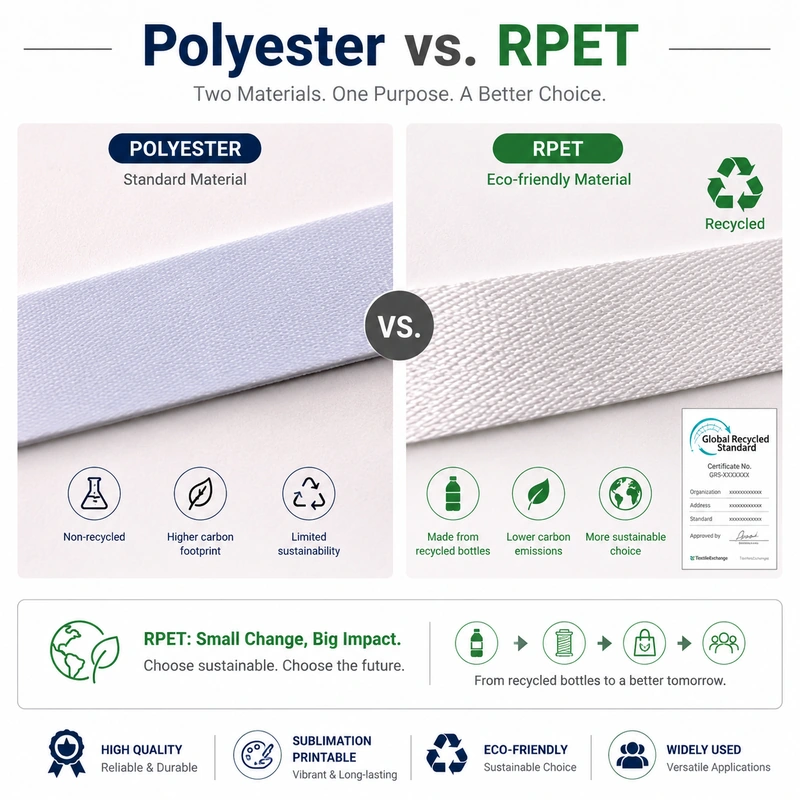
Many of the same production principles apply to both conventional polyester and recycled polyester (RPET) webbing.
Both materials benefit from clean handling, careful winding, appropriate pre-printing preparation, controlled transfer conditions and accurate quality checks.
However, the two materials should be tested separately because differences in yarn, weaving and processing history may affect their dimensional stability or printing behavior.
At LOVECOLOUR, our regular white polyester and RPET webbing ranges are available in seven widths: 10mm, 15mm, 20mm, 25mm, 30mm, 38mm and 50mm, with an approximately 0.6mm standard thickness.
We maintain regular stock for both material types and supply rolls for customers who print and assemble lanyards locally.
For RPET orders, buyers should also verify the recycled-content documentation and any required certification or chain-of-custody evidence. This material verification requirement is separate from printing waste control.
13. How to Store Blank Polyester and RPET Webbing Before Printing
Proper storage helps preserve the appearance and handling quality of blank white webbing after it leaves the factory.
Keep material clean, protected from unnecessary contact with oil or dirt, and stored under reasonably stable conditions suitable for textile materials. Avoid excessive compression, direct contamination and prolonged exposure to conditions that could affect the roll or surface condition.
Where practical, retain the supplier’s product identification and batch information so different materials and deliveries are not mixed.
For customers storing webbing over an extended period, we recommend sampling and inspecting older rolls before large printing runs. A controlled pre-ironing trial may be useful if the material shows noticeable dimensional response to heat.
Suggested Storage and Reuse Procedure
- Keep blank rolls in clean, protective packaging when not in use.
- Store rolls off dirty floors and away from sources of oil or other contamination.
- Avoid unnecessary bending, crushing or deformation during storage.
- Identify material type, width and delivery batch.
- Use a practical first-in, first-out stock rotation system.
- Inspect and test material after extended storage or changed environmental conditions.
- Pre-iron older material before sublimation printing when sample testing indicates a benefit.
There is no single guaranteed shelf life for all polyester or RPET webbing rolls. Storage suitability depends on the specific material, environment and end-use requirements.
14. Choosing a Low-Waste Sublimation Webbing Manufacturer in China
For wholesale importers and printing businesses, the best webbing supplier is not necessarily the one offering the lowest nominal price.
A reliable supply relationship also depends on roll continuity, material preparation, clean production, specifications, realistic quality commitments and repeat-order consistency.
What to Look for in a Webbing Factory
- Actual weaving production capacity rather than only trading finished materials.
- Regularly available widths and suitable material specifications.
- Practical controls for roll joints and material continuity.
- Clean manufacturing equipment and organized material handling.
- Pre-printing preparation processes where relevant.
- Clear roll length and packing specifications.
- Experience with sublimation printing and downstream manufacturing.
- Willingness to confirm the applicable quality criteria before shipment.
- Clear communication about sample approval, stock and delivery arrangements.
Our Guangzhou Manufacturing Experience
Guangzhou Lovecolour Garment Accessories Co., Ltd. is a factory-direct supplier of webbing and custom lanyards in Guangzhou, Guangdong Province, China.
With more than 50 webbing weaving machines across our production operations, we maintain regular stock of white polyester and RPET sublimation webbing for wholesale buyers and printing companies.
Our team also works with sublimation transfer paper printing, heat transfer printing, cutting, sewing and the assembly of finished lanyards with compatible metal or plastic accessories.
Because we handle both raw webbing and downstream manufacturing, we pay close attention to the problems that can increase customers’ printing losses, including excessive joints, dirty material, poor preparation and dimensional changes during heat transfer.
We also have export experience supplying blank webbing and related lanyard materials to international buyers in markets including the United States, United Kingdom, Australia, Saudi Arabia, the United Arab Emirates, Spain, Brazil, Mexico, Chile, Poland, the Philippines, Vietnam and other countries.
For international customers, we can discuss bulk roll supply, material selection, packaging, compatible accessories and additional printing or finishing services according to actual project requirements.
Learn more about our Guangzhou factory and custom lanyard manufacturing capabilities.
15. Frequently Asked Questions About Sublimation Webbing Waste
Why does polyester webbing shrink during sublimation printing?
Webbing may change dimensions during heating because of its yarn, weave, previous processing history, tension and printing conditions. The response varies by material, so dimensional stability should be tested using the intended process.
Can pre-ironing reduce webbing shrinkage?
Pre-ironing can help prepare and flatten suitable webbing and may reduce certain dimensional changes during later heating. The effect depends on the material and process and should be verified through testing.
Should I pre-iron webbing that has been stored for a long time?
We recommend testing older webbing before full production. If the material shows dimensional changes during heating, a controlled pre-ironing pass followed by cooling and sample printing may improve stability and logo registration.
Does polyester webbing expand during long-term storage?
Some stored webbing may exhibit slight dimensional relaxation or apparent changes in size depending on tension, winding and environmental conditions. However, not every polyester roll expands with time, and the cause should not be attributed to moisture alone without evidence.
Does old webbing always need to be ironed again?
No. There is no universal storage period that automatically requires re-ironing. Inspect and test the material based on its actual storage history and processing behavior.
Why does my sublimation logo look blurry?
Possible causes include transfer paper movement, webbing dimensional changes, unstable tension, incorrect heat transfer settings or equipment issues. Check material preparation and printing parameters systematically.
What causes ghosting in sublimation lanyard printing?
Ghosting often involves unintended movement or misregistration between transfer paper and material during printing or separation. Webbing shrinkage can contribute in some cases, but it is not the only possible cause.
Can white webbing stains affect the finished logo?
Yes. Stains, oil marks or contamination on blank white material may remain visible or cause sections to be rejected after printing. Clean production and careful inspection help reduce this risk.
Do your polyester webbing rolls have joints?
Our production focuses on minimizing joints, and many regular rolls are one continuous length without a splice. However, all rolls should not be assumed to be guaranteed splice-free unless that requirement is specifically confirmed.
Do you offer joint-free sublimation webbing?
If your equipment requires uninterrupted rolls, tell us the width, length and quantity. We can review the availability and requirements for that specific order.
Do you provide extra webbing for bulk orders?
For many bulk orders, we provide some additional material to help cover normal processing losses. The quantity depends on the order and should be confirmed rather than assumed as a fixed percentage.
Is RPET webbing more difficult to print than polyester?
Not necessarily. Both can be suitable for sublimation printing. Printing performance depends on the actual material construction and process, so representative testing is recommended.
What roll lengths do you supply?
Our regular packing includes 100 yards or 100 meters per roll, with alternative packing options available for review. One hundred yards equals 91.44 meters.
Can I buy webbing and lanyard accessories together?
Yes. LOVECOLOUR supplies white webbing and related metal or plastic lanyard components. We can also review printing, cutting, sewing and finished product assembly requirements.
How can I calculate my webbing waste rate?
Divide the unusable webbing length by the total material input length and multiply by 100. Use actual production records and separate material defects from normal setup or cutting allowances when investigating the causes of waste.
16. Final Recommendations for Printing Companies and Wholesale Buyers
Reducing sublimation webbing waste begins before the printing machine starts.
Clean, continuous webbing with careful roll preparation can help minimize interruptions and visible defects. Pre-ironing may improve handling and dimensional stability, while additional testing is especially useful for rolls that have been stored for extended periods.
At the same time, professional printing results require control of transfer paper alignment, machine tension, heating conditions, artwork and downstream cutting or sewing.
For bulk buyers, the goal should be reliable usable material rather than simply the lowest quoted price per meter. Evaluate joint frequency, surface quality, material preparation, roll length, production yield and supplier communication together.
At LOVECOLOUR, we manufacture regular white polyester and RPET webbing in seven stocked widths, with approximately 0.6mm standard thickness and 100-yard or 100-meter roll packing. Our production emphasizes low-joint rolls, clean material handling, pre-ironing before winding and practical extra material allowances for many bulk orders.
Need clean, low-splice webbing for your sublimation printing line? Send us your required material, width, quantity, roll length, printing process and destination. Our team can discuss stock, samples, suitable quality requirements and wholesale pricing.
Request Blank Polyester or RPET Webbing Samples & Wholesale Pricing
About This Guide and Technical References
This guide is provided by Guangzhou Lovecolour Garment Accessories Co., Ltd. for sublimation printing businesses, webbing importers, lanyard manufacturers and promotional merchandise suppliers. Company-specific observations reflect our production experience with webbing preparation, weaving, printing and finishing. Illustrative calculations are not laboratory test results or guaranteed production yields.
Independent industry reference: Strapworks – Custom Graphics Quickstart Guide, including discussion of webbing shrinkage and sublimation ghosting.
Related LOVECOLOUR resources: Webbing Products | Custom Lanyards | Customization Services | About Our Factory | Request a Quote.