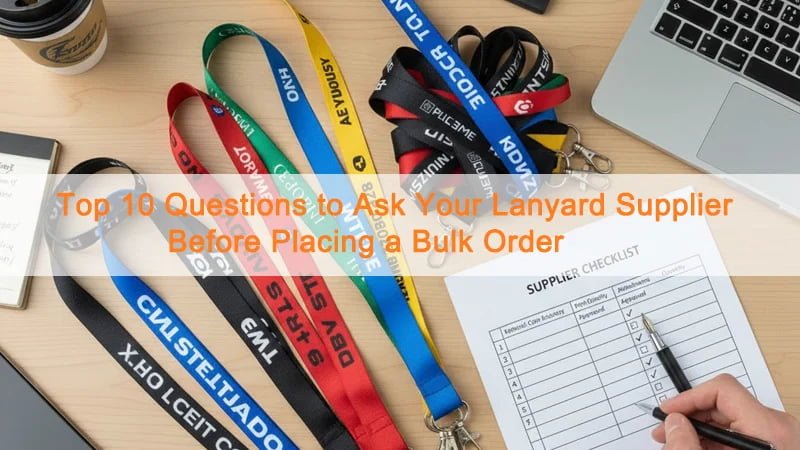
How to Choose a Reliable Lanyard Supplier for Bulk Orders: 10 Questions to Ask
Choosing a lanyard supplier for a bulk order is not simply a matter of comparing the lowest unit price.
Two suppliers may quote the same size and quantity, but the final products can be very different in material feel, logo clarity, color accuracy, hardware strength, packaging, production consistency and delivery reliability.
For brands, promotional product distributors, schools, hospitals, event companies and corporate buyers, these differences matter—especially when hundreds or thousands of lanyards need to look and perform consistently.
As a factory specializing in custom lanyards and branded ID accessories, LOVECOLOUR regularly works with buyers who need help selecting materials, printing methods, widths, attachments, badge holders and shipping options for bulk projects.
Before placing your next order, use the following 10 questions to evaluate whether a supplier can provide more than just an attractive quotation.
Quick Checklist: What Should You Check Before Choosing a Lanyard Supplier?
| What to Check | What You Should Confirm | A Good Supplier Should |
|---|---|---|
| Material | Polyester, nylon, rPET, woven or other options | Explain differences instead of offering only one material |
| Printing | Screen print, heat transfer, dye sublimation or woven | Recommend a process according to your artwork |
| Sample | Digital proof or physical sample | Provide a clear approval process |
| MOQ | Minimum quantity for your construction | Explain how MOQ changes with specifications |
| Pricing | Strap, logo, accessories, packing and shipping | Provide a clear quotation |
| Lead Time | Sampling, production and shipping time | Give a realistic schedule |
| Quality Control | Logo, color, stitching, dimensions and hardware | Explain inspection procedures |
| Compliance | Factory certifications or product testing | Provide relevant documents when required |
| Accessories | Hooks, clips, breakaway buckles, badge holders and reels | Help match compatible components |
| Shipping | Express, air, sea or DDP | Recommend shipping based on your deadline and order size |
The cheapest quotation is not always the lowest-cost solution.
A more useful comparison is:
Product quality + accurate specifications + total landed cost + delivery reliability + communication.
Now let us look at each question in more detail.
1. What Lanyard Materials Can You Supply?
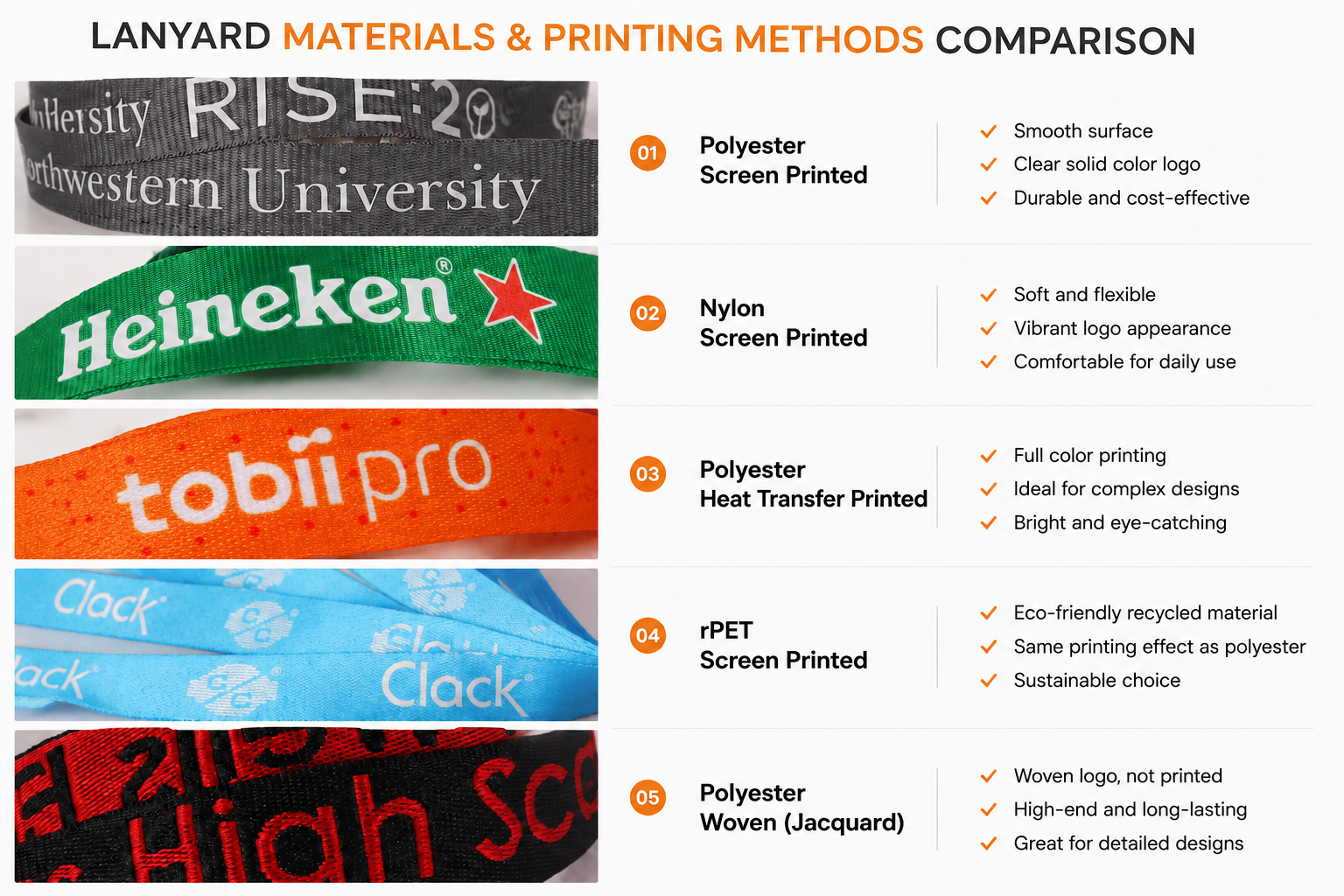
Material affects how a lanyard looks, feels, prints, wears and costs.
A reliable lanyard supplier should not simply tell you that its material is “high quality.” It should be able to explain which material is appropriate for your application.
Common choices include:
Polyester
Polyester is one of the most widely used materials for custom lanyards. It offers a good balance between durability, comfort, printing quality and bulk-order cost.
It is commonly used for:
- conferences
- staff ID lanyards
- schools
- promotional campaigns
- exhibitions
- corporate programs
rPET
Recycled polyester, often referred to as rPET, is increasingly selected for projects where recycled materials are part of the brand or event requirement.
Woven Material
For designs where the logo needs to become part of the fabric rather than simply being printed on the surface, woven lanyards can provide a more textile-like and premium appearance.
Nylon and Other Specialty Materials
Different applications may require different textures, strengths or appearances.
Instead of deciding purely by price, tell your supplier:
- where the lanyard will be used;
- how long it will normally be worn;
- whether it is promotional or for everyday use;
- the required logo detail;
- your target budget;
- whether recycled material is preferred.
A professional supplier should help narrow the choices before production.
You can compare different constructions on our custom lanyards product page.
2. Which Printing or Branding Method Is Best for My Logo?
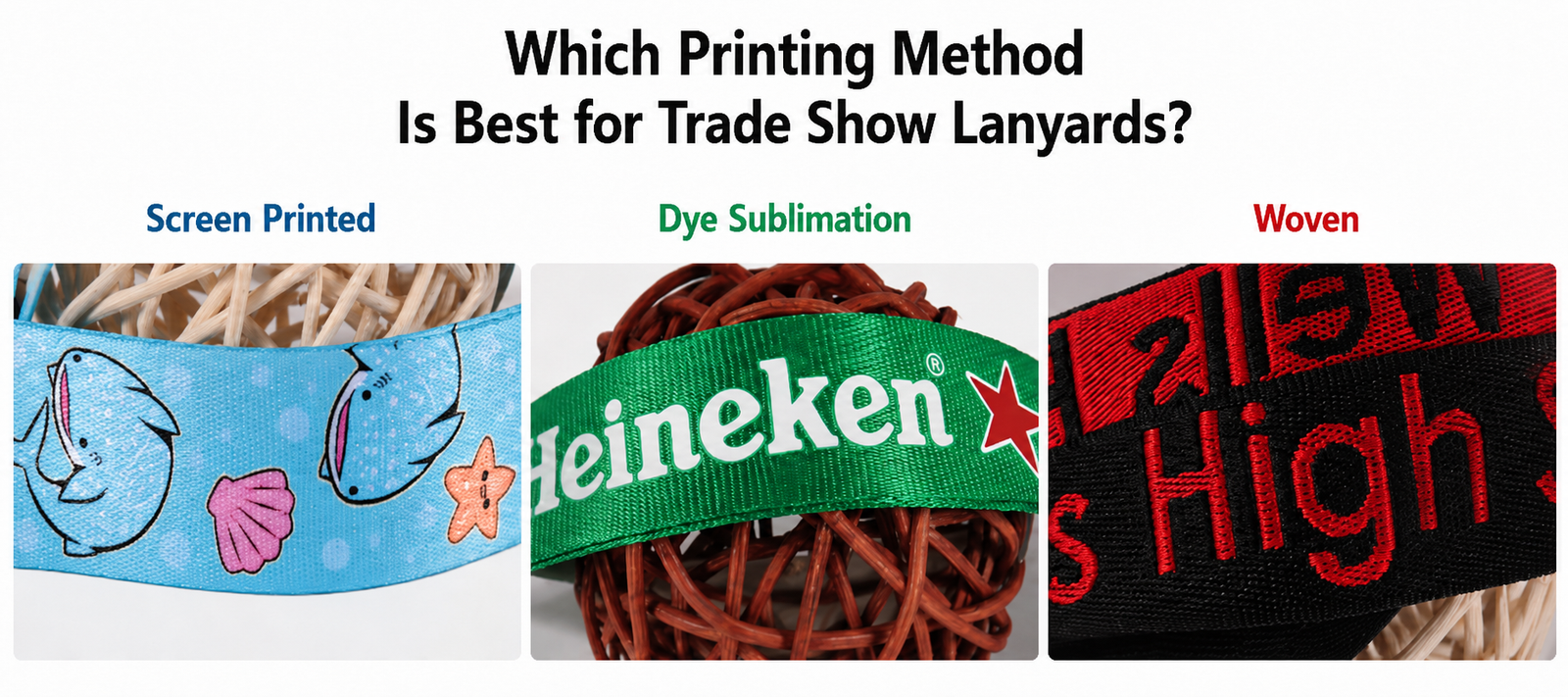
Do not choose a printing method simply because it is the cheapest option.
The correct process depends heavily on the artwork.
For example, a one-color corporate logo does not necessarily require the same process as a full-color event design containing gradients and small details.
Screen Printing
Screen printing is suitable for:
- simple logos;
- solid colors;
- text;
- repeat designs;
- cost-sensitive bulk orders.
It provides a clean and practical result when the artwork is relatively simple.
Heat Transfer or Dye Sublimation Printing
Full-color printing is better suited to:
- gradients;
- multiple colors;
- detailed graphics;
- photographic artwork;
- edge-to-edge designs.
It is frequently used for event, promotional and branded lanyards where visual detail is important.
Woven Logos
A woven design creates the logo directly into the textile structure.
It can be a good option when buyers want a more premium, textile-style finish and long-term logo durability.
A capable manufacturer should review your actual artwork before recommending the production method.
That is much more useful than simply asking:
“Which printing method is best?”
A better question is:
“Which production method is most suitable for this artwork, quantity and application?”
For a more detailed comparison, see our lanyard customization and printing options.
3. Can I Approve a Sample Before Bulk Production?
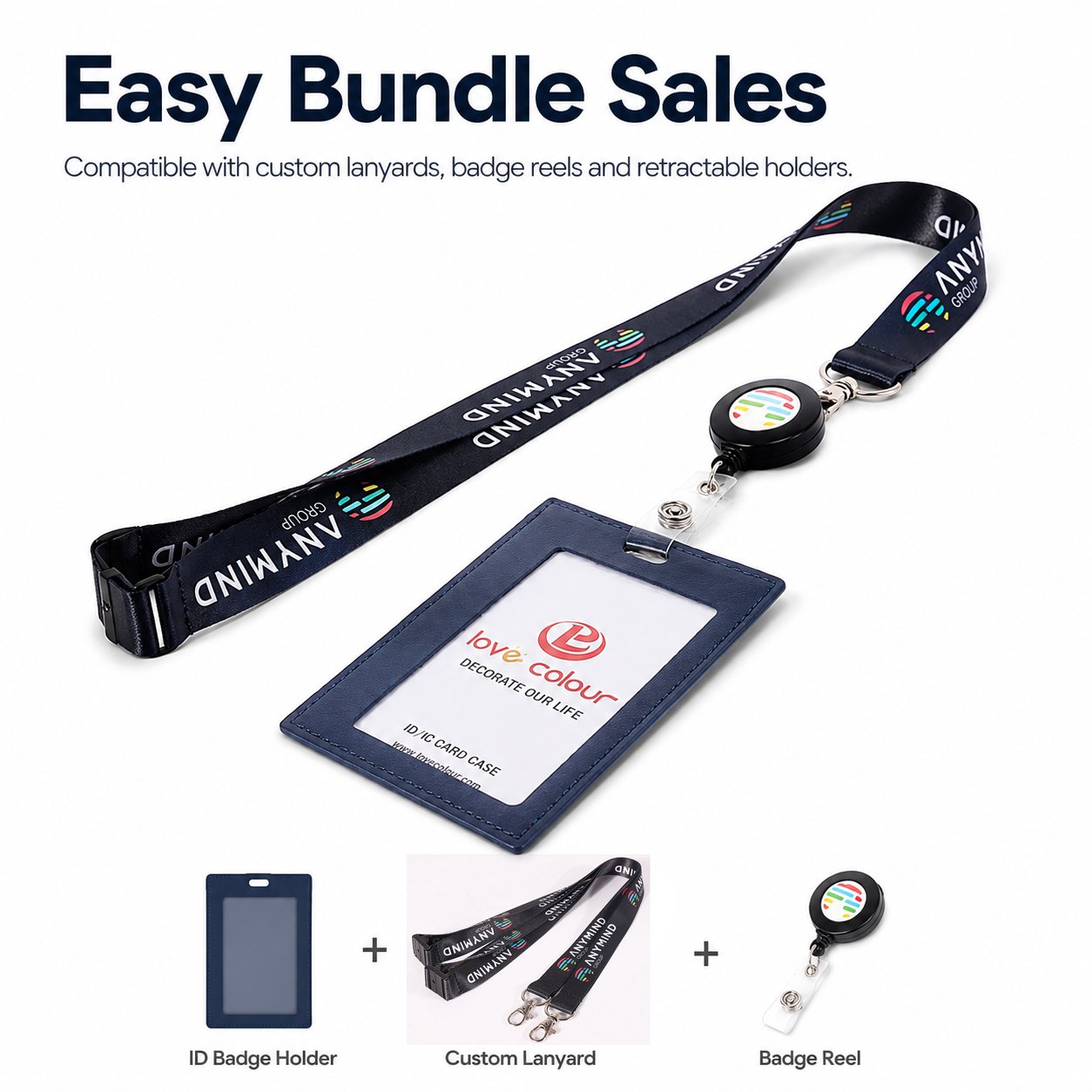
For a bulk custom order, sampling and artwork approval are important risk-control steps.
Depending on the project, approval may involve:
- digital artwork;
- size confirmation;
- Pantone or color reference;
- logo position;
- material;
- lanyard width;
- total length;
- attachment;
- safety buckle;
- detachable buckle;
- badge holder;
- packaging.
For more complicated orders, a physical sample can also be useful before mass production.
This is particularly important when:
- the logo contains small details;
- exact brand colors matter;
- custom hardware is involved;
- the lanyard will be combined with a badge holder;
- multiple components need to be assembled;
- the order quantity is large;
- the product will be distributed at an important event.
A good supplier should clearly distinguish between:
Artwork approval
and
Physical sample approval.
They are not the same thing.
The artwork confirms the visual layout, while the physical sample allows you to evaluate the real product.
Before mass production begins, make sure both you and your supplier agree on the approved specification.
4. What Is Your MOQ and How Is Bulk Lanyard Pricing Calculated?
“What’s your price for 1,000 lanyards?” sounds like a simple question.
In reality, it is usually not enough information for an accurate quotation.
Bulk lanyard pricing can be affected by:
- quantity;
- material;
- width;
- length;
- logo process;
- number of print colors;
- artwork coverage;
- attachment;
- safety buckle;
- detachable buckle;
- badge holder;
- badge reel;
- individual packing;
- custom packaging;
- shipping destination.
This is why two quotations for “1,000 custom lanyards” may not actually describe the same product.
Ask for a specification-based quotation.
For example:
Quantity: 1,000 pcs
Material: Polyester
Width: 20 mm
Logo: Full-color printing
Attachment: Metal hook
Safety Breakaway: Yes
Badge Holder: Yes
Packing: Bulk packing
Destination: USA
Now the quotation becomes much easier to compare.
MOQ can also vary according to product construction.
A standard lanyard may have a relatively flexible minimum quantity, while completely custom hardware, unusual materials or specialty production methods may require a higher MOQ.
If you want to understand the main cost variables before requesting a quote, read our custom lanyard cost guide.
5. What Is Your Production Lead Time and Capacity?
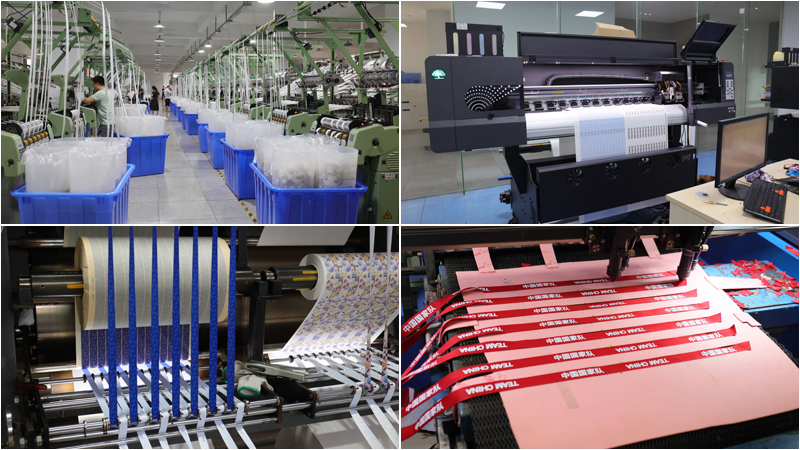
Production time should never be discussed without first defining the product.
A standard printed lanyard and a complicated custom lanyard set may require different timelines.
A realistic project schedule usually contains several stages:
Artwork confirmation → Sampling if required → Sample approval → Material preparation → Bulk production → Quality inspection → Packing → Shipping
When asking about lead time, do not only ask:
“How fast can you make it?”
Instead ask:
“How many production days do you need after final artwork or sample approval?”
Also tell your supplier your required arrival date, not only your preferred production date.
That allows the factory to work backwards and determine whether the project is realistic.
For event orders, this is especially important.
If an exhibition begins on October 20, the important date is not when the factory finishes production—it is when the cartons must arrive at your location.
A good supplier should consider both:
production lead time + shipping lead time.
Rush production can sometimes be arranged, but an unrealistic schedule should be treated as a warning sign rather than a competitive advantage.
6. How Do You Control Quality From Sample to Bulk Production?
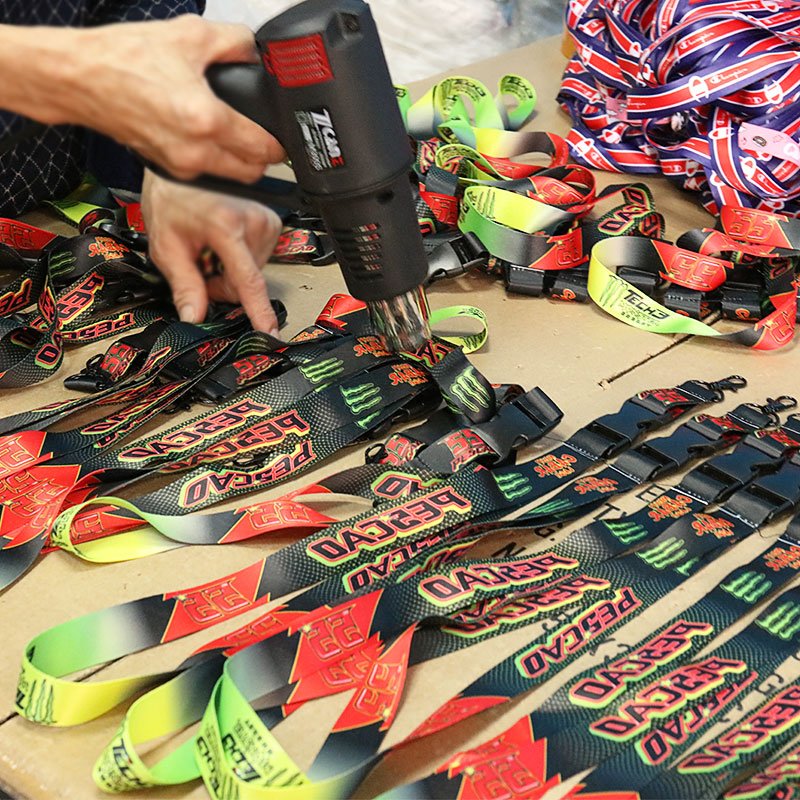
“Good quality” is not a quality-control system.
For bulk custom lanyards, quality should be checked against measurable specifications.
Important inspection points may include:
Material
Does the material match the approved construction and feel?
Width and Length
Are the finished dimensions within the acceptable tolerance?
Logo
Is the artwork clear, positioned correctly and consistent throughout the order?
Color
Does the webbing and printing reasonably match the approved color reference?
Sewing
Are stitching points neat and secure?
Hardware
Do hooks, clips, buckles and other attachments function properly?
Assembly
If the product includes badge holders, safety breakaways or detachable components, are they assembled in the correct configuration?
Packing
Does the quantity, packaging method and carton labeling match the order requirement?
The more components a lanyard has, the more important final assembly inspection becomes.
This is particularly relevant for products such as:
lanyard + badge holder + safety breakaway + detachable buckle + metal attachment
because each component may be correct individually while the assembled set is still wrong.
Before choosing your supplier, ask what is inspected during production and before packing.
You can learn more about our manufacturing and QC approach on the Why Choose LOVECOLOUR page.
7. What Factory Certifications and Product Testing Can You Provide?
This question should be divided into two different areas:
Factory or Management Certifications
These relate to the manufacturing company or management system.
Depending on the supplier, examples may include quality management or social-compliance audits.
Product or Material Testing
These relate to the actual product, material or a specific buyer requirement.
Requirements may vary according to:
- country;
- industry;
- end use;
- customer policy;
- retailer requirements;
- material;
- children’s applications;
- corporate compliance programs.
Do not assume that one factory certificate means that every finished lanyard automatically meets every product regulation in every country.
For compliance-sensitive projects, tell your supplier the specific requirement before ordering.
If testing is required, clarify:
- what needs to be tested;
- which standard applies;
- whether an existing report is acceptable;
- whether a new test is required;
- which laboratory will perform it;
- who will cover the testing cost;
- how testing affects the project schedule.
A professional supplier should distinguish between factory credentials and product-specific testing rather than simply displaying a long list of certification logos.
8. What Lanyard Accessories and Badge Holders Are Available?
A lanyard is rarely just a strap.
For many projects, the attachment is just as important as the printing.
Common options include:
- metal hooks;
- swivel hooks;
- plastic hooks;
- bulldog clips;
- lobster clasps;
- split rings;
- safety breakaway buckles;
- detachable buckles;
- quick-release buckles;
- badge holders;
- badge reels;
- mobile phone attachments.
The best accessory depends on what will be attached to the lanyard.
For example:
Corporate ID Cards
A hook combined with a badge holder may be enough.
Hospitals and Healthcare
Safety breakaway lanyards may be preferred in applications where a neck-release feature is required.
Some staff may also use badge reels when cards need to be repeatedly extended toward scanners or access-control readers.
Schools
The correct setup depends on the wearer, age group and ID system.
Events and Exhibitions
Badge holders, clips and quick assembly are often more important because thousands of badges may need to be prepared efficiently.
Keys or Tools
A stronger hook, detachable buckle or different attachment may be necessary.
Do not select an accessory only from a photograph.
Tell your supplier what will actually be attached to it.
You can view common lanyard accessories or explore our badge holders and badge reels.
For a more detailed explanation of attachment selection, see our custom lanyard accessories buyer’s guide.
9. How Will My Bulk Lanyard Order Be Packed and Shipped?
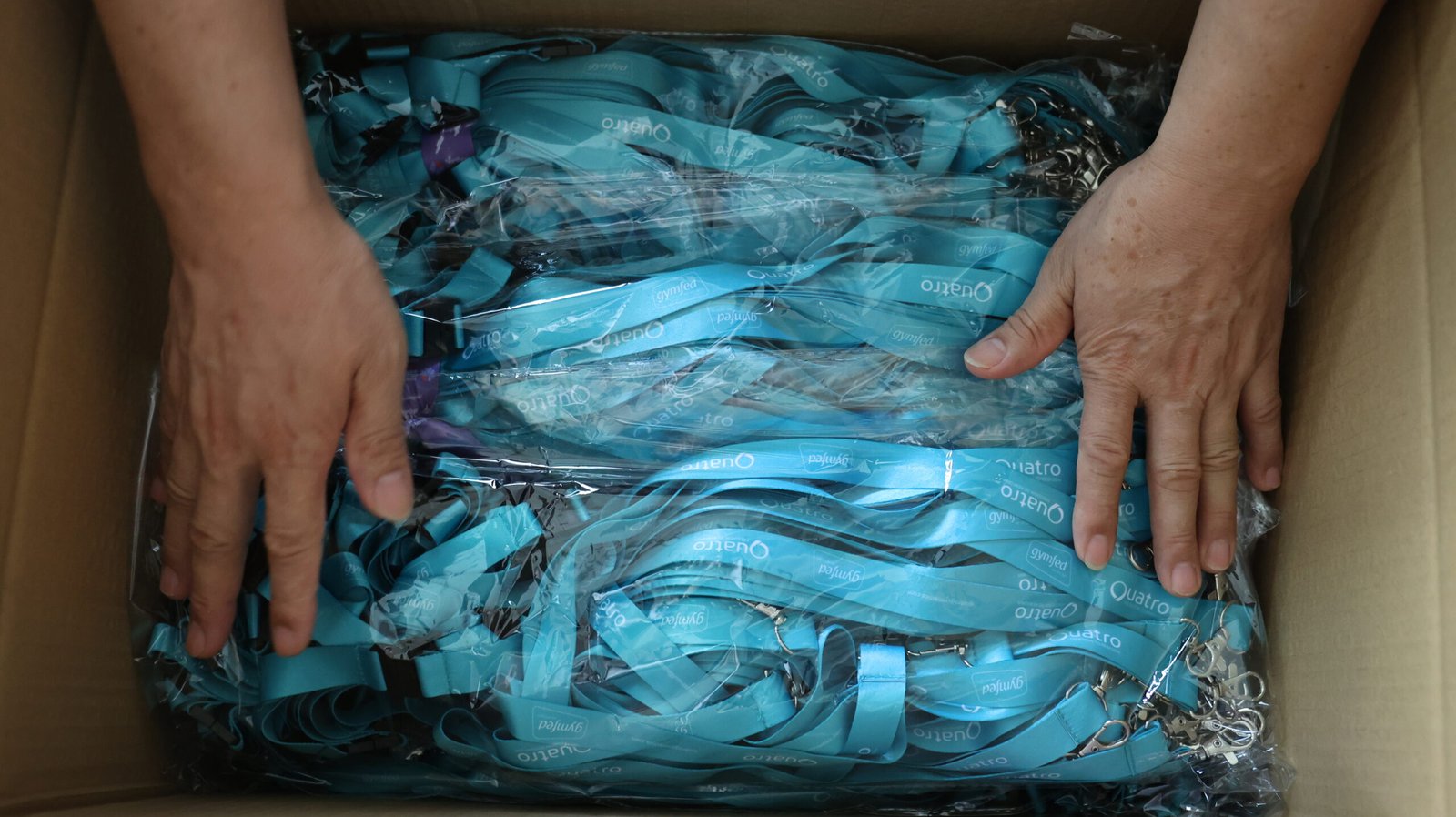
Shipping should be discussed before production—not after the cartons are ready.
The best shipping method depends on:
- destination country;
- total quantity;
- carton size;
- shipment weight;
- required arrival date;
- budget;
- import requirements.
Common options include:
Express Courier
Suitable for smaller or urgent orders where delivery speed is important.
Air Freight
Can be appropriate for medium-sized, time-sensitive shipments.
Sea Freight
Often more economical for large-volume orders when sufficient delivery time is available.
DDP Shipping
DDP solutions may be available for many destinations depending on the country, shipment size and order details.
This can simplify the purchasing process for buyers who prefer a more complete shipping arrangement.
But shipping should not be selected purely according to the cheapest freight quotation.
The better question is:
What is the most practical shipping method for my quantity, destination and required delivery date?
Packing should also be confirmed.
Possible options include:
- bulk packing;
- individual polybags;
- sets packed together;
- barcode labels;
- custom labels;
- retail packaging;
- custom cartons.
If badge holders, reels or other accessories are included, decide whether you want the components packed separately or assembled before shipment.
That small decision can significantly affect how much work your team needs to do after delivery.
10. How Do You Handle Quality Issues After Delivery?
Even with proper sampling and QC, buyers should understand how a supplier handles problems if something goes wrong.
Ask this question before placing the order—not after discovering an issue.
A clear after-sales process should establish:
- how the problem is reported;
- what photos, videos or quantity records are required;
- how the supplier determines the cause;
- how affected quantities are confirmed;
- what corrective solution is available.
Potential solutions will depend on the actual situation and may include replacement, remake or another agreed corrective action.
The important point is that the supplier has a defined process for investigating the problem.
For long-term buyers, after-sales response can be just as important as the first quotation.
A supplier that performs well only when winning an order is very different from one that helps resolve problems throughout the relationship.
If you regularly purchase lanyards, it is also worth reading our guide on building a long-term lanyard supply partnership.
Other Factors That Affect Bulk Lanyard Cost and Lead Time
Buyers often focus on quantity and printing method, but dimensions can also influence the final project.
Here are three questions worth understanding before requesting quotations.
Does Lanyard Width Affect the Bulk Price Per Unit?
Yes, lanyard width can affect unit price.
A wider strap generally requires more webbing material than a narrow strap. Depending on the production method, it may also change:
- printing area;
- artwork layout;
- attachment compatibility;
- finished product weight.
However, width is only one pricing factor.
Quantity, logo process, hardware, badge holders, packaging and customization can have a larger effect on the final price.
Common lanyard widths include:
10 mm, 15 mm, 20 mm and 25 mm
but the right width should be selected according to the logo, application and accessory—not simply according to the cheapest unit price.
For more detail, see our lanyard width guide.
Does Lanyard Length Affect Shipping Costs for Bulk Orders?
Yes, but usually the effect depends on the order size.
A longer lanyard requires slightly more material and can increase the overall shipment weight.
For very large bulk orders, small weight differences multiplied across thousands of pieces may influence freight cost.
However, other factors can have a greater impact, including:
- metal attachments;
- badge reels;
- PVC badge holders;
- individual packaging;
- retail boxes;
- carton volume.
This is why freight should ideally be calculated using the complete finished product specification, not just the strap size.
Does the Size of a Lanyard Affect How Quickly It Can Be Produced?
For standard constructions, changing from one common width or length to another usually has only a limited effect on production time.
Factors more likely to extend production lead time include:
- non-standard materials;
- unusual webbing construction;
- complicated artwork;
- special weaving;
- custom-dyed material;
- custom hardware;
- multiple accessories;
- physical sampling;
- special packaging;
- large order quantities.
In other words:
A slightly wider lanyard does not automatically mean a significantly longer production time.
Product complexity is usually more important than dimensions alone.
What Information Should I Send a Lanyard Supplier for an Accurate Quote?
One of the easiest ways to speed up a custom project is to send enough information in your first inquiry.
You do not necessarily need to know every technical specification.
But the more information you provide, the more accurate the quotation can be.
Use this checklist:
| Information | Example |
|---|---|
| Quantity | 500 / 1,000 / 5,000 pcs |
| Artwork | AI, PDF, EPS or high-resolution file |
| Width | 10 / 15 / 20 / 25 mm |
| Length | Standard or custom |
| Material | Polyester / rPET / woven / need recommendation |
| Logo Method | Screen print / full color / woven / need recommendation |
| Attachment | Hook / clip / ring / buckle |
| Safety Breakaway | Yes / No |
| Badge Holder | Yes / No |
| Badge Reel | Yes / No |
| Packaging | Bulk / individual / custom |
| Destination | Country and ZIP/postcode if available |
| Required Arrival Date | Your event or project deadline |
If you are unsure about the material, printing method or attachment, that is completely normal.
You can simply provide:
artwork + quantity + application + destination + required delivery date
and ask the factory to recommend the remaining specifications.
That is much more efficient than trying to choose every component without understanding the production differences.
Red Flags When Comparing Lanyard Suppliers
Price alone is not enough to determine whether a supplier is reliable.
Be cautious if a supplier:
- cannot clearly explain the proposed material;
- recommends a printing method without reviewing your artwork;
- changes specifications after quoting;
- cannot explain what is included in the unit price;
- promises unrealistic production schedules;
- does not confirm dimensions or accessories;
- cannot explain its QC procedure;
- provides unclear answers about shipping;
- avoids discussing how quality complaints are handled;
- pressures you into mass production before specifications are confirmed.
A professional supplier does not need to make the buying process complicated.
In fact, the opposite is usually true.
The supplier should make complicated customization easier for the buyer to understand.
Should You Choose a Factory or Trading Company for Bulk Lanyards?
Both can work depending on your sourcing model.
What matters is transparency and capability.
If you are working directly with a manufacturer, advantages may include more direct communication regarding:
- material;
- printing;
- production feasibility;
- custom hardware;
- sampling;
- QC;
- production scheduling.
For highly customized or repeat bulk orders, direct access to manufacturing information can be particularly useful.
However, regardless of whether you work with a factory or trading company, compare suppliers according to the same standard:
Can they clearly define the product, reproduce it consistently and deliver it according to the agreed specification?
That matters more than labels alone.
Frequently Asked Questions About Choosing a Lanyard Supplier
What should I ask a lanyard supplier before ordering?
At minimum, confirm the material, printing method, width, length, MOQ, pricing structure, sampling process, production lead time, QC, accessories, packing, shipping and after-sales process.
For custom orders, make sure the quotation is based on a complete specification.
How do I compare quotations from different lanyard manufacturers?
Make sure every supplier is quoting the same product.
Compare:
material + dimensions + logo method + accessories + packaging + quantity + shipping terms
rather than comparing unit price alone.
A cheaper quotation may be based on a different material, hardware or packing method.
Should I get a lanyard sample before placing a bulk order?
For large orders, important brand projects, complicated artwork or customized accessories, a physical sample can reduce risk.
For simpler projects, artwork approval and clear specification confirmation may sometimes be sufficient.
Discuss the appropriate approval method with your supplier before production.
What is a normal MOQ for custom lanyards?
MOQ varies by manufacturer and product construction.
Standard printed lanyards often support lower quantities than products requiring custom weaving, special hardware or other non-standard production.
Always ask for the MOQ of your exact specification, not just a general MOQ.
What affects the price of custom lanyards the most?
The main factors usually include:
- order quantity;
- material;
- width;
- printing method;
- accessories;
- custom construction;
- packaging;
- shipping.
The lowest-cost design is normally one that uses a relatively standard material and construction while still meeting the application requirement.
How far in advance should I order lanyards for an event?
Work backwards from the event date.
Allow time for:
artwork → sample if required → approval → production → QC → shipping → delivery buffer
Do not schedule the project based only on production time.
International transportation and customs-related delays should also be considered.
Can one supplier provide the lanyard, badge holder and badge reel together?
Yes, some manufacturers can supply complete ID accessory sets.
This can simplify color matching, assembly, packing and purchasing.
It is especially useful for:
- hospitals;
- schools;
- corporate ID programs;
- exhibitions;
- conferences;
- events.
If several products will be used together, ask the supplier to check component compatibility before mass production.
Final Checklist Before Placing Your Bulk Lanyard Order
Before you approve production, confirm these points one final time:
✓ Quantity
✓ Material
✓ Width and length
✓ Artwork and logo size
✓ Printing or weaving method
✓ Colors
✓ Attachment
✓ Breakaway or detachable buckle
✓ Badge holder or badge reel
✓ Packing method
✓ Approved artwork or sample
✓ Production lead time
✓ Shipping method
✓ Required arrival date
✓ Final quotation
This simple check can prevent many of the most common purchasing problems.
Looking for a Reliable Custom Lanyard Manufacturer?
Choosing the right lanyard supplier should make your project easier—not create more uncertainty.
At LOVECOLOUR, we support custom lanyard projects from artwork review and product recommendations through sampling, bulk production, quality inspection, packing and worldwide shipping.
Whether you are sourcing lanyards for a brand, promotional campaign, school, hospital, company, exhibition or large event, the best starting point is to send us:
your artwork + quantity + application + destination + required delivery date.
Our team can then recommend a suitable material, printing method, width, accessories and production solution for your project.
Ready to start your custom lanyard project?
View Our Custom Lanyards or contact our team for a factory-direct quotation.