A more important question is:
Does the artwork need to become part of the entire product, or do you only need a logo in a specific area?
For a simple corporate logo, screen printing or heat transfer may be sufficient.
For a retail product with floral artwork, illustrations, gradients, repeating graphics or an original pattern covering the sleeve, full-color dye sublimation is usually the better choice.
There is also another important distinction that many printing guides overlook:
not all all-over artwork is constructed in the same way.
For custom neoprene sleeves, we normally separate full-surface artwork into two practical categories:
- Repeating or seamless pattern artwork
- Positioned or engineered artwork
Understanding this difference is important because it directly affects artwork preparation, seam matching, production tolerance and physical sample approval.
Reviewed by the LOVECOLOUR Product Team
This guide is based on our experience reviewing artwork, sublimation printing, cutting and sewing custom neoprene drink sleeves for OEM and private-label projects.
Quick Answer: Which Neoprene Printing Method Should You Choose?
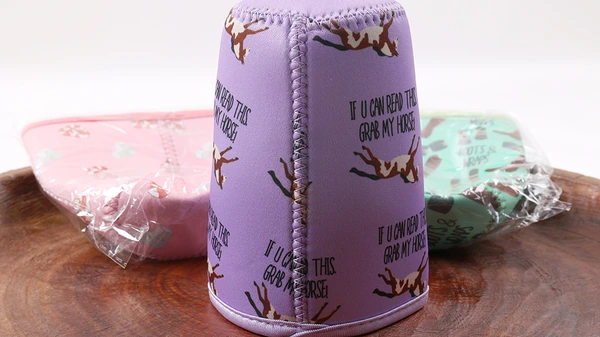
Choose all-over dye sublimation when:
- The artwork covers most or all of the sleeve
- You have repeating or seamless patterns
- You need gradients or many colors
- You are developing a retail product
- The artwork itself is an important part of the product design
- You have photographic or illustrated graphics
Choose screen printing when:
- The artwork is a simple logo
- The design uses a limited number of solid colors
- The printed area is relatively small
- The sleeve is mainly being used as a promotional giveaway
Choose heat transfer when:
- You need a detailed localized logo or graphic
- The design contains multiple colors but does not need to cover the full sleeve
- The artwork is better suited to a transferred graphic than traditional screen printing
The correct printing process should follow the artwork, product positioning and end use—not simply whichever option appears cheapest at first.
What Is All-Over Sublimation Printing?
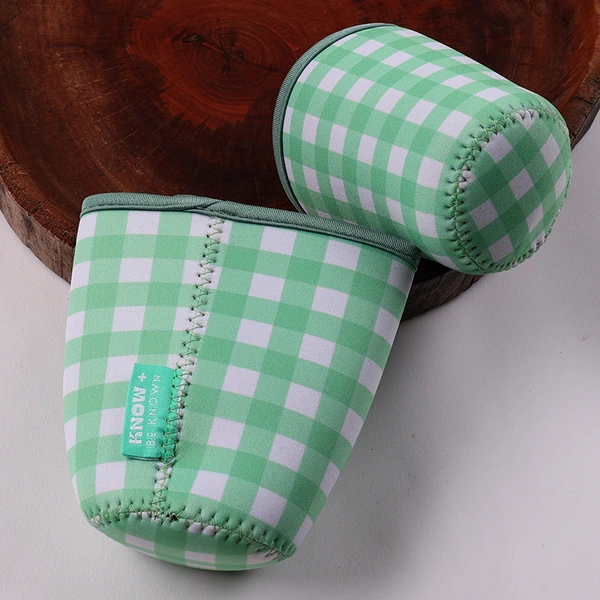
Dye sublimation uses heat and pressure to transfer artwork into the polyester surface laminated to the neoprene.
Instead of leaving a thick layer of ink sitting on top of the fabric, the color becomes part of the polyester surface.
This makes sublimation especially suitable for:
- Full-color artwork
- Seamless patterns
- Gradients
- Illustrations
- Photography
- Complex graphics
- Multi-color brand designs
- Seasonal retail collections
For custom coffee sleeves, pint glass sleeves and other drinkware accessories, sublimation can turn the entire sleeve into a branded visual product rather than simply placing a logo on the front.
For full-wrap product specifications, artwork requirements and OEM options, see our
Custom All-Over Sublimation Neoprene Drink Sleeves.
What Do We Mean by Logo Printing?
“Logo printing” normally refers to artwork placed in a specific localized area instead of covering most or all of the neoprene surface.
Screen Printing
Screen printing is well suited to relatively simple logos, text and solid-color graphics.
It is commonly used for promotional products where the main goal is clear brand visibility rather than a full decorative surface.
Heat Transfer
Heat transfer is useful for detailed localized graphics and multi-color logos when full-surface sublimation is unnecessary.
Localized Sublimation
Sublimation can also be used for artwork that does not cover the entire product.
The right method depends on the sleeve construction, artwork and desired finished appearance.
All-Over Sublimation vs Logo Printing: Quick Comparison
| Feature | All-Over Sublimation | Logo / Localized Printing |
|---|---|---|
| Print Coverage | Full or large-area coverage | Localized area |
| Full Color | Excellent | Depends on printing method |
| Gradients | Excellent | Depends on method |
| Photography | Suitable | Usually not ideal for screen printing |
| Repeating Patterns | Excellent | Not normally the primary application |
| Retail Collections | Excellent | Better for simpler branding |
| Simple Corporate Logo | Possible, but often unnecessary | Excellent |
| Seam Consideration | Important | Usually less important |
| Best Use | Retail, lifestyle and private-label products | Promotional, event and corporate branding |
Two Types of All-Over Artwork You Should Understand
This is one of the most important production distinctions when designing a full-wrap neoprene sleeve.
1. Repeating or Seamless Pattern Artwork
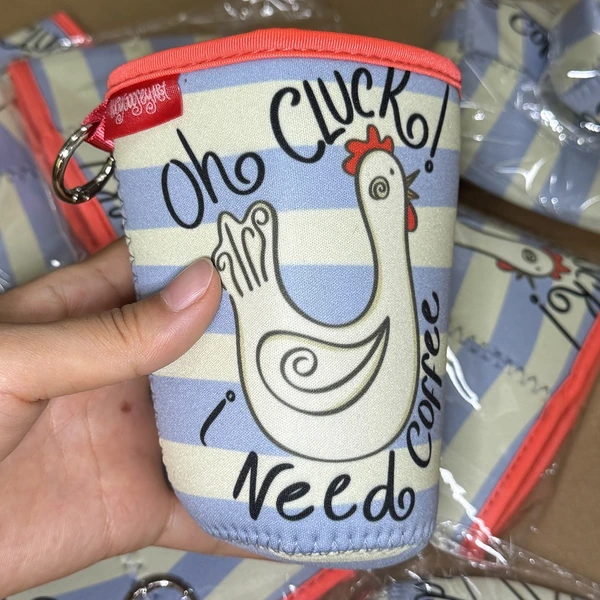
A repeating pattern is designed so that the visual elements repeat continuously throughout the artwork.
Examples include:
- Small floral patterns
- Repeating logos
- Abstract motifs
- Geometric repeats
- Small illustrations
- Texture patterns
- Non-directional graphics
For this type of design, the finished product normally does not depend on one specific flower, line or object matching another specific motif exactly at the sewing seam.
Because the pattern repeats throughout the artwork, a small change in the precise seam position normally does not affect the overall visual result.
This makes repeating patterns particularly suitable for large-volume all-over printed neoprene products.
Practical Production Advantage
The product will still have a sewn connection where required by the construction, but there is usually no need for one exact motif on one side to connect to one exact motif on the other side.
The overall appearance remains visually consistent even when normal cutting and sewing tolerances exist.
2. Positioned or Engineered Artwork
Positioned artwork is different.
The design contains specific elements that must appear in defined locations on the finished sleeve.
Examples include:
- A large illustration spanning several areas
- A logo that must remain centered
- A specific front and back design
- A character or image continuing toward the seam
- Directional geometric artwork
- Text positioned relative to a particular panel
- A design intentionally continuing from one printed panel to another
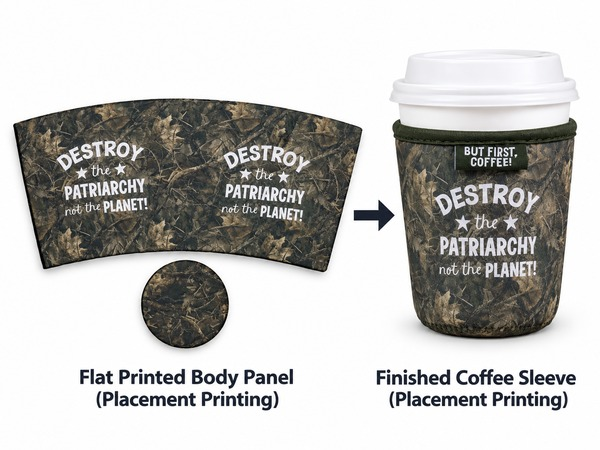
For this type of artwork, we prepare the individual panel files according to the intended position on the finished product.
The panels can be designed so that the graphics visually match at the sewing connection.
However, neoprene is a flexible textile material rather than a rigid printed sheet, so a normal production tolerance must be allowed.
How Full-Wrap Neoprene Sleeves Are Actually Printed
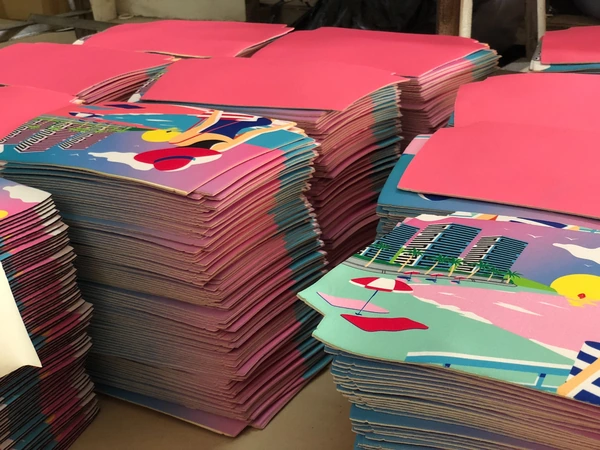
The neoprene sleeve is not normally sewn first and then printed as one finished three-dimensional object.
Instead, each polyester-faced neoprene panel is printed individually before the product is assembled.
The general production sequence is:
- Confirm the sleeve dimensions
- Prepare the production dieline
- Position the artwork on each panel
- Apply high-temperature sublimation
- Allow the material to cool
- Cut the printed panels
- Position the panels
- Sew the final product
Printing panel by panel gives better control over artwork position, pattern scale, seam location, bleed and safe areas.
Why Positioned Artwork Has a Normal Alignment Tolerance
During high-temperature sublimation, the neoprene and polyester-faced construction is exposed to heat and pressure.
After transfer, the material cools.
Because neoprene has natural elasticity, a small amount of shrinkage or dimensional movement can occur.
Additional variation can come from:
- Material elasticity
- Heat-transfer temperature
- Cooling shrinkage
- Cutting tolerance
- Panel positioning
- Sewing tension
- Manual sewing tolerance
For this reason, positioned artwork can be matched carefully at the seam, but 100% absolute millimeter-level alignment on every production piece should not be expected.
A small amount of movement at the sewing line is a normal characteristic of this type of flexible cut-and-sewn product.
Repeating Pattern vs Positioned Artwork
| Artwork Type | Seam Requirement | Production Sensitivity |
|---|---|---|
| Repeating floral pattern | No specific motif normally needs exact alignment | Low |
| Abstract repeating graphic | Usually visually forgiving | Low |
| Small repeating brand icons | Normally tolerant of seam movement | Low–Medium |
| Large positioned illustration | Artwork position needs control | Medium–High |
| Front/back engineered design | Panel location is important | High |
| Thin line crossing seam | Precise alignment is visually sensitive | High |
| Text crossing seam | Not recommended | Very High |
| Exact border around product | Not recommended when zero movement is expected | Very High |
Which Artwork Is Best for Full-Wrap Sublimation?
The most production-friendly designs include:
- Repeating flowers
- Organic illustrations
- Abstract patterns
- Small repeating motifs
- Textures
- Non-directional artwork
- Seamless brand patterns
- Lifestyle graphics
These designs usually tolerate normal material and sewing variation very well.
Which Artwork Needs More Care?
More attention is required when the design contains:
- Thin straight lines crossing the seam
- Exact geometric borders
- Text crossing the seam
- Large logos split across panels
- Highly symmetrical graphics
- A specific illustration that must continue exactly across the sewing line
These designs are not necessarily impossible.
However, the seam location, panel layout and normal production tolerance should be considered during artwork preparation.
For seam-sensitive projects, a physical sample is strongly recommended before bulk production.
Full-Wrap Printing Does Not Mean “No Seam”
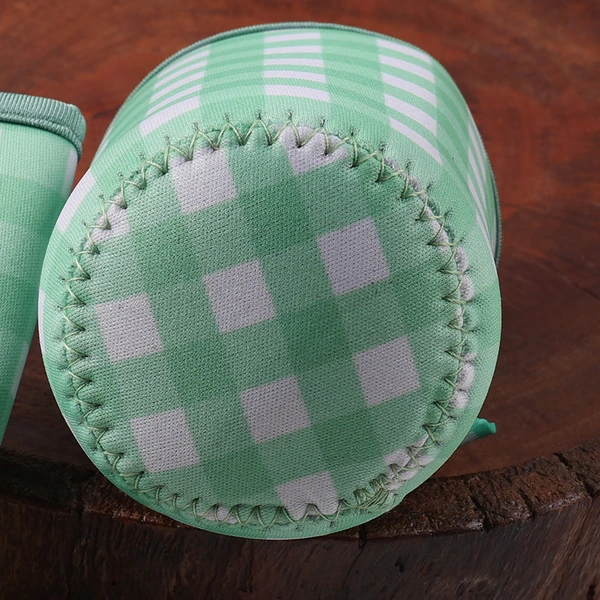
“All-over,” “full-wrap” and “edge-to-edge” describe the print coverage.
They do not mean that a cut-and-sewn neoprene product becomes physically seamless.
If the construction requires sewn panels, the finished product will still have a sewing connection.
The objective is therefore:
Good artwork planning + practical seam placement + controlled production
rather than promising an invisible seam that cannot realistically be guaranteed on every flexible textile product.
Why Tapered Drink Sleeves Need a Proper Dieline
A neoprene drink sleeve is not always rectangular.
Many iced coffee cups and pint glasses are tapered.
The top diameter may be larger than the bottom diameter.
That means a simple rectangular artwork file may distort after it is sewn around the actual cup.
A production dieline may need to consider:
- Top width
- Bottom width
- Sleeve height
- Cup taper
- Seam allowance
- Bleed
- Safe area
- Bottom construction
- Top binding
- Label position
For detailed measuring instructions, see our
Neoprene Drink Sleeve Size & Measurement Guide.
Why Artwork Should Come After Size Confirmation
A common mistake is finalizing a beautiful print file before the product dimensions have been confirmed.
For custom neoprene sleeves, the better workflow is:
Cup dimensions → sleeve construction → dieline → artwork
rather than:
Artwork → guess the sleeve dimensions
This is especially important for:
- Tapered iced coffee sleeves
- Closed-bottom sleeves
- Pint glass sleeves
- Brand-specific drinkware
For sewn-bottom retail-style products, see our
Custom Closed-Bottom Neoprene Iced Coffee Sleeves.
What Is the Best Printing Method for a Retail Brand?
For a retail product, the printed artwork is often part of the product itself.
A lifestyle or beverage brand may develop:
- Floral collections
- Coastal collections
- Holiday editions
- Sports collections
- City souvenir series
- Seasonal colorways
- Original artist collaborations
In these cases, all-over sublimation usually provides much greater creative flexibility than placing the same small logo on every sleeve.
Retail projects can also combine all-over printing with:
- Custom woven labels
- Top binding
- Backer cards
- Hang tags
- Barcode labels
- Individual retail packaging
This can turn a basic promotional sleeve into a more complete private-label merchandise product.
What Is Better for Promotional Giveaways?
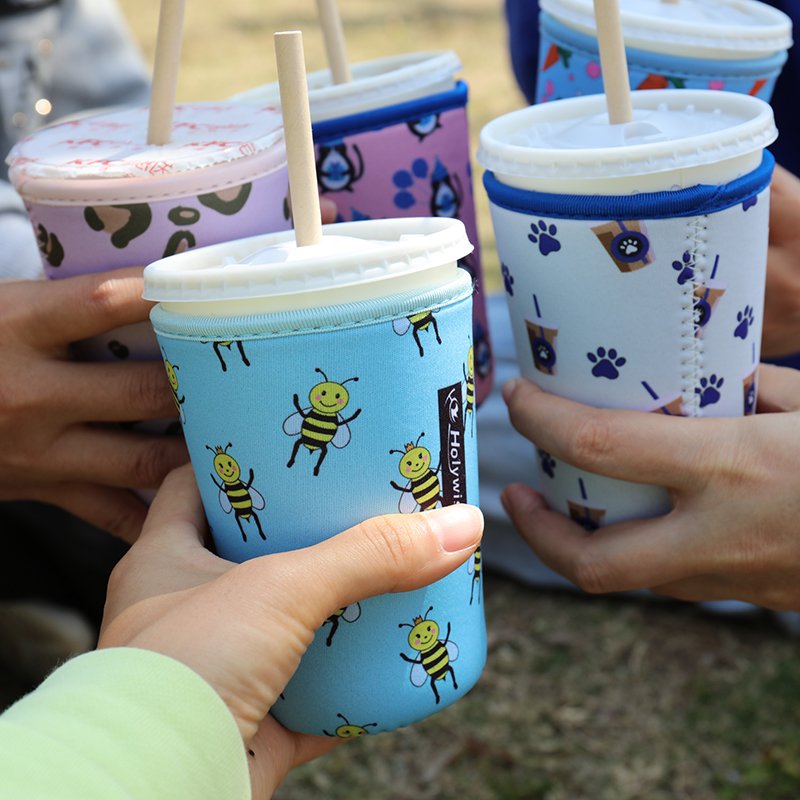
Not every project requires full sublimation.
A simple screen-printed or heat-transfer logo may be more practical when the primary goal is:
- Conference giveaways
- Corporate events
- Café promotions
- Sponsorship campaigns
- Employee gifts
- General promotional distribution
If a buyer only needs one clear logo on a simple sleeve, creating a complex full-wrap design may add unnecessary development work.
Screen Printing vs Heat Transfer vs Sublimation
Screen Printing
Best for:
- Simple logos
- Solid colors
- Text
- Promotional projects
Advantages:
- Straightforward
- Clean appearance
- Suitable for bold branding
Limitations:
- Not ideal for photographic artwork
- Less suitable for complex gradients
- Not normally the first choice for full-surface retail patterns
Heat Transfer
Best for:
- Detailed localized logos
- Multi-color graphics
- Selected promotional designs
Advantages:
- Good detail
- Flexible logo placement
- Useful for designs too complex for basic screen printing
Dye Sublimation
Best for:
- Full-color artwork
- Large-area printing
- Repeating patterns
- Retail collections
- Gradients
- Photography
- Full-wrap graphics
Advantages:
- Excellent design freedom
- Suitable for detailed artwork
- Strong option for polyester-faced neoprene
Digital Mockup vs Physical Sample
A digital mockup is useful, but it serves a different purpose from a physical sample.
Digital Mockup
Useful for checking:
- General artwork placement
- Pattern scale
- Logo position
- Color direction
- Binding combination
- Label location
A digital mockup is primarily a visual planning tool.
Physical Sample
Useful for checking:
- Actual neoprene material
- Real printed color
- Finished dimensions
- Cup fit
- Neoprene thickness
- Artwork appearance after sublimation
- Seam position
- Pattern matching
- Binding
- Stitching
- Woven-label placement
For positioned artwork or seam-sensitive graphics, the physical sample should be the final approval reference before mass production.
You can learn more about our general customization workflow on our
Customization & Production Process
page.
Does Sublimation Change the Color of the Artwork?
Sublimation can reproduce a wide range of colors, gradients and detailed graphics.
However, screen appearance and physical textile printing are not identical systems.
Final appearance can be affected by:
- Artwork color mode
- Monitor calibration
- Polyester surface
- Heat-transfer conditions
- Original artwork quality
For brand-critical projects, physical sample approval is recommended.
Pantone references can also help communicate important brand-color targets, although textile sublimation should not automatically be treated as identical to printing Pantone ink on paper.
Does Neoprene Thickness Affect Printing?
Printing method and material thickness are related but separate product decisions.
Common neoprene thicknesses may include approximately:
- 2 mm
- 3 mm
- 4 mm
The appropriate thickness depends on:
- Cup size
- Insulation requirement
- Desired flexibility
- Product structure
- Retail positioning
- Budget
For broader guidance on materials, thickness and construction, see our
Neoprene Coffee Cup Sleeves: Size, Material & Printing Guide.
Can Several Artwork Designs Be Produced in One Order?
Yes. Multiple artwork designs can be reviewed within one production project.
For an accurate quotation, provide:
- Total quantity
- Quantity per design
- Number of designs
- Sleeve dimensions
- Whether all designs use the same size
- Whether all designs use the same construction
- Whether the woven label is identical
- Whether the binding is identical
- Packaging requirements
For example, five repeating patterns using the same sleeve dimensions, binding and woven label are generally easier to manage than five completely different product constructions.
For B2B quotations, quantity per artwork design is particularly important.
What Affects the Cost of Custom Printed Neoprene Sleeves?
Pricing can depend on:
- Finished dimensions
- Neoprene thickness
- Printing method
- Total quantity
- Quantity per design
- Number of designs
- Product construction
- Closed or open bottom
- Binding
- Woven labels
- Additional accessories
- Retail packaging
This is why comparing only the printing method is not enough to determine the final unit price.
What Buyers Should Send Before Requesting a Quote
For a faster and more accurate quotation, send:
- Artwork or reference design
- Target cup, glass, can or bottle
- Top and bottom diameter if applicable
- Desired sleeve height
- Quantity per design
- Number of designs
- Preferred printing method, if known
- Whether the artwork is repeating or positioned
- Whether seam matching is important
- Woven-label requirements
- Binding requirements
- Packaging requirements
- Delivery country and ZIP/postal code
If you are unsure whether your design is a repeating pattern or positioned artwork, send the original file and explain how you want the finished sleeve to look.
7 Common Artwork Mistakes to Avoid
1. Choosing Printing Only by Price
The lowest-cost printing method is not automatically the best option for a retail product.
2. Finalizing Artwork Before the Dieline
The final print file should follow the confirmed sleeve dimensions and construction.
3. Treating All Full-Wrap Artwork the Same
Repeating patterns and positioned artwork have different seam requirements.
4. Placing Critical Text on the Sewing Line
Normal seam movement may make small text or thin graphics look uneven.
5. Expecting Flexible Neoprene to Behave Like Printed Paper
Neoprene stretches and can move slightly during heating, cooling, cutting and sewing.
6. Treating a Digital Mockup as Final Production Approval
A mockup cannot reproduce every physical characteristic of the actual material.
7. Skipping the Physical Sample for Seam-Sensitive Artwork
A physical sample is the best way to confirm fit, print, pattern position and seam appearance before bulk production.
Choosing Between Repeating Pattern and Positioned Artwork
Choose a Repeating Pattern When:
- You want an all-over visual effect
- Exact motif-to-motif seam matching is not part of the design concept
- You want greater production tolerance
- You are developing multiple retail patterns
- You want the same base construction across several designs
Choose Positioned Artwork When:
- Specific graphics must appear on the front or back
- The artwork has a defined orientation
- A central logo or illustration must remain in a fixed position
- Different panels form part of one intentional composition
Neither artwork type is automatically better.
The correct option depends on the visual concept and production requirements of the finished product.
All-Over Sublimation for Iced Coffee Sleeves
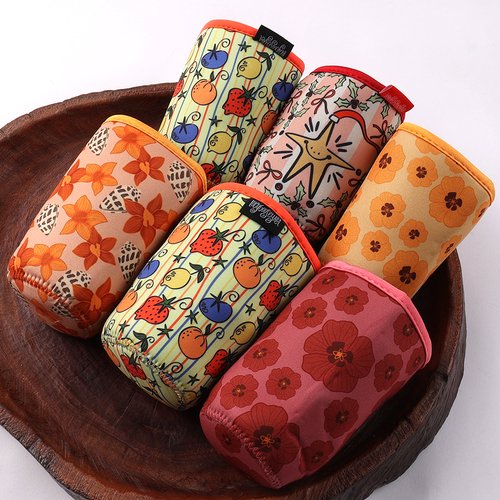
Full-color sublimation is particularly suitable for private-label iced coffee sleeves because the product has a relatively large visible surface.
Common retail designs include:
- Floral collections
- Seasonal patterns
- Travel graphics
- University themes
- Sports artwork
- Fashion prints
- Lifestyle graphics
For products requiring a sewn base and finished top binding, see our
Custom Closed-Bottom Neoprene Iced Coffee Sleeves.
All-Over Sublimation for Pint Glass and Brewery Sleeves
Breweries and beverage brands can use sublimation to develop merchandise that goes beyond a standard front-logo koozie.
Examples include:
- Seasonal beer graphics
- Brewery illustration collections
- Limited-edition merchandise
- Beer festival products
- Taproom retail products
- Tourism and souvenir merchandise
For glass-specific sizing and construction, see our
Custom Neoprene Pint Glass Sleeves.
OEM Neoprene Printing Manufacturer in Guangzhou, China
LOVECOLOUR supports custom neoprene drink sleeve production from Guangzhou, China for brands, retailers, promotional product companies, breweries and international bulk buyers.
For all-over sublimation projects, our workflow can include:
- Product sizing review
- Dieline preparation
- Artwork review
- Repeating or positioned artwork assessment
- Digital mockup
- Physical sampling
- Sublimation printing
- Cutting and sewing
- Quality inspection
- Private-label branding
- Retail packaging
- Export packing
For buyers looking for a China neoprene sleeve manufacturer, Guangzhou sublimation drink sleeve supplier or OEM partner for private-label drink accessories, sending the actual artwork before production is usually the most efficient starting point.
Supplying U.S., European and International Buyers
We support custom neoprene projects for brands and buyers serving markets including the United States, Canada, Europe, the United Kingdom, Australia and the Middle East.
For overseas projects, freight should normally be calculated after the final product configuration is confirmed because shipping cost depends on:
- Quantity
- Product dimensions
- Packaging
- Carton size
- Gross weight
- Destination
This is more reliable than estimating international freight before the product specification has been finalized.
Need Other Neoprene Drink Sleeve Options?
Explore our
Custom Neoprene Cup Sleeves & Stubby Holders
for coffee cups, cans, bottles and other beverage applications.
If your project includes multiple branded products beyond neoprene drink sleeves, our sister company
LOVECOLOUR Promotional Products
also supports broader promotional merchandise and multi-product sourcing projects.
Frequently Asked Questions
Is all-over sublimation better than screen printing?
It depends on the artwork. Sublimation is generally better for full-color, large-area, repeating and highly detailed artwork. Screen printing is often more practical for simple localized logos.
What is a repeating pattern on a neoprene sleeve?
A repeating pattern contains visual elements that repeat continuously across the artwork. Because the design does not normally depend on one specific motif meeting another exact motif at the seam, small seam-position changes are usually much less noticeable.
What is positioned artwork?
Positioned or engineered artwork contains specific graphics that must appear in defined areas of the finished sleeve, such as a centered logo, directional illustration or front-and-back composition.
Can positioned artwork be matched at the sewing seam?
Yes. The artwork can be prepared so the printed panels visually align at the sewn connection as closely as practical.
However, normal production tolerance should be expected because neoprene is elastic and can move slightly during sublimation, cooling, cutting and sewing.
Does a repeating pattern need exact seam matching?
Normally it does not require the same type of exact registration as positioned artwork. Because the motif repeats throughout the design, the seam usually does not depend on one specific graphic element being aligned at one exact point.
Can you guarantee 100% perfect seam alignment?
No. Flexible neoprene can experience small dimensional changes during high-temperature transfer and cooling, and normal cutting and sewing tolerances also apply.
Is slight movement at the seam a printing defect?
Minor variation within the approved production tolerance is a normal characteristic of cut-and-sewn sublimated neoprene products.
Can I send my artwork before ordering a sample?
Yes. We recommend sending the original artwork first so the design, dieline, seam position and printing method can be reviewed before sampling.
Can you make a digital mockup?
Yes. A digital mockup can show the intended artwork layout, but a physical sample should be used to confirm actual print appearance, fit and seam alignment.
Can you print photographs and gradients?
Yes. Dye sublimation is particularly suitable for detailed full-color artwork when the original image resolution is sufficient.
Multiple designs can be reviewed within one project. Please provide the quantity required for each design rather than only the total quantity.
Can I add a woven brand label?
Yes. A custom woven label can be incorporated into suitable sleeve constructions and confirmed during the sample stage.
Can you produce custom sleeve sizes?
Yes. Custom dimensions can be developed from cup measurements, technical drawings or physical reference samples.
Can you ship custom neoprene sleeves to the USA?
Yes. Shipping options can be evaluated after the final quantity, packing specification and delivery destination are confirmed.
Which Printing Method Is Right for Your Neoprene Sleeve?
There is no single printing method that is best for every neoprene drink sleeve.
For a simple promotional logo, screen printing or heat transfer may be the most practical solution.
For a retail product built around original artwork, repeating patterns or detailed graphics, all-over dye sublimation provides much greater creative freedom.
The most important distinction is also not simply “full wrap or logo.”
For full-surface designs, determine whether your artwork is:
Repeating / seamless artwork
or
Positioned / engineered artwork
because these two design strategies behave differently at the sewing seam.
Send Us the Following for a Production Review
- Your artwork
- Target cup or glass dimensions
- Quantity per design
- Number of designs
- Whether the artwork is repeating or positioned
- Whether seam alignment is visually critical
- Required labels, binding and packaging
- Delivery country and postal code
We can review the artwork, recommend the appropriate printing method and prepare a physical sample before bulk production.
Related Products & Guides:
Custom All-Over Sublimation Neoprene Drink Sleeves
Custom Closed-Bottom Neoprene Iced Coffee Sleeves
Custom Neoprene Pint Glass Sleeves
Neoprene Drink Sleeve Size & Measurement Guide
Neoprene Coffee Cup Sleeves: Size, Material & Printing Guide
Custom Neoprene Cup Sleeves & Stubby Holders
Customization & Production Process
Send Your Artwork for a Printing & Production Review.