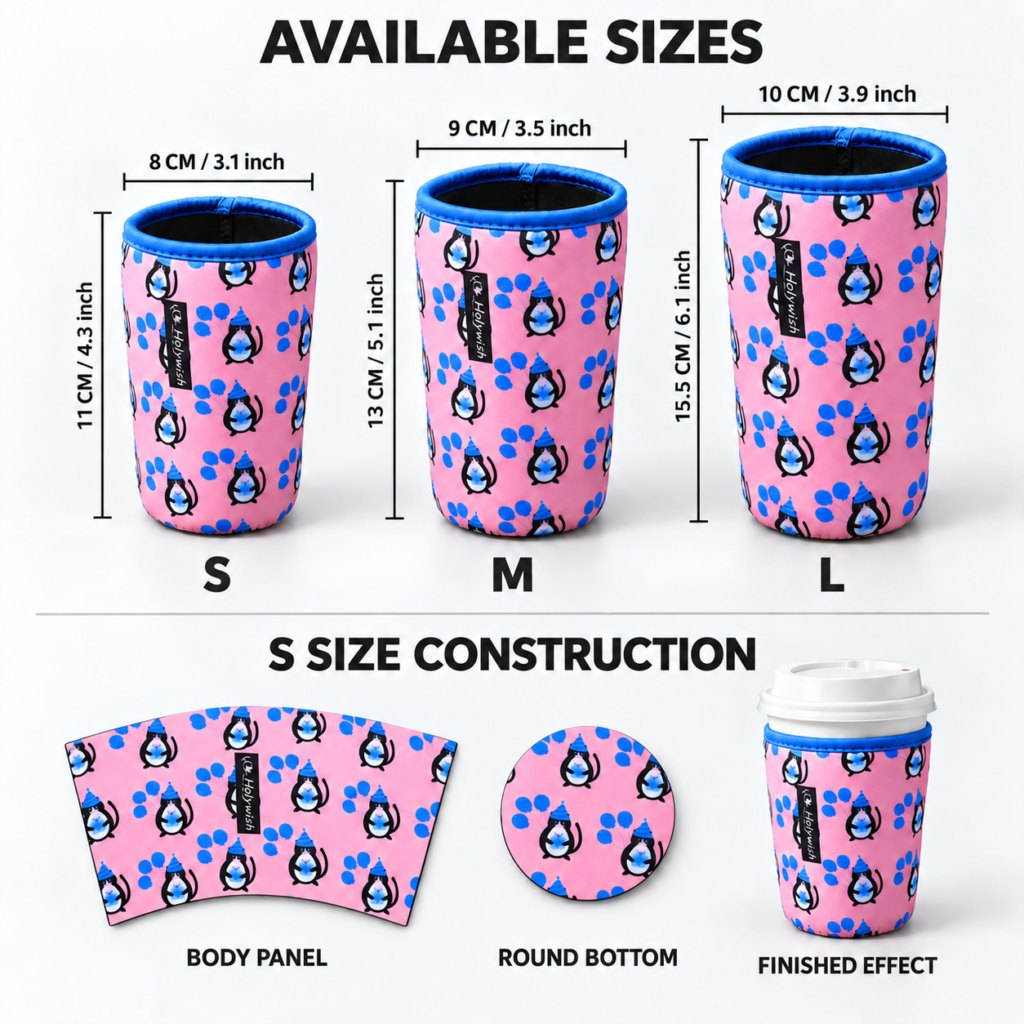
A 20 oz cup from one supplier can have a very different diameter, taper and height from another 20 oz cup.
For an accurate fit, especially for custom iced coffee sleeves, closed-bottom neoprene sleeves, pint glass sleeves and private-label drink accessories, the actual cup dimensions matter more than the number of ounces printed on the cup.
This guide explains how to select and measure neoprene sleeves for 16 oz, 18 oz, 20 oz, 22 oz, 24 oz, 30 oz and 32 oz drinkware, when standard sizing is appropriate, and when a custom pattern should be developed before bulk production.
Reviewed by the LOVECOLOUR Product Team
Last updated: October 2026
Quick Answer: What Size Neoprene Drink Sleeve Do I Need?
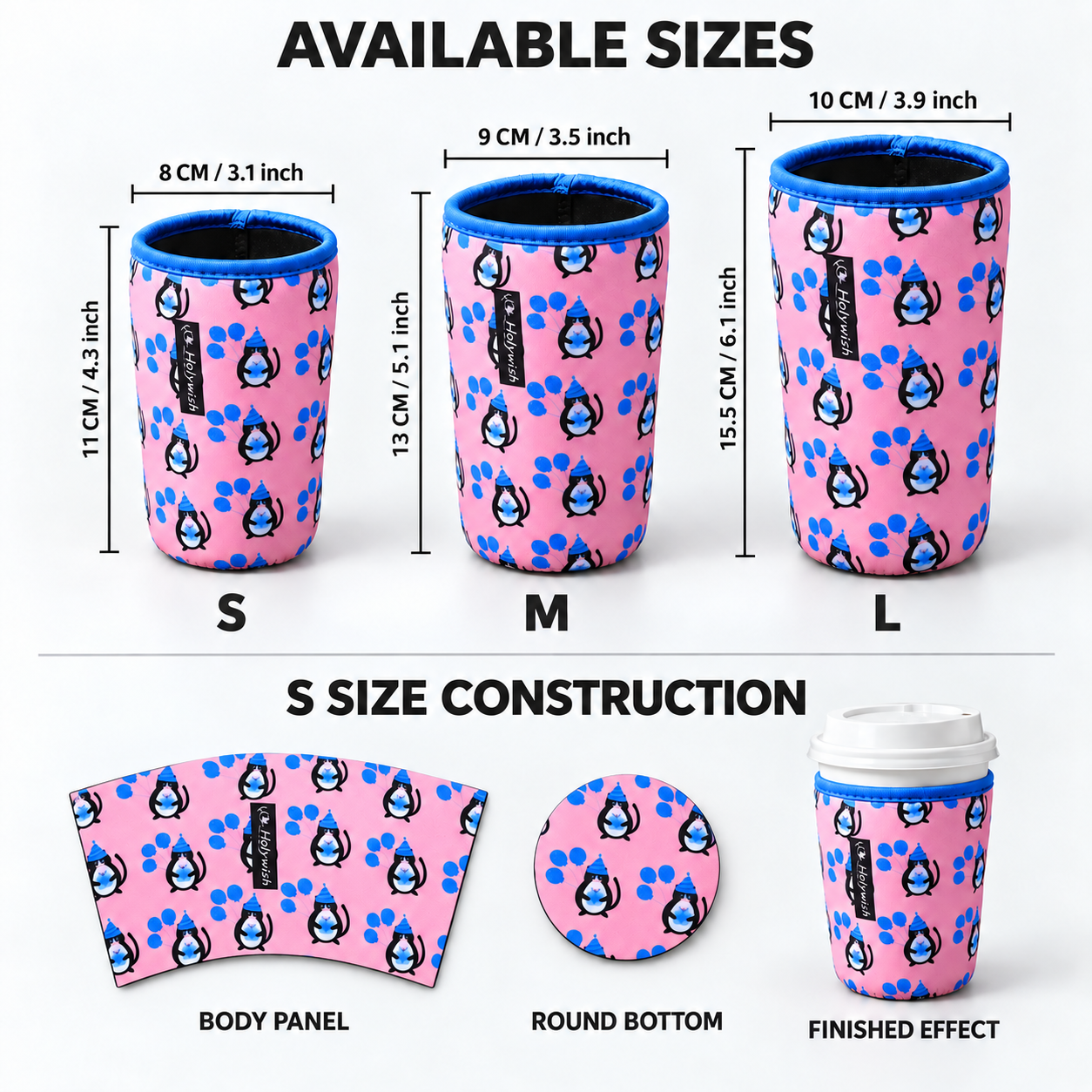
Cup capacity is useful as an initial reference, but it should not be treated as the final production specification.
The actual fit depends on the cup’s top diameter, bottom diameter, height and taper.
| Cup Capacity | Typical Application | General Sleeve Reference |
|---|---|---|
| 12–16 oz | Small iced coffee, cold drinks | Small |
| 16–18 oz | Standard iced coffee, cold brew | Small to medium |
| 20–24 oz | Large iced coffee, milk tea, cold beverages | Medium |
| 24–30 oz | Large takeaway cold drinks | Medium to large |
| 30–32 oz | Oversized iced drinks | Large / custom sizing recommended |
| Custom Drinkware | Brand-specific cups, tumblers and glasses | Custom pattern recommended |
Important: This table is a capacity reference only. Two cups with the same ounce capacity may require different sleeve patterns.
For production, always confirm the actual cup dimensions.
Why Cup Ounces Alone Do Not Determine Sleeve Size
“Ounces” describe how much liquid a cup holds. They do not define the physical shape of the container.
Two 20 oz cups may differ in:
- Top diameter
- Bottom diameter
- Overall height
- Wall taper
- Base shape
- Material thickness
For a simple flexible promotional sleeve, a small variation may still be acceptable.
For a retail-quality product, a closed-bottom sleeve or a sleeve intended to sit at a specific position on the cup, these differences become much more important.
This is why we normally treat cup capacity as the starting point and actual measurements as the production specification.
The Four Measurements Needed for Custom Neoprene Sleeve Sizing
For most custom drink sleeve projects, four measurements provide the basic information needed to evaluate fit.
1. Top Diameter
Measure the outside diameter across the upper part of the cup or glass.
This measurement is particularly important for tapered cups because it helps determine the width of the sleeve opening.
2. Bottom Diameter
Measure the outside diameter near the bottom of the cup.
The bottom diameter is especially important for tapered drinkware and closed-bottom neoprene coffee sleeves.
Ignoring this measurement can result in a sleeve that is too loose at the base or too tight to slide onto the cup correctly.
3. Total Cup Height
Measure from the base of the cup to the top edge.
You may not want the sleeve to cover the entire height, but this measurement helps us understand the overall proportions and taper of the container.
4. Desired Sleeve Height
Decide how much of the cup should be covered by neoprene.
A promotional sleeve may cover only the middle section, while a retail-style iced coffee sleeve may extend much farther down the cup.
How to Measure a Cup for a Custom Neoprene Sleeve
Use the following process before requesting a quote or preparing final artwork.
Step 1: Use the Actual Cup Whenever Possible
Do not rely only on the manufacturer’s nominal capacity if you already have the real cup.
Using the actual drinkware gives much more reliable sizing information.
Step 2: Measure the Top Diameter
Measure straight across the outside of the cup near the position where the top of the sleeve will sit.
Step 3: Measure the Bottom Diameter
Measure straight across the lower section of the cup.
For a closed-bottom sleeve, measure the actual base carefully because this dimension affects the bottom construction.
Step 4: Measure the Total Height
Measure vertically from the bottom to the top edge of the cup.
Step 5: Decide the Sleeve Height
Mark where you want the upper edge of the sleeve to finish and measure from the base or desired lower position.
Step 6: Confirm the Sleeve Construction
Tell the manufacturer whether you need:
- Open-bottom sleeve
- Closed-bottom sleeve
- Bound top edge
- Standard stitched edge
- Special label placement
Step 7: Send a Photo or Cup Model if Available
A clear photo, technical drawing, supplier specification or physical cup sample can help confirm the shape before a production pattern is prepared.
Measurement Template for Your RFQ
You can send the following information when requesting a quotation:
Cup capacity:
Top diameter:
Bottom diameter:
Total cup height:
Desired sleeve height:
Open bottom or closed bottom:
Neoprene thickness:
Number of artwork designs:
Quantity per design:
Woven label required:
Retail packaging required:
Delivery country / ZIP code:
Neoprene Sleeve Sizing for 16–18 oz Iced Coffee Cups
The 16–18 oz range is commonly used for standard iced coffee, cold brew and takeaway cold beverages.
It is also a popular size range for reusable neoprene coffee sleeve projects.
However, not every 16 oz or 18 oz cup uses the same profile.
Some cups are relatively straight while others become noticeably narrower toward the bottom.
For this size range, we recommend confirming:
- Top diameter
- Bottom diameter
- Sleeve height
- Whether the sleeve has an open or closed bottom
If the sleeve is being developed as a private-label retail product rather than a basic promotional giveaway, a physical sample is recommended before mass production.
Neoprene Sleeve Sizing for 20–24 oz Cups
The 20–24 oz range is one of the most common categories for large iced coffee, milk tea and other takeaway cold drinks.
Search terms such as 20 oz coffee sleeve, 22 oz neoprene cup sleeve and 24 oz iced coffee sleeve may suggest that each capacity has one standard size, but actual cup geometry can vary considerably.
A wider 20 oz cup may need a different sleeve from a tall, narrow 20 oz cup.
The same applies to 22 oz and 24 oz drinkware.
For a better fit, treat capacity as a reference and confirm the actual cup profile before cutting the final neoprene pattern.
Neoprene Sleeve Sizing for 30–32 oz Cups
Large 30–32 oz cold drink cups usually require more attention because differences in height and taper become more noticeable.
For oversized cups, we normally recommend custom sizing when:
- The sleeve extends over a large portion of the cup
- The cup has a strong taper
- A closed bottom is required
- The sleeve is intended for retail sale
- The customer requires a consistent fit for repeat orders
Larger sleeves also use more material, so the final dimensions should be confirmed before pricing and bulk production.
Standard Open-Bottom Sleeve vs. Closed-Bottom Sleeve
The correct measurement method also depends on the sleeve construction.
| Sizing Factor | Open-Bottom Sleeve | Closed-Bottom Sleeve |
|---|---|---|
| Top Diameter | Important | Very important |
| Bottom Diameter | Important for taper | Critical |
| Sleeve Height | Flexible | More sensitive |
| Bottom Construction | Not applicable | Must fit cup base correctly |
| Typical Use | Promotions, cafés, events | Retail brands, reusable merchandise |
For retail-style iced coffee products, see our
custom closed-bottom neoprene iced coffee sleeves,
which can be developed with a rounded bottom, bound top edge, full-color sublimation and private-label branding.
How Pint Glass Sleeve Sizing Is Different
Pint glass sleeves should not automatically use the same pattern as takeaway coffee cups or standard can coolers.
Common drinkware may include:
- 16 oz U.S. shaker pint glasses
- 20 oz imperial pint glasses
- Brewery glassware
- Custom promotional glasses
A pint glass is often tapered, and different glass manufacturers may use slightly different dimensions.
For an accurate fit, the actual top diameter, bottom diameter and sleeve height should be confirmed.
If your project is for breweries, bars or retail merchandise, see our
custom neoprene pint glass sleeves.
Pint Glass vs. Can vs. Iced Coffee Cup: Can They Use the Same Sleeve?
Usually not.
Even when the containers hold a similar volume, their shapes can be very different.
| Container | Typical Shape | Sizing Consistency | Custom Sizing Need |
|---|---|---|---|
| Iced Coffee Cup | Often tapered | Varies by supplier | High for precise fit |
| Pint Glass | Straight to tapered | Varies | High for branded retail products |
| Aluminum Can | More cylindrical | Generally more standardized | Lower for common can formats |
| Custom Tumbler | Varies widely | Low | Very high |
Does Neoprene Thickness Affect Sleeve Fit?
Yes. Material thickness is part of the fit calculation and should not be considered separately from the dimensions.
2 mm Neoprene
Thinner neoprene is more flexible and can create a lighter product.
It may be appropriate for certain promotional applications where a slim profile is preferred.
3 mm Neoprene
Approximately 3 mm is a common starting point for many reusable drink sleeves because it provides a balance between flexibility, insulation and structure.
4 mm Neoprene
A thicker construction can create a more substantial hand feel and may be preferred for certain retail products.
However, the pattern still needs to be developed around the actual cup shape.
There is no single “best” thickness for every project.
The correct choice depends on the cup, sleeve design, desired fit and target product positioning.
Does Sublimation Printing Affect Sleeve Size?
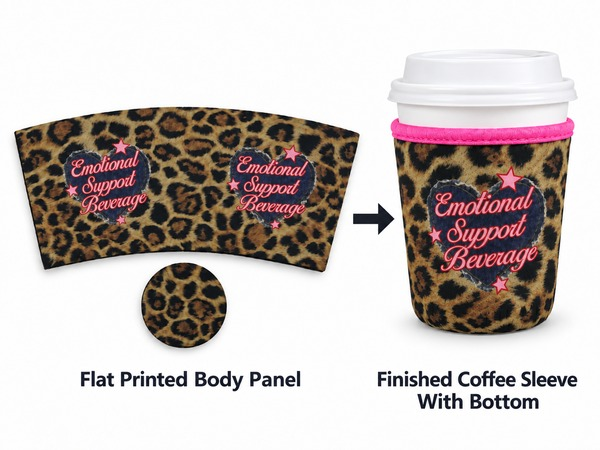
Dye sublimation does not normally determine the physical fit by itself, but the artwork must be prepared according to the final production pattern.
For tapered sleeves, artwork should consider:
- Production bleed
- Cutting line
- Safe area
- Side seam position
- Bottom seam where applicable
- Top binding area
- Pattern continuity
- Potential visual distortion caused by taper
This is why we recommend confirming dimensions before finalizing production artwork.
For a broader explanation of materials and printing methods, read our
Neoprene Coffee Cup Sleeves: Size, Material & Printing Guide.
How Top Binding Affects the Finished Sleeve
A bound top edge adds both visual detail and additional construction to the opening of the sleeve.
When developing a custom product, the binding width and sewing method should be considered during pattern development rather than added after all dimensions have already been finalized.
Binding can be selected to:
- Match the printed artwork
- Create a contrasting accent
- Coordinate with a woven label
- Create consistency across a multi-design retail collection
How Woven Labels Affect Sleeve Construction
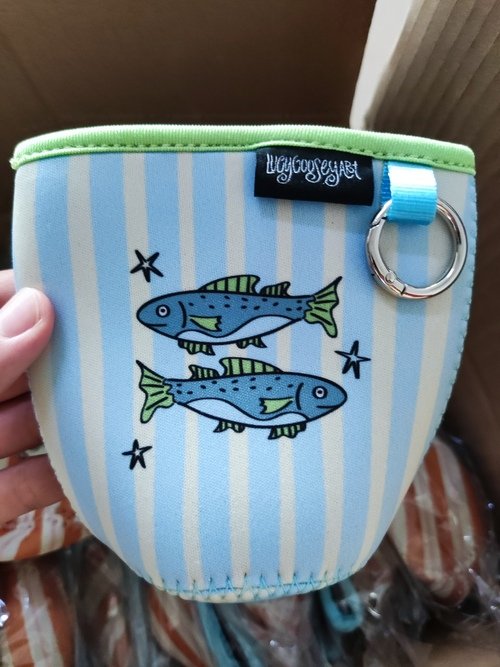
For private-label products, the location of the woven label should also be considered during development.
A label may be positioned:
- Inside the side seam
- Near the upper edge
- At another approved position depending on construction
The label width and seam allowance should be reviewed so the label does not interfere with cup fit or create unnecessary bulk in a critical area.
When Should You Choose Custom Sizing?
A standard sleeve size may be sufficient for simple promotional applications, but custom sizing is strongly recommended when:
- Your cup uses a proprietary or unusual shape
- The cup has a strong taper
- You are developing a closed-bottom sleeve
- You are using a large 24–32 oz cup
- You are developing a pint glass sleeve
- The product will be sold at retail
- Fit consistency is important for repeat orders
- You are creating a long-term branded merchandise program
Standard Size vs. Custom Size for Bulk Orders
| Standard Size | Custom Size | |
|---|---|---|
| Development | Simpler | Requires measurement review |
| Fit | General | Designed around target drinkware |
| Sampling | May be straightforward | Physical fit sample recommended |
| Best Application | General promotions | Private label, retail, exact-fit projects |
What B2B Buyers Should Send Before Requesting a Quote
A complete RFQ allows the manufacturer to quote more accurately and reduces repeated questions during product development.
We recommend including:
- Cup type
- Cup capacity
- Top diameter
- Bottom diameter
- Total cup height
- Desired sleeve height
- Open-bottom or closed-bottom construction
- Preferred neoprene thickness
- Artwork or reference design
- Number of artwork designs
- Quantity per design
- Woven-label requirements
- Packaging requirements
- Delivery country and ZIP/postal code
For private-label programs involving several designs, it is particularly useful to specify the quantity required for each artwork rather than providing only one total quantity.
How We Confirm Fit Before Bulk Production
For custom-size projects, a practical development process is more reliable than estimating fit from cup capacity alone.
1. Review Cup Dimensions
The target cup dimensions and application are reviewed before the sleeve pattern is finalized.
2. Confirm Sleeve Construction
We confirm whether the sleeve is open-bottom, closed-bottom, bound, stitched or requires private-label details.
3. Prepare the Pattern or Dieline
The production pattern is developed around the confirmed dimensions.
4. Produce a Physical Sample
For retail and exact-fit projects, a real sample allows both sides to evaluate the product before bulk production.
5. Test the Fit
The sample should be tested with the target cup or glass whenever possible.
6. Confirm Artwork and Branding Details
Print position, pattern scale, binding and woven-label placement can be reviewed together with the fit.
7. Approve Before Bulk Production
Once the sample specification is confirmed, the approved details become the reference for mass production.
Common Sizing Mistakes We See in Custom Drink Sleeve Projects
Mistake 1: Choosing a Sleeve Only by Cup Capacity
Knowing that the cup is 20 oz is useful, but it does not tell us the exact taper or diameter.
Mistake 2: Ignoring the Bottom Diameter
This is particularly risky for tapered cups and closed-bottom sleeves.
Mistake 3: Measuring Circumference at Only One Point
A tapered cup changes width from top to bottom, so one circumference measurement may not fully describe the shape.
Mistake 4: Not Confirming the Desired Sleeve Height
Two sleeves made for the same cup can look very different if one covers 50% of the cup and the other covers almost the entire body.
Mistake 5: Using a Can Cooler Pattern for a Tapered Cup
A standard cylindrical can pattern may not sit correctly on an iced coffee cup or pint glass with a different taper.
Mistake 6: Finalizing Artwork Before the Dieline
Artwork should follow the final production shape.
Preparing the print file too early can create avoidable artwork adjustments later.
Planning Sizes for Multiple Artwork Designs
Retail brands often develop several patterns within the same collection.
If all designs use the same cup, sleeve dimensions, neoprene thickness, binding and label, the project is generally easier to standardize.
For example, a collection may include:
- Five printed patterns
- One standard sleeve size
- One woven brand label
- One binding color
- The same packaging format
By contrast, projects using several sizes, several bindings and different labels require more production control.
When requesting a quotation, always tell the supplier the quantity per design as well as the total quantity.
Do Sleeve Dimensions Affect Retail Packaging?
Yes.
The finished sleeve size can influence the packaging format and shipping efficiency.
Retail packaging may include:
- Individual clear bags
- Printed backer cards
- Hang tags
- Custom insert cards
- Barcode or SKU labels
- Retail pouches
If the product will be sold online or in stores, packaging requirements should ideally be discussed before bulk production rather than after the sleeves have already been completed.
Custom Neoprene Drink Sleeve Manufacturer in Guangzhou, China
LOVECOLOUR supports custom neoprene drink sleeve projects from Guangzhou, China, including product sizing review, artwork checking, sample development, bulk production, quality inspection and export packing.
For buyers looking for a China neoprene coffee sleeve manufacturer, Guangzhou neoprene drink sleeve supplier or OEM partner for private-label beverage accessories, the most important first step is to provide accurate product requirements rather than selecting a sleeve based only on a generic size chart.
Our custom projects can include:
- Iced coffee sleeves
- Closed-bottom neoprene cup sleeves
- Pint glass sleeves
- Custom drink holders
- Full-color sublimation
- Woven brand labels
- Custom edge binding
- Retail-ready packaging
Explore our
custom neoprene cup sleeves and drink holders
for additional product options.
Custom Neoprene Sleeves for U.S. and International Buyers
We support OEM and private-label projects for brands, promotional product companies, retailers and other bulk buyers serving markets including the United States, Canada, Europe, the United Kingdom, Australia and the Middle East.
For international B2B projects, a complete quotation normally depends on:
- Final sleeve specifications
- Quantity per artwork design
- Packaging
- Carton quantity and weight
- Delivery country
- ZIP or postal code
Shipping methods can then be evaluated after the final production configuration is confirmed.
Frequently Asked Questions About Neoprene Drink Sleeve Sizes
What size neoprene sleeve fits a 16 oz cup?
A small or medium sleeve may be suitable depending on the cup shape, but the actual top diameter, bottom diameter and desired sleeve height should be confirmed before production.
What size sleeve fits a 20 oz iced coffee cup?
Many 20 oz iced coffee cups fall into a medium sleeve category, but there is no universal 20 oz sleeve dimension because different cups can have different tapers and heights.
Can one neoprene sleeve fit both 20 oz and 24 oz cups?
Sometimes, especially if the cups have similar diameters and the neoprene has enough flexibility. However, the fit should be tested rather than assumed from capacity alone.
How do I measure a coffee cup for a neoprene sleeve?
Measure the top diameter, bottom diameter, total cup height and desired sleeve height. Also confirm whether you need an open-bottom or closed-bottom construction.
Do you need both the top and bottom diameter?
For tapered cups, yes. Both measurements help determine the correct pattern and reduce the risk of the sleeve being too loose or too tight.
Does neoprene stretch?
Neoprene has some flexibility, but stretch should not be used as a substitute for correct sizing, especially for retail-quality products.
Is 3 mm or 4 mm neoprene better for a drink sleeve?
Both can work. Approximately 3 mm provides a flexible balance of structure and comfort, while 4 mm creates a thicker hand feel. The preferred option depends on the cup and product positioning.
Are all 16 oz U.S. pint glasses the same size?
No. Capacity may be similar, but dimensions and taper can vary between glass manufacturers. Confirm the actual glass measurements for an exact-fit sleeve.
Can you make a custom sleeve for our own branded cup?
Yes. Custom sizing can be developed from actual dimensions, technical drawings or a physical reference cup.
Do closed-bottom sleeves need different measurements?
They require more attention to the bottom diameter and base construction because the neoprene must fit underneath the cup rather than simply wrap around the side wall.
Can multiple artwork designs use the same sleeve size?
Yes. When the cup dimensions and construction are identical, multiple artworks can use the same basic production pattern.
Can I order a physical prototype before bulk production?
Yes. A physical sample is recommended for new sizes, closed-bottom products and private-label retail projects so the fit and finishing can be evaluated before mass production.
Can you provide a production dieline?
Yes. Once the dimensions and construction are confirmed, artwork can be prepared according to the appropriate production template.
Can you ship custom neoprene sleeves to the USA?
Yes. Shipping options for U.S. and international buyers can be evaluated after the final quantity, packaging, carton details and delivery location are confirmed.
What should I send for an accurate quotation?
Send your cup dimensions, sleeve construction, artwork, number of designs, quantity per design, material preference, branding requirements, packaging and destination.
Need Help Choosing the Correct Neoprene Sleeve Size?
If you are developing a custom coffee sleeve, pint glass sleeve or private-label drink accessory, send us your cup dimensions and project requirements before finalizing the artwork.
For the fastest review, include:
- Top diameter
- Bottom diameter
- Cup height
- Desired sleeve height
- Cup capacity
- Artwork or reference design
- Quantity per design
- Delivery country / postal code
Related Products & Guides:
Custom Closed-Bottom Neoprene Iced Coffee Sleeves
Custom Neoprene Pint Glass Sleeves
Custom Neoprene Cup Sleeves & Drink Holders
Neoprene Coffee Cup Sleeves: Size, Material & Printing Guide
Customization & Production Process
Send us your cup size, artwork and quantity to receive a suitable OEM production recommendation and quotation.