Choosing an RFID wristband for an event is not simply a matter of selecting a color, material or chip from a product list.
The most important question is:
What system does the wristband need to work with?
Two RFID wristbands can look almost identical but behave completely differently. One may be designed for a 125 kHz access-control reader, another for a 13.56 MHz HF system, while another may use UHF technology for a specialized longer-range identification application.
For event organizers, promotional product buyers, ticketing companies and venue operators, choosing the correct wristband therefore requires a combination of RFID compatibility, physical wristband design, security, branding, variable data and real-world testing.
This guide explains how to evaluate those factors before placing a bulk order — and, just as importantly, which decisions should be confirmed by your RFID system or software provider rather than by the wristband manufacturer alone.
If you are already looking for a textile RFID solution, you can also view our custom RFID fabric wristbands for events and access control.
Quick Answer: How Should an Event Organizer Choose an RFID Wristband?
Start with the event system, not the wristband appearance.
Before comparing materials or prices, confirm:
- What will read the wristband?
- What RFID frequency or protocol does the system require?
- Is the wristband for admission, access zones, identification, cashless use or another function?
- Does each wristband need a unique UID, serial number, QR code or encoded value?
- Should the wristband be non-transferable or reusable?
- How long will the attendee wear it?
- Does the finished sample work with the actual event reader or platform?
Once these questions are answered, choosing the physical wristband becomes much easier.
Quick RFID Wristband Selection Guide
| Event Requirement | Typical Wristband Direction | Key Point to Confirm |
|---|---|---|
| Festival or concert admission | Fabric RFID wristband with secure closure | Reader, ticketing platform and chip compatibility |
| Multi-day branded event | Comfortable custom fabric RFID wristband | Wear comfort, security and data structure |
| VIP / Staff / Media zones | RFID + visible color or text identification | Access levels and backend permissions |
| Cashless event | RFID credential specified by the payment platform | Chip and POS / software compatibility |
| Short-term high-volume identification | Disposable wristband solution | Security, quantity and required technology |
| Long-term or repeated use | Reusable RFID wristband | Durability and repeated scanning requirements |
| Smartphone tap-to-website | NFC-enabled wristband | NFC chip and phone-facing application |
Important: These are selection directions, not universal chip recommendations. The correct electronic credential should always be confirmed against the actual reader, software or event platform.
If you are unsure whether your project actually needs RFID or NFC, read our detailed guide to NFC vs RFID wristbands.
Start With Your Reader and Event System — Not the Wristband
This is one of the most important lessons in RFID wristband sourcing.
A buyer may begin by asking:
“What is your best RFID wristband?”
But from a manufacturing perspective, that is not the best first question.
A better question is:
“What does this wristband need to communicate with?”
The wristband is only one physical component of a larger system. Depending on the project, that system may include:
- Entrance readers
- Ticketing software
- Access-control gates
- POS terminals
- Membership software
- Registration databases
- Hotel or venue systems
- Mobile phones for compatible NFC applications
If the RFID credential does not match the system, a perfectly printed wristband can still be the wrong product.
That is why for system-based RFID projects we recommend that buyers provide the reader model, existing RFID card or wristband specification, required chip, frequency or protocol whenever available.
How Does an RFID Wristband Work at an Event?
An RFID wristband combines a wearable band with an RFID chip and antenna.
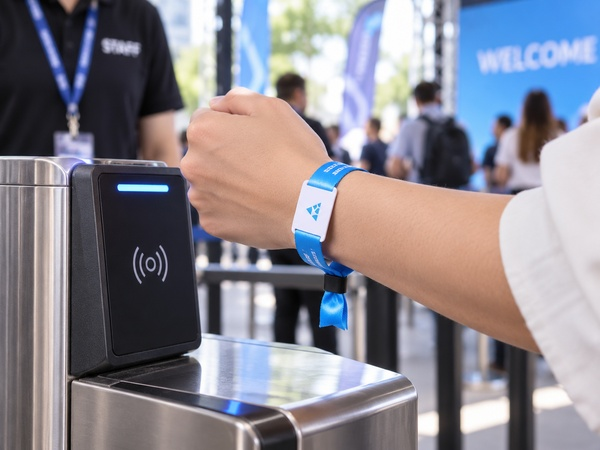
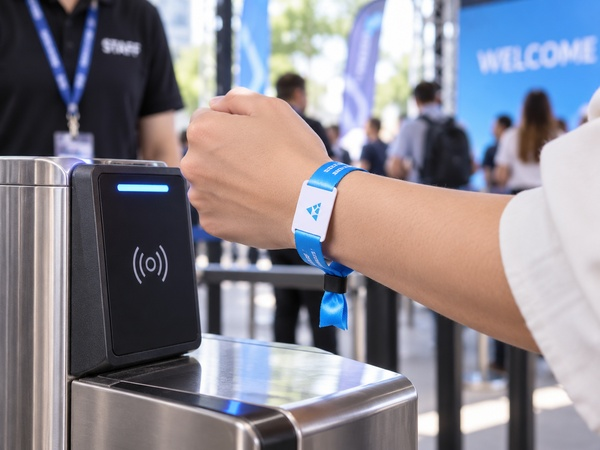
When the wristband is presented to a compatible reader, the reader detects the electronic credential. What happens next depends on the connected system.
For example, the system may:
- Validate an admission credential
- Open an access gate
- Confirm a VIP or staff permission
- Identify an attendee
- Record a check-in
- Connect the credential to an account
- Support a compatible cashless event platform
This distinction matters:
The wristband is the physical RFID credential. It is not, by itself, the complete access-control, ticketing or cashless-payment system.
The final functionality depends on the chip, reader, software, database and configuration used together.
For a deeper discussion focused specifically on entrance management, see our guide to RFID wristbands for access control.
LF vs HF/NFC vs UHF RFID Wristbands
One reason RFID purchasing can become confusing is that “RFID” describes a broad technology family rather than one universal wristband specification.
Event and identification projects may use different frequency ranges.
| RFID Type | Frequency | Typical Project Direction | Buyer Should Confirm |
|---|---|---|---|
| LF RFID | Typically 125 kHz | Selected traditional access-control and identification systems | Reader frequency and supported chip |
| HF RFID | 13.56 MHz | Ticketing, access control, identification and compatible event systems | Protocol, reader and chip specification |
| NFC | 13.56 MHz | Compatible smartphone interaction and selected HF applications | NFC chip, data format and intended phone interaction |
| UHF RFID | Regional UHF RFID bands | Specialized longer-range identification applications | Reader, antenna, protocol and operating environment |
A common sourcing mistake is assuming that all 13.56 MHz wristbands will behave the same way with every reader or smartphone.
They will not.
Frequency is only part of compatibility. Protocol, chip family, memory structure, reader support and software configuration also matter.
For buyers comparing smartphone interaction with conventional RFID infrastructure, our NFC vs RFID comparison explains this distinction in more detail.
A Practical Rule
If your event already has a working reader, card, ticketing platform or RFID system, do not replace the specification with a guess based on wristband appearance.
Send the manufacturer:
- Reader model
- Existing card or wristband
- RFID frequency
- Required chip
- Protocol information
- System provider specification
when those details are available.
Choose the Wristband Material Based on the Event — Not Just Price
Once the RFID technology is confirmed, the next decision is the physical wristband.
The material affects comfort, security, brand presentation, durability and whether attendees are likely to wear the wristband for a few hours or several days.
RFID Fabric Wristbands
Fabric RFID wristbands are particularly suitable for festivals, concerts, conferences, sports events and branded multi-day programs where both comfort and visual presentation matter.
At LOVECOLOUR, our RFID fabric wristbands can be configured with different RFID technologies, fabric styles, tag shapes, closures and visible identification options according to the project.
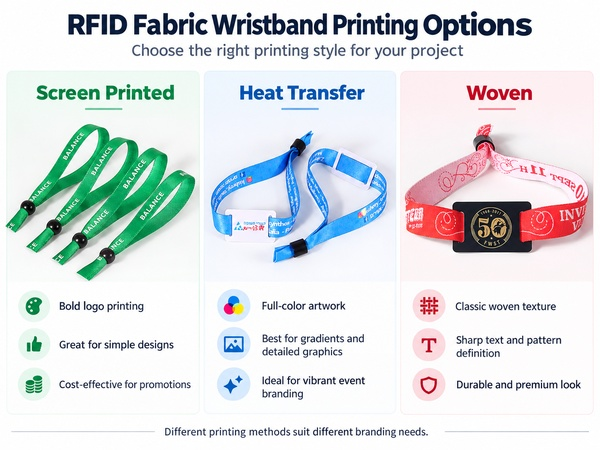
Common fabric decoration methods include:
- Heat transfer / sublimation for full-color artwork, gradients and detailed graphics
- Woven designs for a textile look and simple, strong logos
- Screen printing for straightforward text and limited-color graphics
If you need a fabric wristband without RFID, compare our custom fabric event wristbands.
Disposable Wristbands
For some short-term or high-volume projects, a disposable format may be more practical than a premium multi-day textile wristband.
For example, our custom Tyvek wristbands can support printed identification such as QR codes, barcodes and serial numbers, with RFID options available for selected constructions.
The correct choice depends on the event duration, required security and electronic system.
Reusable Wristbands
Reusable constructions can make more sense for recurring access, memberships, resorts, staff or long-term programs.
However, “reusable” should not automatically be considered better.
If your event requires strict non-transferable admission, a secure one-time closure may be more appropriate than a wristband that can easily be removed and passed to another person.
For a fuller comparison, see disposable vs reusable RFID wristbands.
One-Time vs Reusable Closures: A Small Component With a Big Operational Impact
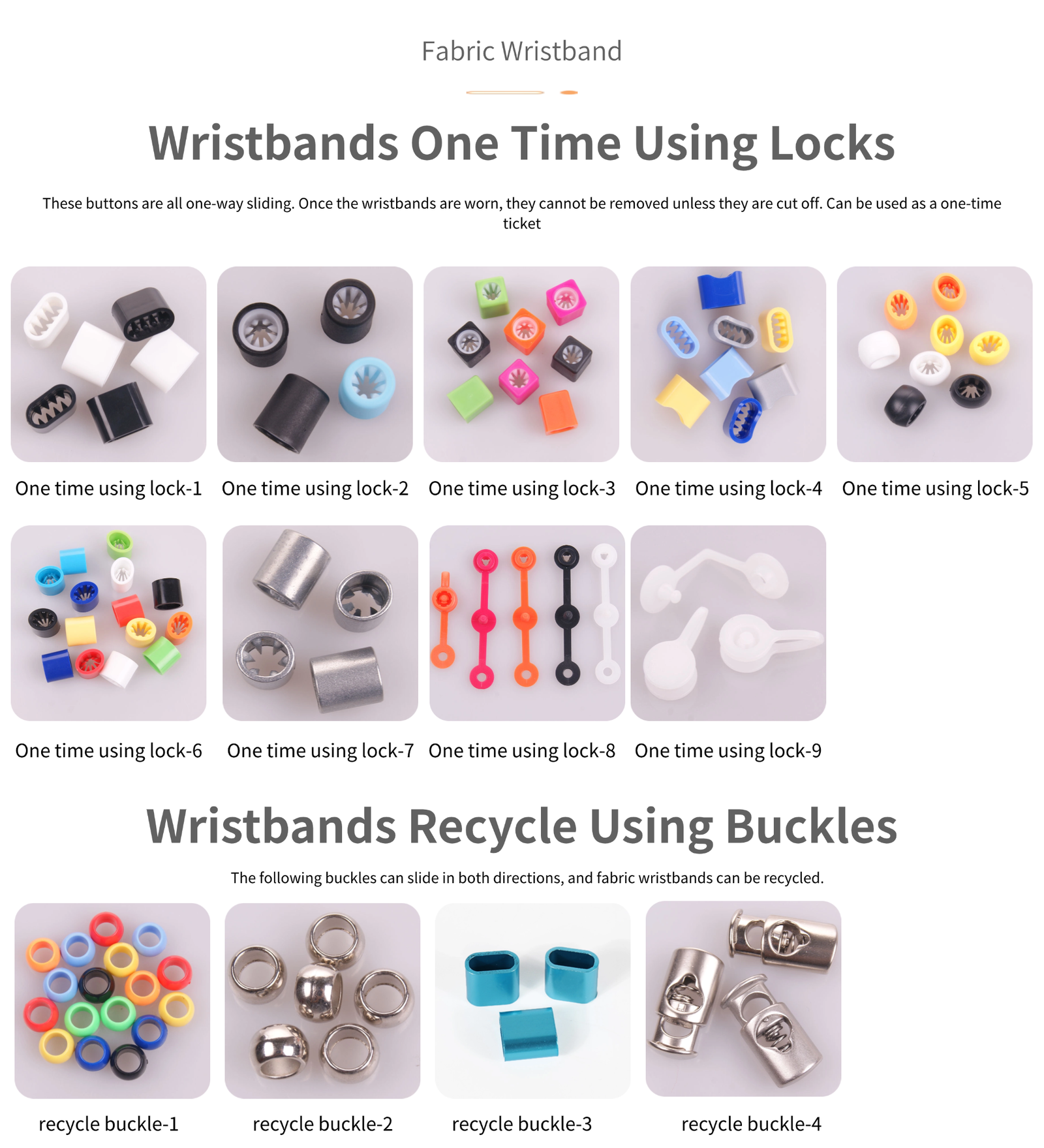
Closure choice is easy to underestimate.
For event organizers, it can affect both attendee convenience and admission security.
One-Time Anti-Transfer Closures
These are designed for projects where removing and transferring the wristband should be difficult.
Typical applications include:
- Ticketed festivals
- Concert admission
- VIP credentials
- Restricted zones
- Multi-day events
Reusable Closures
Reusable closures may be more appropriate when the same user needs to remove and wear the wristband repeatedly.
Typical applications may include:
- Membership programs
- Staff credentials
- Selected resort applications
- Promotional programs
- Longer-term identification
The closure should therefore be chosen according to the access policy — not simply according to which style looks better.
RFID + QR Code + Serial Number: Why Use More Than One Identifier?
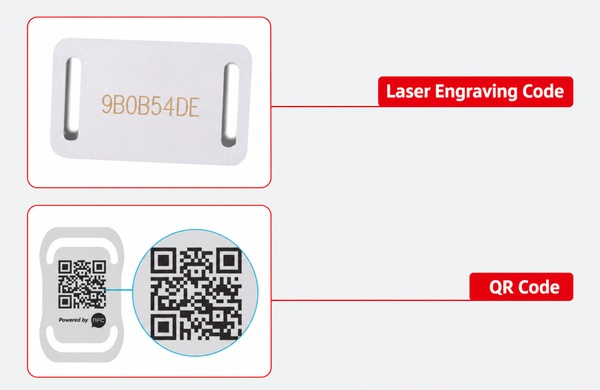
RFID does not need to work alone.
For many event projects, combining electronic and visible identifiers creates a more practical credential.
One wristband may include:
- RFID credential
- Unique QR code
- Sequential serial number
- Barcode
- Participant ID
- VIP / STAFF / MEDIA / CREW text
- Color-coded access level
Each identifier can serve a different purpose.
| Situation | Possible Identification Method |
|---|---|
| Electronic checkpoint | RFID credential |
| Manual inspection | Printed serial number |
| Camera or barcode scanner | QR code / barcode |
| Fast visual identification | Band color or STAFF / VIP / CREW wording |
For large or data-driven projects, it is important to specify before production whether the RFID UID, printed serial number, QR code and customer database must correspond one-to-one.
This should not be treated as a last-minute printing detail.
Cashless RFID Wristbands: Understand What the Wristband Does — and Does Not Do
“Can your RFID wristband support cashless payment?” is a common buyer question.
The more useful answer is:
An RFID wristband can act as the user credential within a compatible cashless system, but the wristband itself is not the payment platform.
A functioning event cashless system normally also requires:
- Compatible RFID readers or POS terminals
- Event or payment software
- User or account database
- Correct chip configuration
- Appropriate security and transaction logic
If your event already uses a cashless platform, ask the platform provider which RFID credential is supported and provide that specification to the wristband manufacturer.
This prevents a surprisingly common purchasing error:
ordering thousands of attractive RFID wristbands first and checking system compatibility afterward.
What Information Should You Send an RFID Wristband Manufacturer?
A good quotation request contains more than quantity and logo artwork.
For an RFID project, send as much of the following information as possible:
| Information | Why It Matters |
|---|---|
| Event type | Helps determine the physical wristband direction |
| Event date | Determines the production and testing timeline |
| Quantity | Affects manufacturing and data-processing planning |
| Reader model | Helps confirm compatibility |
| RFID frequency | Narrows the technology direction |
| Required chip | Important when specified by the system provider |
| Existing card / wristband sample | Useful when technical specifications are unclear |
| Artwork | Determines printing or weaving method |
| UID / encoding requirements | Needed for data processing |
| QR / barcode / serial data | Required for variable-data production |
| Closure type | Determines reusable vs anti-transfer security |
| Packaging | Affects final assembly and fulfillment |
| Delivery country | Needed for shipping planning |
If you do not know the chip name, that does not automatically prevent you from starting the project.
Instead, provide the existing reader model, sample credential, system information or supplier specification whenever possible.
How We Approach RFID Wristband Testing Before Bulk Production
RFID projects should not be approved only by looking at a digital artwork proof.
For system-based orders, the physical sample and the electronic credential both matter.
1. Confirm the Application
First, define what the wristband needs to do: admission, identification, membership, access control, compatible cashless use or another application.
2. Confirm the RFID Requirement
Where possible, provide the reader, system or chip specification before the product construction is finalized.
3. Prepare the Physical Wristband Configuration
Material, RFID module, tag shape, artwork and closure are selected according to the project.
4. Check the Electronic Credential
The RFID component should be checked using compatible equipment to confirm that the required credential can be detected and processed as expected.
5. Verify Variable Data
If the order contains UID mapping, QR codes, barcodes or printed serial numbers, the relationship between electronic and visible data should be confirmed before mass production.
6. Test the Finished Sample With the Actual Customer System
This is especially important for large projects.
A supplier can check the product and RFID component, but the safest final compatibility test is with the actual reader, software or event platform the customer will use.
7. Approve Before Bulk Production
Once the construction, artwork, RFID function and data requirements are confirmed, the project can proceed to bulk production and QC.
Our RFID fabric wristband page shows the available RFID, printing, tag and closure directions in more detail.
Why Read Range Should Not Be Treated as One Fixed Number
Buyers often ask:
“How far can this RFID wristband be read?”
The answer depends on more than the chip name.
Real-world reading performance can be affected by:
- RFID frequency
- Chip and antenna design
- RFID tag size
- Reader power
- Reader antenna
- Wristband construction
- Human body position
- Nearby materials
- Interference
- Installation environment
For this reason, a supplier should be cautious about promising one universal reading distance for every application.
For professional projects, test the finished credential with the actual reader and operating environment whenever possible.
Common RFID Wristband Buying Mistakes
Mistake 1: Choosing the Chip Before Confirming the Reader
A familiar chip name does not automatically mean compatibility.
Better approach: start with the reader or platform specification.
Mistake 2: Assuming NFC and RFID Are Interchangeable
NFC belongs to the broader RFID technology family, but an NFC smartphone application and an RFID access-control system are not automatically the same thing.
Better approach: decide who or what needs to read the wristband.
Mistake 3: Selecting the Cheapest Physical Wristband
A one-day visitor program and a multi-day music festival do not place the same demands on comfort, closure security or durability.
Better approach: choose the construction according to event duration and usage.
Mistake 4: Forgetting Variable Data Until Production Starts
UID, QR code, barcode and serial-number matching can require structured data preparation.
Better approach: define the database and matching rule before manufacturing.
Mistake 5: Treating Cashless Payment as a Wristband Feature Alone
A cashless system requires compatible software, readers and account logic.
Better approach: obtain the RFID credential requirement from the system provider first.
Mistake 6: Skipping the Physical Sample
Artwork approval does not prove electronic compatibility.
Better approach: test a production-representative sample with the actual system before a large order.
Mistake 7: Ordering Too Close to the Event Date
An RFID project may involve artwork, samples, electronic testing, variable-data preparation, manufacturing, QC and international shipping.
Better approach: allow time for compatibility testing rather than planning only around the factory production days.
How Early Should You Order RFID Wristbands for an Event?
There is no single correct timeline for every RFID wristband order.
The schedule depends on:
- RFID chip availability
- Wristband construction
- Quantity
- Custom RFID tag requirements
- Artwork complexity
- Variable-data requirements
- Sample approval
- Reader compatibility testing
- Packaging
- Shipping destination
For a basic printed wristband, production planning may be relatively straightforward.
For an RFID event credential connected to an existing ticketing or access-control platform, additional testing time can be more important than the physical printing time.
That is why we recommend starting the technical confirmation stage as early as practical — especially for large festivals, conferences and access-control programs.
How to Evaluate an RFID Wristband Manufacturer
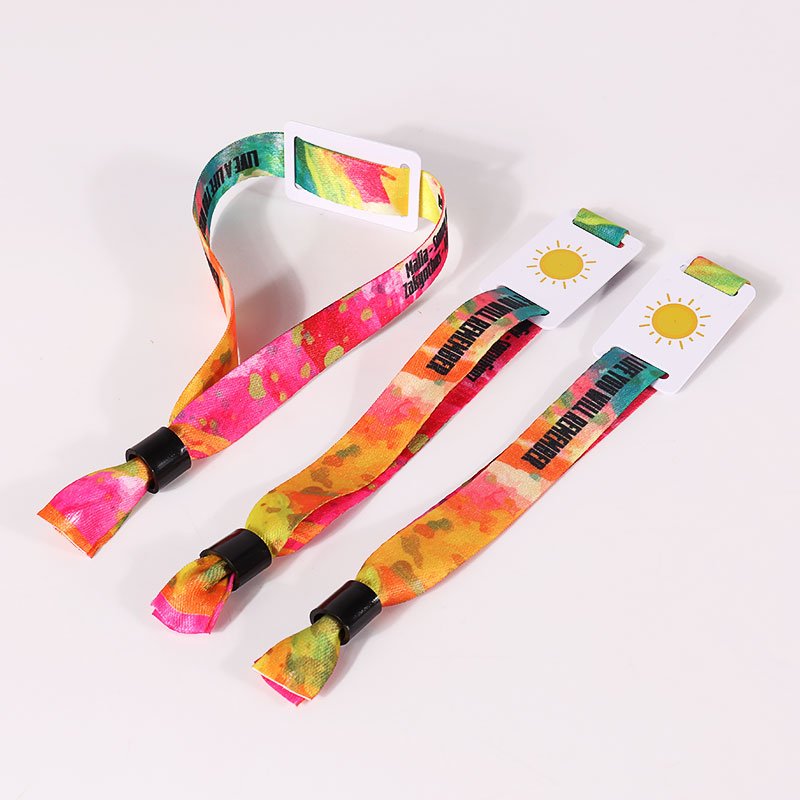
Price matters, but for RFID projects it should not be the only purchasing criterion.
Ask potential suppliers whether they can clearly explain:
- Which RFID frequencies and chip families they can supply
- How they confirm compatibility requirements
- What RFID tag shapes and constructions are available
- How UID, QR code and serial data are handled
- Whether one-time and reusable closures are available
- Which printing or weaving method suits your artwork
- How samples are prepared
- How RFID function is checked before shipping
- How variable data is verified
- How defective products are controlled during QC
A useful supplier should be willing to tell you when more technical information is required before making a recommendation.
That is often more valuable than immediately saying, “This chip will work.”
What a Wristband Manufacturer Can — and Cannot — Determine
This distinction is important for a reliable RFID project.
A Wristband Manufacturer Can Help With:
- Wristband material
- Printing or weaving method
- RFID tag construction
- Available RFID chip options
- Tag shape and dimensions
- Logo customization
- One-time or reusable closures
- QR codes and serial numbering
- Variable-data production
- Packaging
- Sample production
- Manufacturing QC
Your System Provider Should Confirm:
- Required RFID frequency
- Supported protocol
- Required chip when platform-specific
- Reader compatibility
- Software configuration
- Access-control logic
- Cashless-payment integration
- Database structure
- Security rules specific to the platform
The best result comes when the event organizer, system provider and wristband manufacturer work from the same confirmed specification.
RFID Wristband Pre-Order Checklist
Before approving bulk production, check the following:
- ☐ Event date confirmed
- ☐ Quantity confirmed
- ☐ Wristband material selected
- ☐ Reader or event platform confirmed
- ☐ RFID frequency confirmed
- ☐ Required chip / protocol confirmed where applicable
- ☐ Sample tested with the actual reader or system
- ☐ Artwork approved
- ☐ Band size approved
- ☐ RFID tag position approved
- ☐ Closure type approved
- ☐ UID / encoding requirements confirmed
- ☐ QR / barcode / serial-number data confirmed
- ☐ Data matching rule confirmed
- ☐ Packaging confirmed
- ☐ Production timeline confirmed
- ☐ Shipping buffer included
This checklist is especially important for projects involving thousands of individually identified wristbands.
When You May Not Need RFID at All
RFID can add useful functionality, but it should not be added simply because it sounds more advanced.
If your event only needs:
- Visual admission identification
- Basic color coding
- A printed QR code
- A sequential number
- Simple branding
a non-RFID solution may be simpler and more economical.
Depending on the project, you can compare:
- Custom Fabric Wristbands for premium event branding
- Custom Tyvek Wristbands for short-term and high-volume identification
- Custom Wristband Collection for additional materials and constructions
A simpler product that fully solves the event requirement is often a better purchasing decision than adding unnecessary electronics.
Frequently Asked Questions About RFID Event Wristbands
Can I use an RFID wristband with my existing event reader?
Possibly, but compatibility must be confirmed. Send the reader model, supported frequency, chip requirement or an existing working RFID credential whenever available. Do not assume compatibility based only on the wristband frequency.
Which RFID frequency should I choose for an event?
Choose according to the existing reader and event platform. LF, HF and UHF systems serve different applications and use different readers and protocols. If a system already exists, its requirements should determine the RFID credential.
Is NFC the same as RFID?
NFC is part of the broader RFID technology family and operates at 13.56 MHz, but not every RFID wristband is designed for smartphone NFC interaction. Read our NFC vs RFID wristband guide for a deeper explanation.
Can RFID wristbands include QR codes and serial numbers?
Yes. Depending on the construction, RFID wristbands can also include visible QR codes, barcodes, sequential numbers, participant IDs and access-level text. For data-driven projects, confirm whether those visible identifiers need to match the RFID UID or encoded data.
Can every RFID wristband have different data?
Variable RFID and printed data can be supported for suitable projects, but the required data structure should be confirmed before production. Provide the database format and matching requirements in advance.
Are RFID fabric wristbands good for multi-day festivals?
Fabric wristbands are commonly selected where comfort, branding and multi-day wear are important. A one-time security closure can also be considered when non-transferable admission is required.
Should I use a disposable or reusable RFID wristband?
It depends on the operating model. One-time events may prioritize anti-transfer security and easy distribution, while membership or repeated-use programs may benefit from reusable construction. See our disposable vs reusable RFID wristband guide.
Can an RFID wristband be used for cashless payment?
An RFID wristband can function as a credential within a compatible cashless system. The payment function itself depends on the event software, readers, account database and supported RFID technology.
Should I order a sample before a large RFID wristband order?
For system-based projects, yes. A sample allows the physical wristband, RFID credential, reader compatibility, artwork and closure to be evaluated before bulk manufacturing.
What should I send when requesting a quotation?
Send your quantity, event date, application, artwork, wristband size, RFID requirement, reader or system information, variable-data requirements, closure preference, packaging and delivery country. If you do not know the chip, send the reader model or existing working credential whenever possible.
Final Buying Advice: Build the Wristband Around the System
The right RFID event wristband is not necessarily the product with the most expensive chip, the longest specification sheet or the lowest unit price.
It is the wristband that correctly matches:
- Your reader
- Your event software
- Your access policy
- Your data requirements
- Your event environment
- Your branding
- Your security requirements
- Your production timeline
From our manufacturing perspective, the safest workflow is straightforward:
Confirm the system → choose the RFID credential → design the physical wristband → prepare the sample → test it with the real system → approve bulk production.
For buyers planning festivals, conferences, sporting events, attractions or access-control projects, explore our custom RFID fabric wristbands or browse our complete custom wristband range.
Need help defining your RFID wristband specification? Send us your application, reader information, artwork, quantity and event deadline. We can review the physical wristband requirements and help you prepare a suitable manufacturing solution for sampling and bulk production.