Put two smart wristbands on a table and they may look almost identical.
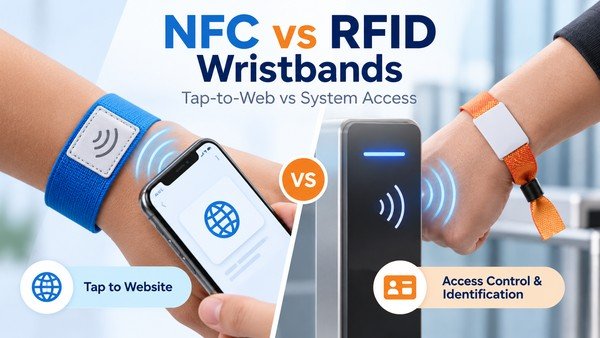
One opens a website when tapped with a smartphone. Another unlocks an event gate. A third works with an older 125 kHz access-control reader. Another can be detected by a UHF system from much farther away.
From the outside, they may all look like the same fabric, elastic or silicone wristband.
Electronically, they can be completely different products.
This is why the question “Should I buy an NFC wristband or an RFID wristband?” is not quite the right place to start.
A better set of questions is:
- Who or what needs to read the wristband?
- How close should the wristband be to the reader?
- What should happen after it is read?
Once those three things are clear, choosing the technology becomes much easier.
Quick Answer: Is NFC the Same as RFID?
RFID stands for Radio Frequency Identification. It is a broad family of technologies that use radio communication between a tag or credential and a compatible reader.
NFC stands for Near Field Communication. It operates at 13.56 MHz and is designed for very short-range interactions between compatible NFC devices and tags.
So NFC belongs within the broader world of RFID technologies, but not every RFID wristband is an NFC wristband.
This distinction matters when ordering because RFID wristbands may use very different frequencies and chip families.
| Technology | Typical Frequency | Typical Reader | Common Wristband Use |
|---|---|---|---|
| LF RFID | 125 / 134 kHz range | Dedicated LF reader | Legacy access control, membership, identification |
| HF RFID | 13.56 MHz | Compatible HF reader | Ticketing, access control, identification |
| NFC | 13.56 MHz | NFC smartphone or compatible NFC reader | Tap-to-web, digital content, smart merchandise |
| UHF RFID | Regional UHF band | Dedicated UHF reader and antenna | Longer-range identification, tracking, timing and selected gate applications |
The important point: frequency alone is still not enough. The exact chip, protocol, reader and software also need to be compatible.
Stop Choosing the Acronym. Start With the Reader.
When a buyer contacts us and says, “I need RFID wristbands,” the first useful question is not:
“Which wristband color do you want?”
It is:
“What will read the wristband?”
If the answer is:
“A customer’s smartphone” → we normally start by looking at NFC.
“Our existing door-access reader” → we need the reader frequency and supported chip.
“Our festival ticketing system” → we need the platform’s credential specification.
“A long-range UHF antenna” → an NFC chip is probably not the correct answer.
This one question prevents many expensive purchasing mistakes.
NFC vs RFID Wristbands at a Glance
| Question | NFC Wristband | Broader RFID Wristband |
|---|---|---|
| Can a compatible smartphone read it? | Often yes, when using an appropriate NFC/NDEF configuration | Not necessarily |
| Designed for deliberate close tapping? | Yes | Depends on frequency and system |
| Can it open a website? | Yes, with a compatible NFC tag encoded with a URL | Not automatically |
| Can it work with access control? | Possible with compatible systems | Yes, if matched to the reader/system |
| Can it support event cashless systems? | Only if the platform supports that credential | Only if the platform supports that credential |
| Can it work at longer read distances? | No — NFC is intentionally short range | UHF RFID can support much longer reads |
| Does the wristband itself provide software? | No | No |
| Does the exact chip matter? | Yes | Absolutely |
Use NFC When the Smartphone Is Part of the Experience
NFC becomes especially interesting when you want the person wearing the wristband to interact with it using a compatible smartphone.
For example, an NFC wristband can be programmed with an NDEF web link.
The experience can be as simple as:
Tap Wristband → Open Website → View Digital Content
This makes NFC particularly useful for:
- Smart merchandise
- Brand campaigns
- Digital business cards
- Membership content
- Event schedules
- Artist and fan content
- Product information
- Daily inspirational content
- Faith-based products
- Loyalty and promotional campaigns
Apple supports background reading of appropriate NDEF URI records on compatible iPhones, while Android also supports NDEF URI handling on NFC-enabled devices.
A Real Example: A Wristband That Opens a New Prayer Every Day
This is a useful example because it shows the difference between an NFC product and a traditional RFID system credential.
Suppose a Christian gift brand or ministry wants to sell a reusable elastic wristband.
The customer taps the bracelet with a phone and sees:
Today’s Bible Verse
Today’s Prayer
Today’s Devotional Message
A common misunderstanding is that someone must rewrite the NFC chip every day.
They do not.
A better architecture is:
NFC Wristband → Fixed URL → Website → Daily Content Changes
The NFC tag can continue storing the same web address while the website changes what appears on that page each day.
This distinction matters for brands developing products at scale.
If 20,000 bracelets have already been manufactured and shipped, you do not want to physically reprogram every bracelet whenever the digital content changes.
For Long-Term NFC Products, Think About the URL Before the Chip
Here is another B2B detail that is easy to miss.
Imagine encoding thousands of wristbands directly with a long destination URL:
yourbrand.com/campaign/daily-message/version-final-2026
Later the brand redesigns its website and that page disappears.
The physical wristbands are still in customers’ hands.
A more flexible commercial setup can use a controlled branded redirect:
NFC Wristband → tap.yourbrand.com/daily → Current Destination
The physical NFC data stays the same while the brand controls where that URL leads.
This can make it easier to change:
- Campaign pages
- Daily content
- Languages
- Seasonal offers
- Membership destinations
- Website platforms
- Future product experiences
For a retail NFC product that may remain in use for years, URL architecture can matter more than choosing between two chips with slightly different memory sizes.
What NFC Chip Is Commonly Used for Tap-to-Web Wristbands?
For simple smartphone-facing NFC applications, the NTAG21x family is commonly considered.
| Chip | Available User Memory | Typical Direction |
|---|---|---|
| NTAG213 | 144 bytes | Simple URLs and common NFC interactions |
| NTAG215 | 504 bytes | Applications needing more NDEF storage |
| NTAG216 | 888 bytes | Larger NFC data requirements |
NXP specifies NTAG213, NTAG215 and NTAG216 as NFC Forum Type 2 Tag compliant ICs with 144, 504 and 888 bytes of user memory respectively.
That does not mean NTAG216 is automatically “better.”
If all you need is a short web link, buying extra memory that the application never uses may add no practical value.
Choose the chip around the data and customer journey — not around the biggest number on a specification sheet.
Use RFID When the Wristband Must Work With a System
Now consider a completely different project.
A festival operator already has:
- Entrance readers
- VIP checkpoints
- Ticketing software
- A user database
- Cashless POS infrastructure
In this case, the wristband is not primarily a “tap a phone and open a website” product.
It is a system credential.
The important questions become:
- Which frequency does the system use?
- Which exact chip families are supported?
- Does the system identify the wristband by UID or other credential data?
- Is secure authentication required?
- What data must be encoded?
- What reader models are installed?
- What closure/security level is required?
This is where the broader RFID conversation becomes more important than simply asking whether a phone can read the wristband.
The Chip Is Not the System
This is probably the most important sentence for any buyer ordering smart wristbands:
An RFID or NFC wristband is a credential. It is not automatically an access-control, ticketing or cashless-payment system.
For example, putting an RFID chip inside a wristband does not automatically give you:
- Ticket validation
- A cashless wallet
- Top-up functionality
- Refund processing
- VIP access rules
- Attendance analytics
- Customer accounts
Those functions are normally created by the software, readers and database around the wristband.
The physical credential must be compatible with that ecosystem.
This is why serious projects should confirm the platform and reader requirements before selecting the chip.
Does an NFC Wristband Automatically Work for Cashless Payments?
No.
This is one of the most misleading assumptions in the market.
“NFC” and “contactless payment” are often mentioned together because NFC is used in contactless technologies. But an NFC wristband containing a basic URL tag does not suddenly become a bank card or complete event-payment solution.
A festival cashless system normally involves:
- Compatible wristband credential
- Reader or POS hardware
- Event software
- User/account database
- Top-up or payment logic
- Security and permission rules
If a platform specifies MIFARE DESFire, MIFARE Ultralight or another credential, ordering NTAG213 simply because it is “NFC” may be the wrong choice.
Ask your system provider for the exact credential specification.
LF, HF/NFC and UHF RFID: What Do Buyers Actually Need to Know?
LF RFID
Low-frequency RFID is still found in older or established access-control, identification and membership systems.
Common examples may include chip families such as EM4200, TK4100 and other LF credentials.
If your existing reader requires LF RFID, a smartphone NFC wristband is not a substitute.
HF RFID / NFC
High-frequency RFID operates at 13.56 MHz. This group includes several different contactless technologies and chip families.
This is also where NFC operates.
Depending on the application, buyers may encounter:
- NTAG213 / 215 / 216
- MIFARE Ultralight
- MIFARE DESFire
- ICODE
- Other HF technologies
However, do not assume that every 13.56 MHz chip behaves identically with a smartphone or with every access-control system.
Same frequency does not mean same application.
UHF RFID
UHF RFID is designed for a very different type of interaction and can support considerably longer reading distances with compatible UHF readers and antennas.
It can be useful for applications such as:
- Longer-range identification
- Asset tracking
- Selected race/timing applications
- Inventory and logistics
- Hands-free or portal-style identification
A normal smartphone does not turn into a UHF RFID reader simply because it contains NFC.
If the goal is “tap the bracelet with a phone,” UHF is normally solving the wrong problem.
Two Wristbands Can Look Identical and Still Be Completely Incompatible
This is something buyers rarely see in product photography.
Take a custom fabric wristband with a rectangular RFID tag.
The outer product may have:
- The same printed fabric
- The same logo
- The same tag shape
- The same one-way closure
But one version may contain an LF chip, another an HF credential and another a UHF inlay.
That means the visual sample alone cannot confirm compatibility.
For smart wristbands, there are really two samples to approve:
Physical Sample — Does it look and feel right?
Electronic Sample — Does it work correctly with the actual reader, phone or system?
Both matter.
RFID Fabric Wristband or NFC Elastic Wristband?
These two products illustrate how the technology should follow the use case.
| RFID Fabric Wristband | NFC Elastic Wristband | |
|---|---|---|
| Main Purpose | System credential | Smart interaction / merchandise |
| Typical User | Event operator, venue, access system | Brand, retailer, ministry, artist, membership program |
| Typical Reader | Dedicated RFID reader | Compatible smartphone |
| Common Function | Entry, identification, access, compatible cashless systems | Website, digital content, campaign, daily message |
| Band Construction | Adjustable fabric with secure or reusable lock | Reusable stretchable closed-loop band |
| Anti-Transfer Security | Can use one-way lock | Normally reusable and removable |
| Retail Packaging | Available | Especially suitable |
| Best Starting Question | “Which system must it work with?” | “What should happen after the customer taps?” |
Choose the Wristband Material Separately From the Technology
There are actually two decisions in every smart-wristband project:
Decision 1: What should the electronics do?
Decision 2: What should the person wear?
These should not be confused.
Fabric Wristbands
Fabric wristbands are a strong choice for festivals, concerts and multi-day events where comfort, visual branding and access-control closures matter.
They can be produced with heat-transfer printing, woven designs, screen printing, serial numbers, QR codes and different closure systems.
For standard versions without electronics, see our Custom Fabric Wristbands.
Elastic Wristbands
Elastic wristbands are reusable, comfortable and particularly attractive for merchandise, private-label products, memberships and products intended to be kept after an event.
They can carry full-color artwork on both sides, woven or printed labels, individual numbers and retail packaging.
Adding NFC turns the same product into a reusable digital touchpoint.
Silicone Wristbands
Silicone is useful when durability, water resistance and repeated use are important. NFC/RFID versions can also be produced, but the chip and construction still need to match the intended system or smartphone interaction.
What About UID, Serial Numbers and QR Codes?
These terms are often mixed together, but they are not the same thing.
UID
Many RFID/NFC chips contain an identifier used by readers or systems. Exactly how that UID is created, accessed or used depends on the chip family.
For projects that rely on UID, confirm:
- Which UID field the system reads
- Required format and length
- Whether UID data needs to be exported before shipment
- Whether it must be mapped to another identifier
Visible Serial Number
A wristband can also carry a printed human-readable number such as:
000001
000002
000003…
This is useful for manual identification, inventory, limited editions or operational backup.
QR Code
A QR code can provide an additional camera-readable method of reaching a URL or identifying a credential.
Depending on the project, we can review workflows such as:
RFID UID ↔ Serial Number ↔ QR Code ↔ Customer Database Record
Not every project needs all four. But if they must correspond, that relationship should be defined before bulk production.
NFC + QR Is Often Better Than NFC Alone for Consumer Products
For smart merchandise, we often recommend considering both NFC and QR instead of treating them as competitors.
The NFC chip provides the convenient tap experience.
The QR code provides a visible alternative.
For example:
On the wristband: hidden NFC inlay
On the woven label: small “TAP” symbol
On the retail card: QR code + simple instructions
This gives the customer two ways to reach the same experience while keeping the bracelet itself visually clean.
One URL for Everyone or a Unique URL for Every Wristband?
This is another question brands should answer before manufacturing.
| Data Structure | Typical Use |
|---|---|
| Same URL on all wristbands | Daily prayers, campaign pages, public event content |
| Different URL on each wristband | Personalized products or member experiences |
| Same domain + unique ID | Product activation, analytics or individual journeys |
| RFID UID mapped in a database | Access control, ticketing, membership systems |
| QR + NFC linked to the same destination | Retail smart merchandise |
For bulk variable-data projects, the supplier should review the data structure before production rather than after the wristbands have already been manufactured.
Five Buying Mistakes We See in Smart Wristband Projects
1. Asking for “RFID” Without Providing the Reader
RFID is too broad a specification.
“13.56 MHz, required chip X, compatible with reader Y” is a useful specification.
2. Choosing NTAG213 Because the Buyer Heard the Word NFC
NTAG213 is excellent for many smartphone and web-link applications, but it does not automatically replace the credential required by a professional access-control or cashless platform.
3. Assuming the Wristband Contains the Whole Payment System
The physical credential and the software platform are different parts of the project.
4. Approving Only the Artwork
For smart wristbands, test the actual chip with the actual phone or reader before mass production.
5. Permanently Locking NFC Data Too Early
If the NFC project requires locking or write protection, first confirm the final URL and customer journey. Some data-protection decisions can be difficult or impossible to reverse later.
A Simple Decision Tree: NFC or RFID Wristband?
Do you want users to tap the wristband with their own smartphone?
→ YES: Start with an NFC-compatible option.
→ NO: Continue.
Does the wristband need to work with an existing access, ticketing or payment platform?
→ YES: Ask the platform for its exact RFID credential specification.
→ NO: Continue.
Do you need longer-range or hands-free identification?
→ YES: Investigate an appropriate UHF RFID solution.
→ NO: Continue.
Do you only need visual identification, branding or a printed number?
→ YES: You may not need a chip at all.
A standard fabric, elastic, silicone, Tyvek or other custom wristband may be simpler and more economical.
What Should You Send a Wristband Manufacturer Before Asking for a Quote?
For a normal custom wristband, artwork, size and quantity may be enough to start.
For an NFC or RFID project, a good B2B brief should contain more information.
| Information | Why It Matters |
|---|---|
| Application | Determines whether the project is access, interaction, tracking, membership or another use case |
| Reader / System | Helps confirm electronic compatibility |
| Frequency | Separates LF, HF/NFC and UHF requirements |
| Specified Chip | Prevents incorrect substitutions |
| Quantity | Affects production and data-processing workflow |
| Wristband Style | Fabric, elastic, silicone or another construction |
| Artwork | Determines branding and production process |
| Data Requirement | URL, UID, serial number, QR, encoding or variable data |
| Closure | Determines reusable vs anti-transfer requirements |
| Packaging | Important for private-label and retail projects |
| Deadline | Allows sampling, encoding and testing time to be planned correctly |
When Should You Order RFID Fabric Wristbands?
Consider an RFID fabric wristband when your project is mainly about:
- Event access
- Ticketing
- VIP or zone permissions
- Attendee identification
- Existing RFID systems
- Compatible cashless platforms
- UID-based credential management
Fabric is particularly suitable for branded, multi-day event environments because it combines wearer comfort with large custom artwork areas and multiple closure options.
Explore Custom RFID Fabric Wristbands →
When Should You Order NFC Elastic Wristbands?
Consider an NFC elastic wristband when your project is mainly about:
- Smartphone tap-to-web
- Dynamic online content
- Daily Bible verses or prayers
- Membership content
- Artist and fan merchandise
- Private-label smart products
- Brand engagement
- Retail-ready NFC products
The elastic construction is reusable and works especially well when the wristband itself is intended to become merchandise rather than a disposable event credential.
Explore Custom NFC Elastic Wristbands →
Need a Deeper RFID Buying Guide?
If your project is specifically for a festival, venue or event-access system, we have a separate guide covering RFID wristband materials, security, chip compatibility, supplier evaluation and event planning in more detail:
Read: RFID Wristband Buying Guide for Event Organizers →
If you are comparing budgets across fabric, elastic, NFC, silicone and other styles, see our 2026 Custom Wristband Pricing Guide.
Frequently Asked Questions About NFC vs RFID Wristbands
Is NFC better than RFID?
Neither technology is automatically better. NFC is highly useful for close-range smartphone interaction, while other RFID technologies may be more appropriate for access control, legacy systems, long-range identification or specialized event applications. The correct choice depends on the reader and intended function.
Is every NFC wristband an RFID wristband?
NFC operates within the broader radio-frequency identification/contactless technology ecosystem at 13.56 MHz. However, not every RFID wristband is NFC because RFID also includes other frequencies and standards.
Can a phone read any RFID wristband?
No. Smartphones equipped with NFC are designed to interact with compatible NFC/HF technologies. They do not automatically read 125 kHz LF or standard UHF RFID wristbands.
Can an NFC wristband open a website?
Yes. A compatible NFC tag can contain an NDEF URI record so a compatible NFC smartphone can offer the user a web link.
Does the NFC chip need to be rewritten when website content changes?
No, not if the NFC wristband continues pointing to the same URL. The webpage behind that URL can change daily or as often as the website owner wants.
Which NFC chip is good for a simple URL?
NTAG213 is commonly suitable for simple web-link applications. NTAG215 and NTAG216 provide more user memory when additional NDEF storage is required.
Is MIFARE the same as NTAG?
No. They are different chip families with different products and capabilities. Always match the exact credential to the intended system rather than treating all 13.56 MHz products as interchangeable.
Can NFC wristbands be used for event access control?
They can be used with compatible systems, but the exact chip and protocol must match the platform and reader. A simple NFC URL tag should not automatically be assumed to work with a professional access-control system.
Can NFC wristbands be used for cashless payment?
Only as part of a compatible cashless system. The wristband itself is not a complete payment platform. Hardware, software, account logic and a compatible credential are also required.
What is the advantage of UHF RFID?
UHF can provide considerably longer reading distances and support specialized identification, timing, tracking and portal-style applications. It is different from a deliberate smartphone NFC tap.
Should I use RFID or NFC for a daily prayer bracelet?
If the main goal is for a customer to tap a compatible smartphone and open a daily prayer, Bible verse or devotional webpage, an NFC-compatible wristband is generally the more appropriate direction.
Should I use RFID or NFC for a festival gate?
Start with the festival’s ticketing or access-control platform. Ask which frequency, chip and credential format its readers support, then manufacture the wristband around that system.
Can RFID UID, printed numbers and QR codes be matched?
Depending on the chip and project workflow, UID information, visible serial numbers, QR codes and customer database records can be organized together. Define the required relationship and provide the data structure before production.
The Best Smart Wristband Starts With One Question
Not:
“RFID or NFC?”
But:
“What exactly should happen when someone presents or taps this wristband?”
If a phone should open digital content, start with NFC.
If an existing gate, ticketing, membership or cashless system needs to identify the wearer, start with that system’s credential requirements.
If the wristband must be detected from farther away, investigate the appropriate UHF RFID solution.
And if all you need is branding or visual identification, you may not need electronics at all.
At LOVECOLOUR, we manufacture custom fabric, elastic, silicone and other wristbands with NFC/RFID integration, custom printing, UID/data processing, serial numbers, QR codes, closures and retail packaging according to project requirements.
Send us your application, reader or system information, artwork, quantity, required data and deadline. We can help you build the wristband around the real use case rather than simply choosing a chip from a list.