A finished custom motorcycle key tag looks simple: textile artwork, a compact fabric body, a metal eyelet and a key ring.
But behind that small product is a sequence of decisions involving artwork preparation, textile production, size control, edge finishing, metal hardware, quality inspection and packaging.
For brands, motorcycle clubs, automotive merchandise sellers, promotional product distributors and wholesale buyers, understanding this process makes it easier to communicate with a manufacturer, evaluate samples and avoid problems before bulk production begins.
This guide explains a typical manufacturing workflow for custom embroidered and woven key tags, from the first logo file through finished bulk packing.
If you are looking for the finished product rather than the manufacturing process, visit our
Custom Embroidered & Woven Motorcycle Key Tags.
What Is a Custom Fabric Key Tag?
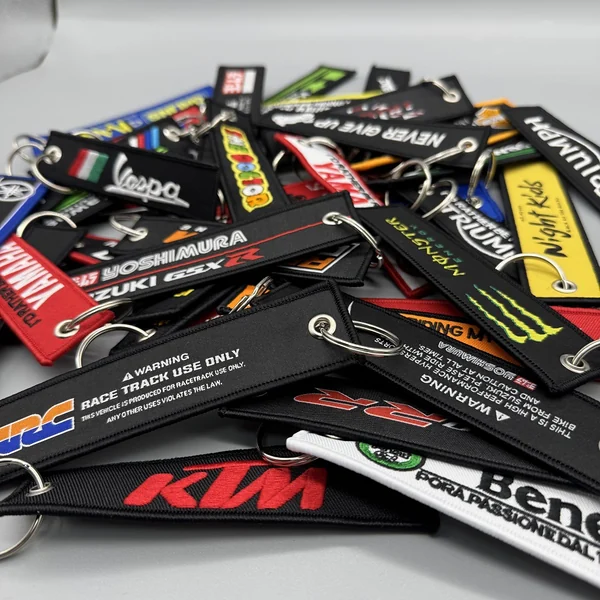
A fabric key tag is a compact textile accessory commonly used with motorcycle keys, car keys, racing merchandise, club products and promotional programs.
A typical construction includes:
- Embroidered or woven textile artwork
- Flat fabric body
- Finished or reinforced edges
- Metal eyelet
- Split key ring
Compared with a conventional metal keychain, the textile body creates a larger branding area and a distinctive merchandise appearance.
Depending on the logo, the artwork can be produced using either computer embroidery or a woven technique.
Production Overview: From Logo to Finished Key Tag
A typical custom key tag project can be divided into the following stages:
- Artwork review
- Embroidery or woven method selection
- Artwork preparation
- Color selection
- Textile logo production
- Cutting and shape preparation
- Front and back assembly
- Edge finishing
- Metal eyelet installation
- Key ring assembly
- Quality inspection
- Packaging and shipping
The exact workflow can vary according to the product structure, size and artwork, but these stages cover the main manufacturing decisions that B2B buyers should understand.
Step 1: Artwork Review Before Production
The production process should begin with the artwork—not with the machine.
Before embroidery or weaving starts, the logo needs to be evaluated at the intended finished key tag size.
What Should Be Checked?
- Smallest lettering
- Thin lines
- Logo proportions
- Number of colors
- Spacing between design elements
- Front and back artwork
- Metal eyelet position
- Finished product dimensions
This step is especially important because artwork that looks clear on a computer screen may not reproduce the same way when reduced to a textile product only a few centimeters wide.
Why Small Text Creates Problems
Small lettering is one of the most common issues in fabric key tag production.
For example, a logo may contain:
- A main brand name
- A small slogan
- A website
- A model name
- A registered mark
The main logo may be easy to reproduce, while the smallest text determines whether embroidery or woven production is more appropriate.
This is why a professional custom key tag manufacturer should review the complete artwork rather than quoting only from the overall logo dimensions.
Step 2: Decide Between Embroidery and Woven Production
Once the artwork is reviewed, the next step is selecting the textile production method.
Embroidery
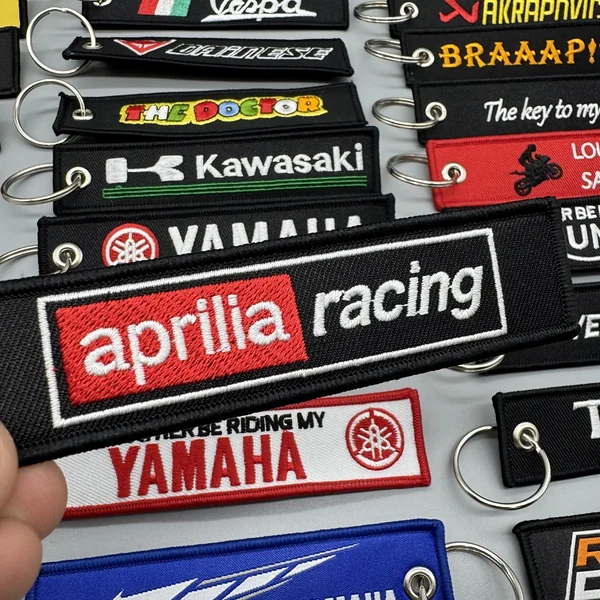
Computer embroidery creates the artwork using visible stitches.
It normally provides:
- Raised texture
- Visible thread structure
- Strong dimensional appearance
- Good performance with bold lettering
- Classic racing and club merchandise styling
Woven
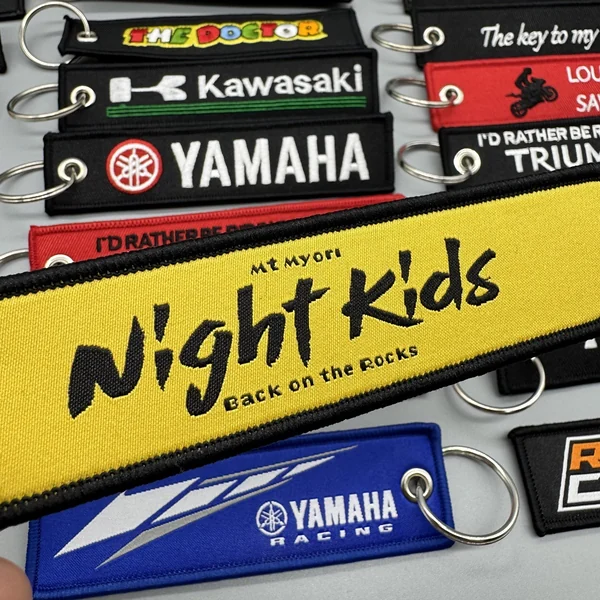
Woven production uses finer yarn to build the design into a flatter textile surface.
It normally provides:
- Finer logo detail
- Better small-text reproduction
- Cleaner thin lines
- Flatter surface
- More precise complex graphics
For a detailed comparison, read our
Embroidered vs Woven Key Tags: Which Is Better for Your Logo?.
Step 3: Prepare the Artwork for Textile Production
The original customer artwork normally needs to be translated into production-ready textile information.
For embroidery, the design must be prepared so the machine understands stitch direction, density, sequence and color changes.
For woven production, the artwork must be converted into a layout that can be reproduced through woven yarn structure.
This is different from simply sending a JPG file directly to a machine.
Artwork Adjustments May Include:
- Increasing very small text
- Thickening thin lines
- Adjusting spacing
- Simplifying unnecessary detail
- Moving artwork away from the eyelet area
- Balancing the front and back layouts
Any adjustment that affects the appearance of the original logo should be confirmed with the buyer before bulk production.
Step 4: Select Thread or Yarn Colors
Color selection is another important production stage.
For custom projects, buyers may provide:
- Pantone references
- Brand guidelines
- Previous approved samples
- Physical color references
The factory then selects practical embroidery thread or woven yarn colors according to the available material and target appearance.
Why Textile Colors May Look Different From a Screen
Digital RGB colors are emitted by a screen, while embroidery thread and woven yarn reflect physical light.
The finished appearance can therefore be influenced by:
- Thread or yarn material
- Surface texture
- Lighting
- Viewing angle
- Background color
For color-sensitive OEM orders, physical sample confirmation can be useful before bulk production.
Step 5A: Embroidered Key Tag Production
For an embroidered key tag, the logo is formed through computer-controlled stitching.
The production system follows the prepared embroidery file to create the design using the selected thread colors.
Important Embroidery Factors Include:
- Stitch density
- Stitch direction
- Letter clarity
- Color sequence
- Thread tension
- Logo coverage
- Overall shape
The goal is not simply to use more stitches. Excessive stitch density can also make a small textile product unnecessarily stiff or crowded.
The correct balance depends on the artwork and finished size.
Step 5B: Woven Key Tag Production
For a woven key tag, finer yarn is used to reproduce the artwork through the woven textile structure.
Because the design is constructed differently from embroidery, woven production is often better suited to:
- Detailed brand marks
- Fine lettering
- Thin outlines
- Complex symbols
- Multiple small design elements
The finished surface is typically flatter and smoother than embroidery.
Step 6: Cutting and Shape Preparation
After the textile design is produced, the material needs to be prepared to the required finished dimensions.
Size consistency is important because even a small difference can affect:
- Logo alignment
- Front and back registration
- Eyelet position
- Finished product appearance
- Retail packaging fit
One common motorcycle key tag format is approximately 13 × 3 cm, but custom dimensions can be developed according to the artwork.
Step 7: Front and Back Assembly
Many fabric key tags use artwork on both sides.
The front and back may contain:
- The same logo
- Different logos
- Logo + brand name
- Club name + chapter
- Racing team + number
- Brand logo + slogan
During assembly, alignment matters.
A key tag can look poorly made even when both individual sides are correct if the front and back are noticeably misaligned.
Step 8: Edge Finishing
The outer edge is an important part of the final visual quality.
Edge finishing helps:
- Maintain the product shape
- Create cleaner corners
- Reduce loose fibers
- Keep the front and back aligned
- Improve overall appearance
The edge color can also become part of the design.
For example, a black body with a red border can create a very different merchandise appearance from a completely black construction.
Step 9: Install the Metal Eyelet
The metal eyelet is a small component, but its position and installation quality are important.
The eyelet creates a reinforced opening where the key ring connects to the textile body.
During Eyelet Installation, Check:
- Position
- Alignment
- Metal finish
- Secure installation
- Distance from the edge
- Clearance from important artwork
One common artwork mistake is placing a logo or small text too close to the eyelet area.
For this reason, the hardware position should be considered during artwork preparation rather than at the final assembly stage.
Step 10: Add the Split Key Ring
After the eyelet is installed, the split key ring can be assembled.
The key ring specification may include:
- Diameter
- Wire thickness
- Metal finish
- Opening tension
For most standard motorcycle and automotive fabric key tags, this is a straightforward component, but buyers developing private-label products should still confirm that the ring specification is consistent with the approved sample.
Step 11: Quality Inspection Before Packing
Quality control should evaluate the complete product—not only the logo.
For custom embroidered and woven key tags, common inspection points include:
- Product dimensions
- Logo clarity
- Small-text readability
- Color consistency
- Embroidery or woven quality
- Front and back alignment
- Edge finishing
- Loose threads
- Eyelet position
- Eyelet installation
- Key ring assembly
- Overall shape
- Quantity
- Packaging accuracy
Why Small Textile Products Still Need Serious QC
A fabric key tag is inexpensive compared with many automotive products, but that does not mean quality problems are invisible.
Because the product is small, buyers often notice defects immediately.
Typical Problems Can Include:
- Crooked logo
- Different finished lengths
- Loose embroidery threads
- Unreadable small text
- Uneven edges
- Misaligned front and back
- Eyelet installed too close to the logo
- Loose eyelet
- Incorrect key ring
- Mixed colors within one batch
For repeat OEM programs, an approved sample is useful as a reference for future production.
Step 12: Packaging for Wholesale, Retail or Promotional Use
The final production stage is packaging.
The correct packing method depends on how the buyer will distribute the product.
Common Options Include:
- Bulk packing
- Individual polybags
- Custom backing cards
- Printed paper cards
- Barcode labels
- SKU labels
- Custom stickers
- Retail-ready packaging
- Multi-item merchandise sets
For e-commerce sellers, distributors and retail merchandise buyers, packaging should ideally be discussed during quotation rather than after the bulk products are already finished.
How Long Does Custom Key Tag Production Take?
There is no single production time for every order.
The schedule can be affected by:
- Artwork complexity
- Embroidery or woven process
- Sample requirements
- Order quantity
- Custom colors
- Hardware availability
- Packaging requirements
- Current production schedule
For B2B projects with a fixed event or product launch date, the required delivery date should be provided at the quotation stage.
This allows the manufacturer to evaluate sampling, production and shipping together rather than treating each stage separately.
Sample Production vs Direct Bulk Production
Whether a physical sample is necessary depends on the project.
A Physical Sample Is Especially Useful When:
- The logo is new
- Small text needs verification
- Brand colors are important
- The buyer is comparing embroidery and woven
- The product size is customized
- Retail merchandise quality is important
- The order quantity is large
- The product will be reordered repeatedly
For established repeat orders using an already approved specification, the production process may be simpler.
How to Compare Samples From Different Key Tag Suppliers
When sourcing from several manufacturers, do not compare only whether the sample “looks good.”
Compare the same technical points:
| Inspection Item | What to Compare |
|---|---|
| Logo | Detail, readability and proportions |
| Colors | Consistency with approved targets |
| Dimensions | Finished length and width |
| Edges | Shape, consistency and loose fibers |
| Front / Back | Alignment and orientation |
| Eyelet | Position, finish and installation |
| Key Ring | Diameter, thickness and finish |
| Overall Feel | Textile texture, stiffness and finished appearance |
This makes supplier comparison much more objective than comparing price and photographs alone.
What Should B2B Buyers Send Before Production?
A clear RFQ helps the supplier evaluate the project accurately.
Recommended Information Includes:
- Logo or artwork
- Required quantity
- Preferred finished size
- Embroidery or woven preference, if already decided
- Front and back design
- Required colors
- Key ring requirements
- Packaging requirements
- Required delivery date
- Destination country and postal code if shipping is required
If you do not know whether embroidery or woven is suitable, send the artwork first.
The production method can be selected after the logo detail and finished size are reviewed.
How to Evaluate a China Key Tag Factory
International buyers often search for a China key tag manufacturer, embroidered key tag factory or woven key tag supplier.
A useful supplier evaluation should go beyond asking:
“Are you a factory?”
Instead, ask who controls the important stages of the project.
Useful Questions Include:
- Who reviews the customer artwork?
- Who prepares embroidery or woven production files?
- Who confirms thread or yarn colors?
- Who manages sample development?
- Who checks product dimensions?
- Who controls eyelet installation?
- Who performs final quality inspection?
- Can approved samples be retained for repeat orders?
- Can the supplier manage customized retail packaging?
These answers provide more useful sourcing information than a simple manufacturer label.
Working With a Guangzhou Key Tag Manufacturer
For overseas buyers searching for a Guangzhou key tag manufacturer, Guangzhou embroidered key tag supplier or China woven key tag factory, one advantage of working with an experienced supplier is the ability to coordinate several production components within one project.
A custom key tag may involve:
- Artwork preparation
- Embroidery
- Woven textile production
- Cutting
- Edge finishing
- Metal eyelets
- Key rings
- Packaging
- Quality inspection
- International shipping
LOVECOLOUR is a custom lanyard and fabric key tag manufacturer based in Guangzhou, China, supporting OEM and ODM projects for brands, promotional product companies, automotive merchandise sellers, motorcycle clubs and global B2B buyers.
Our role is not only to receive a logo and start production. Artwork, size, logo method and application should be reviewed together before the final specification is confirmed.
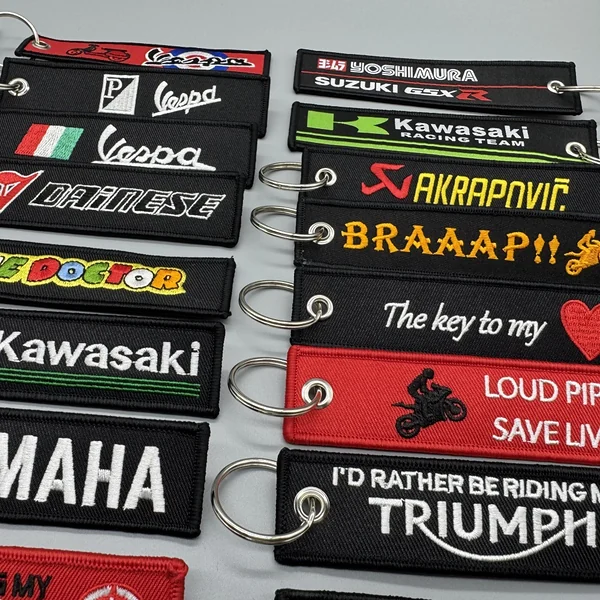
OEM & Private-Label Key Tag Production
For OEM and private-label projects, the buyer may need more than a standard logo change.
Custom options can include:
- Embroidery or woven artwork
- Custom dimensions
- Custom front and back design
- Brand colors
- Border colors
- Metal eyelet finish
- Key ring specification
- Individual packaging
- Backing cards
- Barcode or SKU labels
For a repeat merchandise program, it is useful to keep an approved specification covering all of these points.
Wholesale Key Tags: Why Repeat-Order Consistency Matters
For wholesale motorcycle key tags, promotional distributors and merchandise sellers, the first order is only part of the sourcing decision.
If the product sells well, the buyer may need the same item again six months later.
Repeat-order consistency depends on having clear records of:
- Artwork version
- Finished size
- Thread or yarn colors
- Logo production method
- Eyelet specification
- Key ring specification
- Packaging
- Approved sample
This is why B2B buyers should evaluate not only whether a factory can produce one successful sample, but whether the supplier can manage the product as a repeatable specification.
Common Manufacturing Problems and How to Prevent Them
Problem 1: Small Text Is Not Clear
Cause: Artwork contains details that are too small for the selected manufacturing method.
Prevention: Review the logo at finished size and consider woven construction or artwork adjustment where appropriate.
Problem 2: Logo Looks Different From the Original Artwork
Cause: Textile production cannot reproduce every digital detail exactly.
Prevention: Confirm a production-ready artwork layout before sampling.
Problem 3: Front and Back Are Misaligned
Cause: Assembly or cutting tolerances are not controlled sufficiently.
Prevention: Confirm alignment standards during sampling and inspect during bulk production.
Problem 4: Eyelet Covers Part of the Logo
Cause: Hardware position was not included during artwork planning.
Prevention: Include the eyelet area in the artwork template from the beginning.
Problem 5: Bulk Product Does Not Match the Sample
Cause: The approved sample was not treated as a complete production reference.
Prevention: Record the approved artwork, colors, dimensions, hardware and packaging specifications before bulk production.
Embroidered or Woven: Where Does the Manufacturing Process Differ?
| Production Factor | Embroidery | Woven |
|---|---|---|
| Artwork Preparation | Converted for stitch production | Prepared for woven yarn structure |
| Main Material | Embroidery thread | Finer woven yarn |
| Surface | Raised | Flatter |
| Fine Detail | More limited | Generally better |
| Bold Texture | Excellent | More subtle |
The remaining assembly stages—such as edge finishing, eyelet installation, key ring assembly and QC—can be similar depending on the final product construction.
Frequently Asked Questions About Key Tag Manufacturing
The customer artwork is reviewed and converted into production-ready embroidery information. The design is then stitched using computer-controlled embroidery equipment before the fabric body is cut, finished, assembled with a metal eyelet and key ring, inspected and packed.
The artwork is prepared for woven textile production using finer yarns. The woven design is then finished into the required key tag shape before edge finishing, hardware assembly, inspection and packaging.
Why does woven reproduce smaller text better?
Woven construction generally uses finer yarn than conventional embroidery stitches, allowing more detail to fit into a limited textile area.
Can the front and back use different designs?
Yes. Different logos, text or color combinations can be developed on each side depending on the product construction.
What size should a motorcycle key tag be?
There is no single required size. One common format is approximately 13 × 3 cm, but the final dimensions should be selected according to the artwork, branding requirements and intended use.
Can a factory produce from a JPG or PNG logo?
High-resolution JPG or PNG artwork can often be reviewed, but vector formats such as AI, EPS, SVG or PDF are preferred because they provide cleaner source information for production preparation.
Can I see a digital mockup before production?
Yes. A digital production layout can be prepared to confirm logo position, size, colors and other details before physical production.
Should I make a physical sample?
A physical sample is recommended when the project contains new artwork, important brand colors, custom dimensions, detailed logos or large bulk quantities that require physical verification before production.
Yes. Embroidered and woven key tags can be produced for wholesale buyers, promotional product distributors, motorcycle clubs, automotive merchandise sellers and private-label programs.
Can I customize the packaging?
Yes. Packaging options can include bulk packing, individual bags, backing cards, barcode labels, SKU labels and customized retail packaging.
Can a Guangzhou supplier handle OEM key tag orders?
Yes. Guangzhou-based manufacturers and suppliers may support OEM projects including custom artwork, textile production, hardware selection, packaging and export order coordination. Buyers should confirm the exact capabilities of the supplier they choose.
What should I send for a factory quotation?
Send your logo, quantity, preferred size, artwork requirements, packaging needs and delivery deadline. If you are unsure whether embroidery or woven is more suitable, the supplier can review the artwork first.
Can you manufacture an existing automotive or motorcycle logo?
Production can be based on customer-supplied artwork. Buyers should ensure they have the appropriate authorization or intellectual property rights when using third-party trademarks, registered logos or copyrighted designs.
The Best Manufacturing Process Starts Before Production
The most important part of custom key tag manufacturing is not the final eyelet or key ring.
It is making the correct decisions before production begins.
A reliable workflow is:
- Review the artwork.
- Select embroidery or woven according to the logo.
- Confirm the finished size.
- Plan the eyelet position.
- Confirm colors.
- Approve the production layout.
- Sample when necessary.
- Use the approved specification for bulk production.
- Inspect the complete product before packing.
When those stages are managed correctly, the manufacturing process becomes more predictable and repeat orders become easier to control.
Looking for a Custom Key Tag Manufacturer in Guangzhou, China?
LOVECOLOUR is a Guangzhou-based manufacturer of custom embroidered and woven key tags, lanyards and short key straps, supporting OEM and ODM projects for international B2B buyers.
We work with brands, promotional product companies, automotive merchandise sellers, clubs and other buyers requiring custom textile accessories.
For a new project, send us:
- Your logo or artwork
- Required quantity
- Preferred size
- Embroidery or woven preference, if known
- Reference image
- Packaging requirements
- Required delivery date
If you only have the logo and a reference picture, that is enough to begin the review.
View our
Custom Embroidered & Woven Motorcycle Key Tags,
compare
Embroidery vs Woven Key Tags,
or explore our full
Custom Lanyard & Key Strap Range.