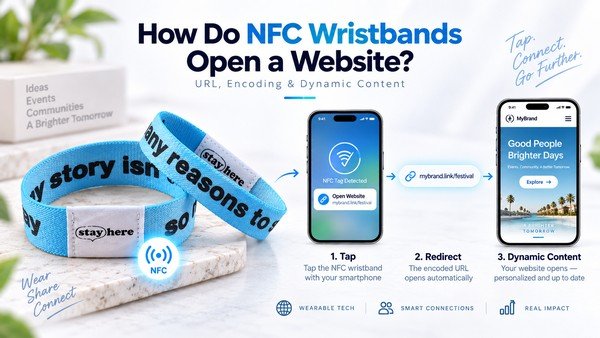
Tap a wristband with a phone. A website opens.
It looks simple — and for the person wearing the wristband, it should be simple.
But for a brand planning to manufacture 1,000, 10,000 or 50,000 NFC wristbands, the important questions begin before that tap:
Which NFC chip should we use? What exactly is stored inside the chip? Can the website change later? Can every bracelet have a different link? Should we lock the NFC data? Do we need an app? Can we add a QR code as backup? And what happens if the brand changes its website two years after the wristbands have already been sold?
These questions matter because an NFC wristband is not just a piece of hardware.
It is a physical product connected to a digital journey.
In this guide, we explain how that journey works — from the NFC chip inside the wristband to the webpage customers finally see.
The Short Answer: How Does an NFC Wristband Open a Website?
For a standard tap-to-web application, the NFC wristband contains a compatible 13.56 MHz NFC tag programmed with a web address.
The basic journey is:
NFC Wristband → Smartphone Detects Tag → URL Appears → User Opens Link → Website Loads
The URL is normally stored using a standardized NFC data format such as an NDEF URI record.
On compatible NFC-enabled smartphones, this makes it possible to connect the physical wristband to online content without requiring the customer to type a URL manually.
For simple website links, a dedicated branded app is often unnecessary, although the exact scanning behavior and notification interface can vary by phone model, operating system and settings.
What Is Actually Stored Inside the NFC Chip?
This is where many first-time buyers misunderstand the product.
If the wristband opens a webpage containing videos, photos, prayers, schedules or membership information, all of that content is not stored inside the NFC chip.
The chip usually stores something much smaller:
a URL.
For example:
https://yourbrand.com/daily
The website stores the actual content.
That distinction is extremely important because even relatively small NFC memory can connect to an enormous amount of online content.
Think of the NFC tag as a digital doorway rather than a miniature hard drive.
The Chip Is Not the Content Platform
This is one of the most useful ways for B2B buyers to think about NFC merchandise.
There are really three separate layers:
| Layer | What It Does |
|---|---|
| Physical Product | The elastic, fabric, silicone or other wristband the customer wears |
| NFC Layer | The chip and antenna that contain or reference digital data |
| Digital Layer | The website, content platform, membership page or campaign experience |
A good NFC project considers all three.
If the wristband looks excellent but scans poorly, the product fails.
If the NFC chip works perfectly but opens a slow or confusing webpage, the customer experience still fails.
And if the digital platform disappears while thousands of wristbands are still in circulation, the physical merchandise loses much of its smart functionality.
NFC product development therefore should not stop at choosing a chip.
Can an NFC Wristband Show Different Content Every Day?
Yes — and this is one of the most interesting applications of NFC wristbands.
The NFC chip does not need to be rewritten every day.
Instead, the wristband can continue opening the same URL while the content behind that URL changes.
The architecture looks like this:
NFC Wristband
↓
Same URL
↓
Website or Content Platform
↓
New Content Today
Tomorrow, the physical NFC wristband can tap to exactly the same URL but the website can display something different.
This makes NFC particularly useful for products designed around repeated engagement rather than a one-time scan.
A Real Product Concept: Daily Prayer or Bible Verse Wristbands
Consider a faith-based merchandise company, church, ministry or Christian gift brand.
Instead of selling a bracelet printed with only one permanent Bible verse, the company can create an NFC elastic wristband that connects the wearer to new content every day.
The customer taps the wristband and opens:
- Today’s Bible verse
- Today’s prayer
- A short devotional
- A reflection or message
- Audio or video content
The next day, the same bracelet can display something new.
The NFC tag has not changed.
The website has.
This same model can be used far beyond faith-based products.
For example:
- Daily affirmations
- Fitness challenges
- Daily meditation
- Language-learning content
- Artist or fan updates
- Event schedules
- Tour content
- Member-only resources
- Loyalty promotions
- New product releases
This is where an NFC wristband becomes more than a promotional giveaway.
It becomes a reusable physical entry point into an ongoing digital relationship.
The Most Important NFC Decision May Not Be the Chip — It May Be the URL
Buyers often spend a lot of time asking:
NTAG213 or NTAG215?
But for a long-term tap-to-web product, another question may matter even more:
What URL will still work three years from now?
Imagine producing 30,000 bracelets with this URL permanently encoded:
yourbrand.com/products/campaign-2026-final-version-2
Two years later, the company rebuilds its website.
The old page disappears.
The wristbands are still sitting in customer homes around the world.
This is why we often recommend thinking about URL architecture before mass encoding.
For NFC Merchandise, Your Domain Becomes Part of the Product
A physical wristband may last for years.
The domain it points to should be planned with the same long-term thinking.
For example, instead of encoding a temporary campaign page directly, a brand could use a short URL under a domain it controls:
tap.yourbrand.com/daily
That URL can then redirect to whatever destination is currently active.
The structure becomes:
NFC Wristband → Controlled Brand URL → Current Content
If the content platform changes later, the brand updates the redirect rather than replacing the physical wristbands.
This creates an important principle for large NFC merchandise programs:
Own the link that your physical product depends on.
A free third-party short-link service may be convenient during testing, but relying on a service you do not control for a product intended to remain active for years introduces unnecessary risk.
Static URL vs Dynamic Destination: They Are Not the Same Thing
The phrase “dynamic NFC” is sometimes used loosely.
In many tap-to-web projects, the NFC data itself is actually static.
The dynamic part is what happens after the URL opens.
| Setup | NFC Data | Can Destination Change? | Typical Use |
|---|---|---|---|
| Direct Static URL | Final webpage | Only if that page remains under your control | Simple permanent pages |
| Controlled Redirect URL | Short branded URL | Yes, destination can be updated | Long-term merchandise |
| One URL per Product Design | Different URL by SKU | Yes, depending on backend | Product collections |
| Unique URL per Wristband | Unique token/link | Yes, depending on platform | Activation, membership, personalization |
Understanding this before production makes data preparation much easier.
Should Every NFC Wristband Use the Same URL?
Not necessarily.
There are several useful data structures depending on the project.
Option 1 — One URL for Every Wristband
All wristbands open the same destination.
This is usually the simplest solution for:
- Daily Bible verses
- Public campaigns
- Artist websites
- Event schedules
- Brand landing pages
It is simple to manufacture and simple to manage.
Option 2 — Different URL for Each Product Design
A brand selling ten different wristband designs may want each design to open different content.
For example:
Design A → Strength
Design B → Gratitude
Design C → Hope
Design D → Peace
Each SKU can point to its own content pathway while all products remain part of the same collection.
Option 3 — A Unique URL for Every Individual Wristband
For more advanced programs, every wristband can contain an individual link or token.
For example:
tap.brand.com/a7x93k
tap.brand.com/m42p8q
tap.brand.com/r9d31n
This can support:
- Product activation
- Unique customer journeys
- Membership onboarding
- Limited editions
- Per-unit analytics
- Personalized content
However, it also creates a more complex manufacturing data workflow.
If 20,000 wristbands each contain unique links, the encoding file, wristband numbering, QR codes and packaging must be carefully controlled.
Do Not Confuse a Unique URL With the NFC Chip UID
This is another important technical distinction.
An NFC chip may have an electronic identifier such as a UID, while the URL stored on the tag is application data.
They are not automatically the same thing.
For a normal tap-to-website experience, a website should not be designed on the assumption that the user’s browser automatically receives the NFC chip’s UID.
If a brand wants each wristband to have a unique web identity, a cleaner approach is often to encode a unique web token into each wristband’s URL and let the website map that token to the correct product record.
For example:
Physical Bracelet #01258
↓
Unique NFC URL Token
↓
Database Record #01258
↓
Customer Experience
This also makes the digital architecture easier to manage independently from the chip hardware.
For Personalized NFC Products, Never Put Sensitive Customer Data Directly in the URL
Suppose a company wants every wristband to connect to a personalized account.
A poor URL structure might expose information directly:
/member/john-smith-email-address…
A better approach is to use a random or non-obvious token:
/p/7km42x9q
The website then looks up the relevant customer or product information securely on the backend.
The wristband should provide the identifier required by the digital experience — not unnecessarily expose personal information in the visible URL.
NFC Does Not Need the Internet — But the Website Does
There are two separate actions happening during a tap.
Step 1: The phone reads the NFC tag.
That short-range NFC communication itself does not require the NFC tag to contain a battery or mobile data connection.
Step 2: The phone opens the website.
At that point, an internet connection is normally needed to load online content.
This is important when designing products for locations with poor mobile coverage.
If the digital experience will be used inside stadiums, remote festivals or crowded venues, website performance and network conditions should be considered as part of the project.
Does an NFC Wristband Need a Battery?
Standard passive NFC wristband tags do not require their own battery.
The NFC interaction is powered through the electromagnetic field created during communication with the compatible reader or smartphone.
This is one reason passive NFC works well for wearable merchandise: the wristband does not need charging simply to provide a basic tap-to-link experience.
Does the Customer Need an App?
For a standard NDEF web-link application on a compatible NFC smartphone, a dedicated product app is often unnecessary.
The phone can detect the NFC tag and provide a way for the user to open the URL.
However, phone behavior is not identical across every model and operating system.
For this reason, brands should avoid packaging instructions that promise one exact screen or notification on every device.
A better instruction is simple:
“Hold the NFC area near the NFC reader position on your phone, then follow the link notification.”
Tap Is Not Scan: Make the Customer Instructions Clear
We often see NFC products described with the instruction “Scan Here.”
Technically, that language is more natural for a QR code.
For NFC, the better customer action is:
TAP
or:
HOLD PHONE HERE
Good wristband or packaging instructions might use:
NFC • TAP HERE
TAP FOR TODAY’S MESSAGE
TAP TO CONNECT
TAP TO UNLOCK CONTENT
This sounds like a small detail, but product instructions affect how quickly first-time users understand what to do.
Where Should the NFC Chip Be Placed Inside an Elastic Wristband?
For an NFC elastic wristband, the electronics need to work without making the product uncomfortable or visually awkward.
Two structures are particularly useful.
Round NFC Antenna Module
A compact round antenna and chip can be positioned beneath a sewn fabric area or brand label.
This creates a defined NFC tapping zone.
The outside label can display:
- Brand logo
- NFC icon
- TAP instruction
- Short message
- Individual number
Thin Flexible NFC Inlay
Another option is a thin flexible NFC inlay integrated into the wristband or label structure.
Customers sometimes describe this as a “paper-thin chip,” but the more accurate product term is flexible NFC inlay.
This can produce a flatter and more discreet smart-wearable design.
It is particularly useful for:
- Private-label bracelets
- Faith-based merchandise
- Fan merchandise
- Membership products
- Retail smart accessories
Whichever construction is selected, actual NFC performance should be tested in the finished wristband rather than judging the electronic component by itself.
Why NFC Antenna Placement Matters More on a Wristband
An NFC inlay tested flat on a table is not the final product.
Once it is sewn into an elastic wristband, bent around a wrist and placed close to the human body, the real reading environment changes.
Performance can be influenced by:
- Antenna size
- Chip and inlay construction
- Bending
- Fabric layers
- Stitching position
- Nearby metal components
- Phone NFC antenna location
- The way the wearer presents the wristband
This is why we recommend testing the actual production construction with real phones before approving a large NFC wristband order.
Which NFC Chip Should You Use for a Website Link?
For many standard smartphone-facing web applications, buyers commonly consider the NTAG21x family.
| Chip | User Memory | Typical B2B Direction |
|---|---|---|
| NTAG213 | 144 bytes | Simple web URLs and common NFC merchandise |
| NTAG215 | 504 bytes | Projects requiring more NDEF data |
| NTAG216 | 888 bytes | Larger NFC data payloads |
For a simple short website URL, NTAG213 is often enough.
A larger-memory chip is not automatically a better product.
Choose based on the actual data requirement.
Do Not Calculate NFC Chip Capacity by URL Characters Alone
The memory number on a chip specification does not mean every byte can simply be treated as one visible character of your final URL.
NDEF formatting and record structure also use space.
Instead of designing an unnecessarily long encoded URL and then choosing a larger chip to accommodate it, consider whether the URL itself can be shorter and better structured.
For example:
yourbrand.com/nfc/daily-prayer-campaign-2026-version4
could potentially become:
tap.yourbrand.com/daily
The second structure is easier to manage, easier to test and easier to communicate to customers.
Should You Keep the NFC Tag Rewritable?
During sample development, keeping the tag rewritable can be useful.
The customer may still change:
- The URL
- The campaign destination
- The final domain
- The NDEF data
- The product workflow
Once everything is approved, the project can determine whether write protection or locking is required.
For suitable chips, the recommended operational thinking is:
Encode → Test → Approve → Protect or Lock if Required → Verify → Pack
Never treat irreversible NFC configuration as the first step.
Locked NFC Does Not Mean the Digital Content Must Be Permanent
This is another advantage of using a controlled URL architecture.
Suppose the NFC tag is permanently locked after being programmed with:
tap.brand.com/daily
The URL stored on the physical chip can no longer be changed.
But the website owner can still change what that address displays or where it redirects.
This gives the project two useful characteristics:
Stable physical NFC data + flexible online content.
For long-term merchandise, that can be a much better balance than repeatedly rewriting the physical tag.
When Should NFC Data NOT Be Locked?
Permanent locking is not appropriate for every project.
Keep the project rewritable when:
- The destination has not been finalized
- The customer wants to reprogram products later
- The wristbands are being used for demonstrations
- The buyer manages changing NFC data directly
For retail products, the correct choice depends on whether protecting the original link or maintaining future rewrite flexibility is more important.
NFC + QR Code: Better Together Than Competing
One of the most useful design decisions for consumer-facing NFC merchandise is adding a QR code as a secondary pathway.
NFC provides:
Tap → Open
QR provides:
Camera → Scan → Open
Using both can be valuable because:
- Some customers are unfamiliar with NFC
- NFC antenna positions differ between phones
- QR provides a visible backup
- A QR code can be placed on the packaging instead of affecting the wristband design
A clean retail configuration might look like:
Wristband: Hidden NFC inlay
Small label: NFC icon + TAP
Packaging card: QR code + instructions
This keeps the physical product attractive while still giving customers an alternative way to reach the digital content.
Should the QR Code and NFC Link Go to the Same Place?
They can, but they do not have to.
For the simplest customer experience, both can point to the same branded redirect.
For more advanced analytics, a business may choose separate source links that ultimately reach the same content.
This lets the company distinguish:
NFC taps from QR scans.
That data can help brands understand how customers actually interact with the product.
Can an NFC Wristband Track Every Customer?
Not automatically.
A standard NFC wristband containing the same public URL on every piece will generally send users to the same webpage.
That website can measure normal web activity, but it does not magically know which physical wristband was tapped.
If per-unit measurement is required, the project should be designed for it.
For example:
Bracelet A → Unique URL Token A
Bracelet B → Unique URL Token B
Bracelet C → Unique URL Token C
The backend can then associate each unique token with a product record.
This distinction is important for brands building:
- Product activation programs
- Limited-edition merchandise
- Loyalty programs
- Member products
- Connected packaging
- Campaign analytics
The NFC Landing Page Is Part of the Product
If a customer taps a beautifully made bracelet and waits eight seconds for a poorly designed desktop page to load, the physical product gets blamed too.
That means the website experience should be treated as part of NFC product quality.
A good NFC landing page should usually be:
- Mobile-first
- Fast to load
- HTTPS secured
- Easy to understand immediately
- Designed around one main action
- Readable without zooming
- Stable over time
The best NFC interaction is not:
“Look, my phone detected a chip.”
It is:
“That was useful.”
What Should Happen After the Tap?
This question should be answered before a wristband enters production.
Examples include:
| Product | After the Tap |
|---|---|
| Daily Prayer Bracelet | Today’s prayer or Bible verse |
| Artist Merchandise | Exclusive fan content |
| Sports Wristband | Team content, schedule or membership page |
| Conference Wristband | Agenda, map or speaker information |
| Fitness Bracelet | Daily workout or coaching content |
| Brand Promotion | Campaign, product page or offer |
| Membership Product | Member portal or activation page |
| Retail Smart Merchandise | Story, authenticity information or ongoing content |
If nobody can clearly answer “what happens after the tap?”, the project probably is not ready for mass production yet.
Do Not Use a Simple NFC URL Tag as a High-Security Credential
A basic NFC wristband designed to open a public URL is excellent for engagement and smart merchandise.
That does not make it the right technology for every security application.
A public URL can be copied and shared.
If a business needs:
- Secure access authentication
- Payment credentials
- High-value product authentication
- Protected membership credentials
the project should use an appropriate secure NFC/RFID architecture and backend rather than assuming that a simple web-link tag provides authentication by itself.
If your project is primarily about gates, ticketing, access control or compatible cashless infrastructure rather than smartphone web interaction, read our NFC vs RFID Wristbands Guide or our RFID Wristband Buying Guide.
From One NFC Bracelet to 50,000 Pieces: The Data Workflow Changes
Programming one sample is easy.
Managing thousands of unique NFC products is an operations project.
For bulk orders, B2B buyers should define:
- How many SKUs are involved?
- Does every wristband use the same URL?
- Are URLs unique by design or by piece?
- Do printed numbers need to match NFC data?
- Does a QR code need to match the NFC link?
- Which product goes into which packaging?
- Does each SKU require its own barcode?
- Should data be locked after programming?
- What testing method is required?
These decisions should be documented before mass encoding begins.
A Practical Variable-Data File for NFC Manufacturing
For a project with individual NFC links, the buyer can prepare a structured spreadsheet or CSV file.
| Piece | SKU | Serial Number | NFC URL | QR URL | Package Barcode |
|---|---|---|---|---|---|
| 0001 | HOPE-M | 000001 | Unique URL A | QR A | SKU Barcode A |
| 0002 | HOPE-M | 000002 | Unique URL B | QR B | SKU Barcode A |
| 0003 | PEACE-L | 000003 | Unique URL C | QR C | SKU Barcode B |
The exact format depends on the project, but the principle is simple:
define the relationship between physical product, digital data and packaging before production.
For Unique NFC Links, Data QC Can Matter as Much as Print QC
A normal custom wristband factory checks:
- Color
- Logo clarity
- Size
- Stitching
- Elasticity
- Packaging
An NFC project adds another quality layer:
- Correct chip
- Correct programmed link
- NFC response
- Correct serial mapping
- Correct QR mapping
- Correct SKU packaging
- Lock status if required
For individual-link projects, the buyer and manufacturer should agree before production whether every unit requires data verification or whether another inspection plan is appropriate.
Before You Produce 10,000 NFC Wristbands, Test the Entire Customer Journey
Do not test only whether the NFC chip can be read.
Test the complete experience:
Wristband → Tap Position → Phone Notification → URL → Redirect → Landing Page → Final Action
Then ask:
- Can a first-time user find the NFC area?
- Does it work with several common phone models?
- Does the URL open correctly?
- Does the redirect work?
- Is the page mobile-friendly?
- Does the QR backup work?
- Does the packaging explain the tap clearly?
- Can the destination still be managed next year?
This is the difference between testing a chip and testing a product.
NFC Elastic Wristbands Are Especially Suitable for Smart Merchandise
For customer-facing merchandise, an elastic wristband provides several useful advantages.
It is:
- Reusable
- Comfortable
- Easy to put on and remove
- Suitable for full-color artwork
- Available in multiple wrist sizes
- Compatible with woven or printed brand labels
- Suitable for custom retail packaging
The outside and inside can carry the same artwork or completely different designs.
A woven label can provide a premium textile logo, while a full-color printed label works well for complicated or gradient artwork.
Custom serial numbering, paper cards, PVC display cards, individual bags, SKU labels and barcode packaging can also be integrated into private-label programs.
See our Custom Elastic Wristbands for the standard version without NFC.
For NFC-enabled smart merchandise, see our Custom NFC Elastic Wristbands.
Think Beyond “NFC Wristband”: Think Smart Merchandise
The same digital architecture does not have to stop at wristbands.
A brand can apply the idea to:
- NFC keychains
- NFC patches
- NFC labels
- NFC lanyards
- NFC hang tags
- NFC promotional gifts
- NFC packaging
This creates an entirely different way to think about promotional products.
The physical item is no longer only carrying a logo.
It can become a persistent entry point to a digital brand experience.
For Private-Label Buyers, Design the Physical and Digital Product Together
An online seller may think they are ordering:
“5,000 custom NFC bracelets.”
In reality, the project may contain:
5 wristband designs × 4 sizes × 5 NFC destinations × 20 SKUs × custom packaging × barcode labels.
This is why private-label NFC programs should be planned as a complete product system.
A good manufacturing brief should include:
- Artwork files
- Wristband sizes
- Quantity by SKU
- NFC function
- Chip requirement
- URL structure
- Variable data file
- QR requirements
- Serial-number requirements
- Label artwork
- Retail packaging
- Barcode / SKU information
- Delivery deadline
How We Would Plan a Custom NFC Wristband Project
Step 1 — Define What Happens After the Tap
Website, daily content, membership page, artist content, product activation or another experience.
Step 2 — Define the URL Architecture
Same URL, branded redirect, URL by SKU or unique URL per wristband.
Step 3 — Select the NFC Chip & Inlay
Choose the chip, antenna structure and wristband integration according to the required experience.
Step 4 — Design the Physical Wristband
Confirm size, artwork, inside/outside printing, label and NFC tap position.
Step 5 — Prepare Variable Data
Provide individual URLs, QR codes, serial numbers and packaging mappings where required.
Step 6 — Make the Sample
Test physical quality and electronic performance together.
Step 7 — Test the Digital Journey
Confirm NFC response, URL, redirect, landing page and phone experience.
Step 8 — Approve Locking Rules
Decide whether the NFC data should remain writable or be protected after final approval.
Step 9 — Bulk Production & Encoding
Manufacture the physical products and complete the approved NFC data-processing workflow.
Step 10 — QC, Matching & Packaging
Verify physical workmanship, NFC functionality, data relationships and retail packaging before shipment.
Frequently Asked Questions About NFC Wristbands and Website Links
Can an NFC wristband open a website?
Yes. A compatible NFC tag can be programmed with a web URL using an NFC data format such as an NDEF URI record. A compatible NFC-enabled smartphone can then detect the tag and offer the user the link.
Do I need an app to open an NFC wristband URL?
For standard compatible NDEF web links, a dedicated product app is often unnecessary. Actual behavior depends on the smartphone model, operating system and NFC settings.
Can an NFC bracelet open a different page every day?
Yes. The NFC chip can continue pointing to the same URL while the website behind that URL changes its content daily.
Do I need to rewrite the NFC chip every day?
No. If the URL remains the same, the website content can be updated without reprogramming the physical NFC tag.
Which NFC chip is best for opening a website?
NTAG213 is commonly suitable for simple URL-based projects. NTAG215 and NTAG216 offer more user memory when additional NFC data is needed.
Can every NFC wristband have a different website link?
Yes. Variable NFC encoding can be used so that different pieces contain different URLs or unique tokens, depending on the project.
Can one NFC wristband have both NFC and a QR code?
Yes. NFC and QR are often useful together. The NFC provides a tap experience while the QR code provides a visible alternative.
Can the URL be changed after the NFC tag is locked?
The URL physically stored on a permanently locked tag cannot normally be rewritten. However, if the encoded URL is a redirect or other address controlled by the brand, the online destination behind that URL can still be changed.
Can the wristband track individual users?
A shared public URL does not automatically identify which physical wristband was tapped. If per-unit identification or analytics are required, unique URLs or another appropriate backend architecture should be planned.
Can an NFC wristband work without internet?
The NFC tag itself can be detected without a mobile internet connection, but loading an online webpage normally requires internet access.
Does an NFC wristband need a battery?
A standard passive NFC tag does not require its own battery for normal NFC communication.
Can NFC wristbands be used for daily Bible verses and prayers?
Yes. The wristband can open a fixed website address while the website publishes a new Bible verse, prayer or devotional message each day.
A compatible NFC tag can store a web URL pointing to a social profile, link page or other supported web destination.
Can an NFC URL wristband be used for access control?
A simple web-link NFC tag should not automatically be treated as a secure access-control credential. Access-control projects should use a credential and security architecture compatible with the actual system.
Can an NFC wristband be used for payment?
A simple programmable URL wristband is not automatically a payment credential. Cashless or payment applications require compatible hardware, software, security and credential technology.
Yes. Depending on the construction, a round NFC antenna module or thin flexible NFC inlay can be integrated beneath fabric or a sewn label. The final product should be tested to confirm real-world NFC performance.
Can I order NFC wristbands with private-label packaging?
Yes. Depending on the project, NFC elastic wristbands can be combined with branded paper cards, PVC display cards, individual packaging, woven or printed labels, serial numbers, SKU labels and barcodes.
The Best NFC Product Is Not the One With the Most Technology
It is the one where the technology almost disappears.
The customer wears the wristband.
They know where to tap.
The phone responds.
The page opens quickly.
The content gives them a reason to come back tomorrow.
Behind that simple experience may be a carefully planned combination of:
Wristband Design + NFC Inlay + URL Architecture + Dynamic Content + Data Management + Packaging + Quality Control.
That is the difference between putting an NFC chip into a bracelet and building a real NFC product.
If you are developing a custom NFC wristband, smart merchandise collection or private-label connected product, send us your artwork, quantity, wristband sizes, NFC function, URL structure, variable-data requirements and packaging idea.
LOVECOLOUR can support the physical wristband, NFC integration, custom branding, data-processing requirements and retail packaging as part of one manufacturing project.
Discuss Your Custom NFC Wristband Project →
You can also explore our complete Custom Wristbands Collection or compare product costs in our Custom Wristband Pricing Guide.