A customer sends a colorful mascot and asks a simple question:
“Can you put this on a slap bracelet?”
Usually, the answer is yes.
But the more useful question is:
Should the design be printed, reproduced in full color, molded as a 3D character, or redesigned as part of the bracelet itself?
Those choices can produce four very different products — with different costs, lead times, tooling requirements and visual results.
That is why designing a good custom silicone slap bracelet should start with the project goal, not with a printing machine.
This guide explains how promotional companies, brands, distributors, event suppliers and merchandise buyers can turn a logo, character or concept into a production-ready silicone slap bracelet — and avoid the most common mistakes before placing a bulk order.
What Makes a Modern Silicone Slap Bracelet Different?
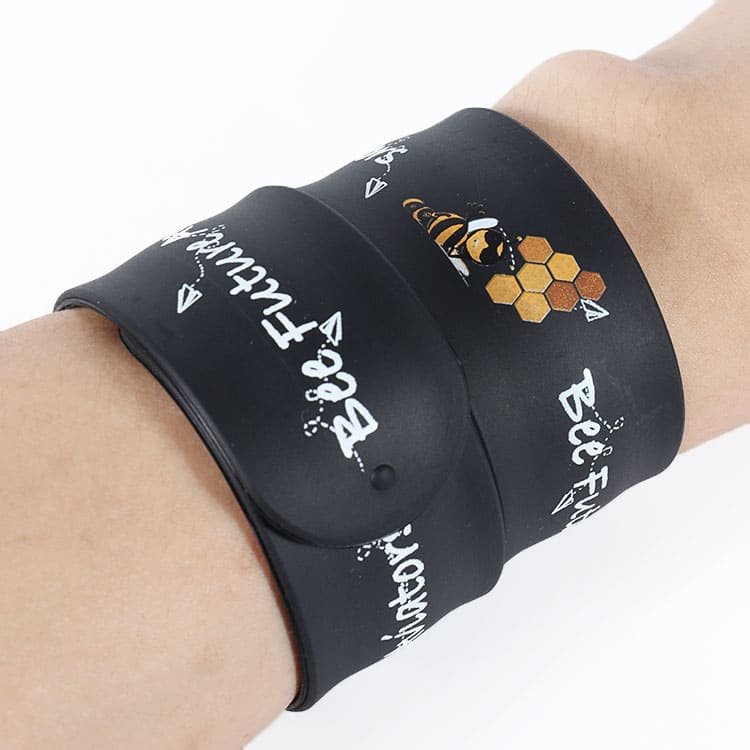
The slap-and-wrap mechanism may be simple, but modern customization can go far beyond a plain colored band with one printed logo.
Today, a silicone slap bracelet project may include:
- Ready-stock bracelet colors
- Custom Pantone-matched silicone colors
- Screen printed logos
- Heat transfer graphics
- UV or full-color artwork
- 3D cartoon characters
- Brand mascots
- Raised silicone details
- Custom molded shapes
- Retail backing cards
- Barcode or branded packaging
This means the product can sit anywhere between a simple promotional giveaway and a fully developed piece of branded merchandise.
The important question is not “How much customization is possible?”
It is:
“How much customization does this particular project actually need?”
Start With the Goal, Not the Printing Method
One of the most common sourcing mistakes is choosing a process before defining what the finished product needs to achieve.
A buyer may ask for UV printing because the artwork contains many colors, even though a molded 3D character would create a much stronger product. Another buyer may request a completely new mold when a stock-color bracelet with a clean screen-printed logo would meet the campaign goal at a much lower development cost.
| Project Goal | Recommended Starting Point |
|---|---|
| Simple promotional giveaway | Stock color + screen printed logo |
| Corporate brand campaign | Custom Pantone color + logo printing |
| Colorful illustration or pattern | Heat transfer or full-color printing |
| Mascot or character merchandise | 3D molded cartoon design |
| Unique branded product | Custom shape + dedicated mold |
| Retail souvenir or gift item | Custom product + retail-ready packaging |
For many B2B projects, choosing the correct customization level at the beginning saves more money than negotiating a few cents from the final unit price.
Stock Colors or Custom Pantone Colors?
Color is one of the first decisions in a silicone slap bracelet project.
There are generally two routes.
Option 1 — Ready-Stock Colors
Stock colors are ideal when speed, simplicity and cost control are the main priorities.
They are particularly useful for:
- Trade-show giveaways
- Short promotional campaigns
- School activities
- Corporate events
- Distributor stock projects
- Orders with short lead times
If an existing color is already close to the campaign theme, there may be little reason to create a new color specifically for a one-time promotion.
Option 2 — Custom Pantone Color
A custom silicone color becomes more valuable when the product itself needs to match a brand identity.
This is more appropriate for:
- Corporate brand colors
- Sports clubs
- Retail collections
- Mascot merchandise
- Tourism products
- Repeat wholesale programs
- Long-term branded products
A practical rule is simple:
If color is part of the brand identity, provide a Pantone reference rather than a screenshot from a phone or computer.
RGB colors displayed on a screen are not a reliable production reference for physical silicone. For projects where color consistency matters, the physical sample should be approved before mass production.
Screen Printing, Heat Transfer, UV or 3D Molded Design?
The same logo can sometimes be manufactured using several different processes.
The best method depends on the artwork, order quantity, expected appearance and budget.
Screen Printing — Best for Simple, Clear Branding
Screen printing is usually a practical solution for:
- Simple company logos
- One-color designs
- Short text
- Event names
- Website addresses
- High-volume promotional orders
When a project only needs a clean logo on a colored bracelet, a complicated production process often adds cost without adding real value.
For simple promotional projects, clarity usually matters more than complexity.
Heat Transfer — Better for More Color and Detail
Heat transfer can be considered when the artwork includes more colors, decorative graphics or repeated patterns.
Typical examples include:
- Multi-color illustrations
- Character artwork
- Repeating graphics
- Promotional patterns
- More detailed branded designs
UV or Full-Color Printing — Useful for Complex Artwork
Full-color printing becomes useful when simplifying the artwork would remove too much of the original design.
It can be considered for:
- Color gradients
- Complex illustrations
- Colorful cartoons
- Detailed logos
- Artwork with many color areas
However, just because an artwork file contains many colors does not automatically mean full-color printing is the best solution.
A cleaner simplified design may sometimes look stronger on a bracelet than a very detailed graphic reduced to a small size.
3D Molded Design — When the Artwork Should Become the Product
This is where silicone slap bracelets become much more interesting.
Instead of printing a mascot onto the bracelet, the mascot can become a raised silicone element attached to or integrated with the band.
This works particularly well for:
- Animals
- Brand mascots
- Cartoon faces
- Food characters
- Tourism icons
- Sports symbols
- Company characters
- Souvenir merchandise
A useful design principle is:
A design that can be printed does not automatically make a good 3D mold.
The artwork usually needs to be adapted for manufacturing.
How Do You Turn a Mascot Into a 3D Slap Bracelet?
This is one of the most important differences between a printing project and a real custom-product-development project.
If a buyer sends a detailed mascot illustration, the factory should not simply copy every line into a mold.
Step 1 — Simplify Very Fine Details
Small eyelashes, thin hair strands, tiny text and narrow decorative lines may look excellent on a computer screen but may not reproduce clearly in molded silicone.
The goal is not to remove the character’s personality. It is to preserve the most recognizable features while making the design production-friendly.
Step 2 — Decide What Should Be Raised
Not every part of the character needs the same height.
Typical raised features may include:
- Face
- Eyes
- Ears
- Logo symbol
- Character outline
- Decorative icon
Good 3D design uses depth deliberately rather than making every part thick.
Step 3 — Separate the Color Areas
A flat illustration may contain shadows, gradients and blended colors.
A molded silicone design often needs more clearly defined production color zones.
This is why the artwork may need to be simplified before tooling.
Step 4 — Control the Thickness
More 3D depth does not automatically mean a better product.
Excessive thickness can:
- Increase product weight
- Increase material cost
- Increase packaging volume
- Make the design feel bulky
- Change how the bracelet sits when worn
The goal is to create enough depth to make the character visually interesting without turning the decorative element into unnecessary weight.
Step 5 — Approve a 2D or 3D Rendering
Before tooling, the buyer should confirm:
- Character proportions
- Logo placement
- Color areas
- Raised and recessed sections
- Overall dimensions
If you are developing a completely new product, our customization process explains how artwork review, sampling and production confirmation can be handled before bulk manufacturing.
Step 6 — Tooling
Once the structure is confirmed, a new mold can be prepared if the design does not match an existing tooling option.
Step 7 — Physical Sample
The physical sample is where a digital idea becomes a real product.
It should be evaluated not only for appearance, but also for thickness, flexibility, surface finish, color and how the bracelet actually feels when used.
When Is a Custom Shape Worth the Tooling Cost?
Not every order should use a new mold.
For a one-time promotional event requiring a simple company logo, stock bracelets plus printing are often the more efficient choice.
A custom mold becomes more reasonable when:
- The product itself needs a unique brand identity
- A mascot or character is central to the project
- The product will be sold at retail
- The buyer expects repeat orders
- A proprietary shape helps differentiate the product
- The perceived value of the item matters more than minimum unit cost
For example, spending money on a complicated new mold for 500 simple conference giveaways may not provide enough benefit.
But for a tourism souvenir or character merchandise program that may be reordered for several years, the tooling cost can be spread across repeat production.
This is why B2B buyers should evaluate tooling as a product-development investment, not only as an extra charge on the first order.
How Do You Choose the Right Silicone Slap Bracelet Size?
Choosing the largest bracelet is not always the best solution.
Size affects:
- Logo visibility
- Artwork space
- Product weight
- Wearing comfort
- Packaging size
- Unit cost
Narrow Designs
Narrower bands work well for:
- Simple logos
- Short text
- Basic promotional giveaways
- Projects where material cost is important
Standard Widths
A medium-width bracelet often provides the best balance between:
- Wearability
- Logo area
- Product weight
- Promotional visibility
For many standard projects, this is the most practical starting point.
Wider Designs
Wider bracelets become useful when the project includes:
- Larger characters
- More detailed artwork
- Large brand logos
- Retail-oriented designs
- Decorative molded features
If the width is increased only because the buyer wants a larger logo, it is worth checking whether a cleaner logo layout on a standard size would achieve the same result at lower cost.
Product Size Is Not the Same as Imprint Area
This is an easy detail to overlook.
A bracelet may be 215 mm long, but that does not mean the entire 215 mm is an ideal printing zone.
The usable imprint area may be reduced by:
- Rounded ends
- Required edge clearance
- Curved areas
- Production tolerances
- The selected printing method
Before finalizing artwork, ask for:
Finished Product Size
The total length, width and thickness of the bracelet.
Recommended Imprint Area
The area where logos and text can be reproduced most reliably.
This is especially important when the artwork includes small text, multiple sponsor logos or detailed illustrations.
The correct sequence is:
Confirm the product and print area first → design the final artwork second.
Not the other way around.
7 Design Mistakes That Make Custom Slap Bracelets Look Cheap
1. Trying to Keep Every Tiny Artwork Detail
A logo or mascot designed for a website may contain details that do not translate well to a small physical product.
Simplification is not necessarily a loss of quality. Sometimes it improves the final result.
2. Choosing Bracelet and Logo Colors With Too Little Contrast
A dark logo on a similarly dark silicone background may look elegant on screen but disappear on the finished product.
Always consider how easily the branding can be recognized at normal viewing distance.
3. Designing to the Full Product Size
The finished bracelet size and the actual printable area are different measurements.
Ignoring this can result in logos being reduced at the final production stage.
4. Sending Screenshots Instead of Production Artwork
Low-resolution screenshots can make clean logo reproduction difficult.
Vector AI, EPS or PDF artwork is usually preferable where available.
5. Making 3D Details Too Thin
Very fine molded lines may lose definition or become difficult to manufacture consistently.
A production-ready 3D design should be visually clean and structurally practical.
6. Using an Expensive Custom Mold for the Wrong Project
A completely new product shape is valuable when uniqueness matters.
It is less valuable when the buyer simply needs an inexpensive branded giveaway.
7. Thinking About Packaging After the Product Is Finished
This mistake is especially common with retail products.
If the bracelet will eventually need:
- A backing card
- Barcode
- Hanging hole
- Retail label
- Branded packaging
those requirements should ideally be discussed before finalizing product dimensions.
Packaging is part of the product system, not an afterthought.
Stock Product or Full Custom Development?
| Factor | Stock Bracelet + Logo | Full Custom Development |
|---|---|---|
| Speed | Usually faster | Requires more development time |
| Tooling | Usually no new mold | May require new tooling |
| Color | Existing stock colors | Custom Pantone color possible |
| Design Freedom | Moderate | High |
| 3D Character | Limited | Excellent option |
| Custom Shape | Limited | Available |
| Best Use | Promotional campaigns | Brand merchandise and retail projects |
Neither option is automatically better.
The right choice depends on whether the buyer values speed and simplicity or differentiation and product identity.
Promotional Giveaway or Retail Product? Packaging Changes the Project
Two identical bracelets can require very different production planning depending on how they will be distributed.
Promotional Giveaway
For free distribution at events, simple packaging may be enough.
Typical solutions include:
- Bulk packing
- Individual clear bags
- Simple grouped packaging
Retail Merchandise
A product intended for retail may need:
- Individual packaging
- Printed backing card
- Brand story
- Barcode
- SKU label
- Hanging hole
- Retail-ready carton configuration
If the final product will be sold in stores, online marketplaces or souvenir shops, the packaging specification should ideally be confirmed during product development.
This avoids discovering after production that the bracelet dimensions do not fit the intended packaging.
What Actually Changes the Price of a Silicone Slap Bracelet?
Two quotations for what looks like “the same slap bracelet” can be very different because the project specification may not actually be the same.
The main cost variables usually include:
- Order quantity
- Bracelet size
- Stock or custom silicone color
- Printing method
- Number of printed colors
- Artwork coverage
- One-side or multi-area printing
- New mold requirements
- 3D design complexity
- Product thickness
- Individual packaging
- Retail packaging
- Sampling requirements
- Shipping method
This is why asking only for:
“Price for 1,000 slap bracelets?”
does not provide enough information for a meaningful comparison.
If you are comparing different wristband materials and quantities, our custom wristband pricing guide provides additional reference information before requesting a final factory quotation.
What Should You Check on a Pre-Production Sample?
A sample should not be approved only because it “looks good.”
For a silicone slap bracelet, check the following areas carefully.
Color
Compare the physical color with the approved reference under reasonable lighting conditions.
If Pantone matching is important, do not rely only on a phone photograph of the sample.
Surface Finish
Check whether the silicone surface is smooth and whether the edges are clean and comfortable.
Logo Quality
Inspect:
- Logo sharpness
- Small text
- Print alignment
- Color registration
- Ink coverage
3D Molded Details
For cartoon or custom shaped products, check whether:
- Facial details are recognizable
- Small molded features remain clear
- Colors are separated cleanly
- Raised areas have sufficient definition
- The decorative element feels proportional to the bracelet
Slap Function
Open and wrap the bracelet several times.
Check that the mechanism works consistently and that the product does not show obvious surface damage during normal sample testing.
Dimensions
Confirm the length, width and thickness against the approved specification.
Packaging Fit
If retail packaging is planned, place the actual bracelet into the intended packaging rather than approving the product and package independently.
This is especially important for thicker 3D cartoon designs.
Why Does Such a Simple Product Still Work for Promotions?
The slap bracelet mechanism is deliberately simple.
That is part of its strength.
It is:
- Interactive
- Wearable
- Reusable
- Easy to demonstrate
- Easy to distribute
- Large enough for visible branding
More importantly, modern manufacturing allows an old familiar product format to be turned into something much more brand-specific.
The mechanism is familiar. The customization does not have to be.
A simple colored band can become a mascot, a retail souvenir, a tourism product or a small piece of character merchandise.
That flexibility is what makes silicone slap bracelets more interesting for modern B2B buyers than the basic mechanism might suggest.
Which Silicone Slap Bracelet Should You Choose?
Use this quick decision guide.
| Your Requirement | Recommended Direction |
|---|---|
| “I need an economical branded giveaway.” | Stock color + simple screen print |
| “Our corporate color must match.” | Custom Pantone silicone + logo printing |
| “Our artwork has many colors.” | Heat transfer or full-color printing |
| “We have a mascot.” | Custom 3D cartoon design |
| “We want a product competitors cannot easily copy.” | Custom shape + dedicated mold |
| “We want to sell it in stores.” | Custom molded product + retail packaging |
| “We mainly need night visibility.” | Consider a reflective slap wristband instead |
If low-light visibility is the main requirement rather than creative silicone customization, compare this product with our custom reflective slap wristbands.
B2B Silicone Slap Bracelet Ordering Checklist
Before requesting a quotation, prepare the information that actually changes the product and price.
| Item | What to Provide |
|---|---|
| Application | Promotion, retail merchandise, school project, souvenir, brand campaign, etc. |
| Quantity | Estimated order quantity and expected repeat volume |
| Product Style | Stock printed, custom color, full-color, 3D cartoon or custom shape |
| Size | Existing size or required dimensions |
| Color | Stock color or Pantone reference |
| Artwork | AI, EPS, PDF or high-resolution reference |
| Printing | Simple logo, full-color artwork or other requirement |
| 3D Design | Mascot, character or custom molded structure if required |
| Packaging | Bulk, individual bag, backing card or retail package |
| Destination | Country or delivery location |
| Deadline | Required arrival date or event date |
A good inquiry does not need to be long. It needs to contain the information that affects production.
Frequently Asked Questions About Custom Silicone Slap Bracelets
What is the best printing method for a silicone slap bracelet?
There is no single best method for every design. Screen printing is usually suitable for simple logos and text, while heat transfer or full-color printing may be better for more detailed artwork. A 3D molded design may be more appropriate when the character or logo should become part of the product itself.
Can silicone slap bracelets be Pantone color matched?
Custom color matching can be produced for suitable projects. If brand color consistency is important, provide a Pantone reference and confirm the physical sample before bulk production.
Can you print a full-color design on a slap bracelet?
Full-color artwork can be produced using suitable processes depending on the bracelet surface, artwork and required result. The design should be reviewed before confirming the printing method.
Can a company mascot be turned into a 3D slap bracelet?
Yes. Mascots, animals, icons and cartoon characters can be adapted into molded silicone designs. The original artwork may need to be simplified so that small details can be manufactured clearly and consistently.
Do custom shaped slap bracelets require a new mold?
A completely new shape or 3D structure will normally require dedicated tooling unless an existing mold already matches the design requirements.
What artwork file should I send?
Vector AI, EPS or PDF files are preferred for logos where available. High-resolution reference images can also be useful for mascots, characters and concept development.
What is the difference between product size and imprint area?
Product size refers to the complete dimensions of the bracelet. Imprint area refers to the recommended usable space for logos or artwork. The printable area is normally smaller than the total product dimensions.
How much detail can a 3D silicone design include?
The practical level of detail depends on the size, thickness and structure of the molded element. Very thin lines, tiny text and extremely small features may need to be simplified before tooling.
Should I choose stock colors or custom colors?
Choose stock colors when speed and simplicity are more important. Choose a custom Pantone color when the bracelet needs to match a specific brand identity or long-term merchandise program.
What should I check before approving a sample?
Check color, dimensions, surface finish, logo quality, printing alignment, 3D molded details, slap function and packaging fit before approving bulk production.
What affects the cost of bulk silicone slap bracelets?
Quantity, dimensions, custom colors, printing method, number of colors, mold development, 3D complexity, packaging, sampling and shipping can all affect the final project cost.
Are silicone and reflective slap bracelets the same product?
No. Silicone slap bracelets are better suited to colorful branding, 3D characters and creative molded designs. Reflective slap wristbands are generally selected when low-light visibility is an important part of the project.
Final Advice: Design for the Product You Actually Need
The most successful custom slap bracelet is not necessarily the one with the most colors, the biggest logo or the most complicated mold.
It is the one where the design, material, production method, budget and final application all make sense together.
For a simple event giveaway, a stock bracelet with a clean logo may be exactly right.
For a branded mascot or retail souvenir, custom color, 3D molding and dedicated packaging may be worth the additional development.
The key is to make those decisions before tooling and sampling — not after mass production has already started.
If you are developing a silicone slap bracelet project, send your artwork, quantity, size, color, application and packaging requirements to LOVECOLOUR. Our team can review the project and recommend an appropriate manufacturing route from artwork preparation and sampling through bulk production.
You can also browse our full range of custom wristbands if you are comparing silicone, reflective, fabric, Tyvek and other wristband options.