These questions matter when ordering custom lanyards for employee ID cards, trade shows, schools, conferences, promotional merchandise and wholesale distribution. A small misunderstanding in the measurement method can affect the finished product, hardware position, badge height and manufacturing cost.
For custom lanyard buyers, understanding the difference between webbing width, flat length, cutting length, finished drop and attachment dimensions is more important than simply choosing a size from a supplier’s catalog.
This practical lanyard size guide explains common width and length references, shows how manufacturers account for folded stitching allowances, and uses four actual LOVECOLOUR production artwork examples to demonstrate why the finished lanyard construction must be considered before cutting the webbing.
The manufacturing examples are drawn from LOVECOLOUR’s lanyard production workflow in Guangzhou, China, where our dedicated custom lanyard manufacturing experience dates back to 2014.
Quick Answer: What Is the Standard Lanyard Size?
A common adult neck lanyard reference is approximately 900mm (35.4 inches) of total flat webbing length, with a nominal folded length of roughly 450mm (17.7 inches) before accounting for the specific assembly, hardware and measurement points. Popular widths include 10mm, 15mm, 20mm and 25mm, with 20mm often selected for corporate branding and events.
However, there is no single mandatory lanyard size for every application. Suppliers may describe dimensions differently, and the finished drop depends on the construction.
| Specification | Common Reference | What Buyers Should Confirm |
|---|---|---|
| Webbing Width | 10mm, 12mm, 15mm, 20mm, 25mm | The actual width of the strap. |
| Adult Flat-Length Reference | Around 900mm / 35.4 inches | Whether the dimension refers to raw webbing, flat finished strap or another measurement. |
| Nominal Folded Length | Around 450mm / 17.7 inches for a simple 900mm loop reference | The exact measurement points and whether sewing, buckles and hardware are included. |
| Shorter or Longer Options | Custom according to application | Required finished drop, user group and accessory construction. |
| Sewing Fold-Back Length (Confirmed Example) | In the confirmed example, the 30 mm dimension specifies the length of webbing folded back for sewing. | Do not treat the width dimension as extra cutting length, or apply the confirmed fold-back value to every joint or lanyard construction. |
| Final Badge Position | Depends on the assembled product | Webbing drop, connector length, holder dimensions and actual wearing fit. |
Always specify what the quoted dimension measures. For example, “20mm × 900mm polyester lanyard” is less precise than a specification that also defines the webbing cutting length, finished drop and attachment configuration.
1. Understanding Lanyard Dimensions: Six Measurements Buyers Should Know
Before comparing lanyard sizes, it is important to distinguish the measurements used in product catalogs, artwork layouts, production instructions and finished-product inspections.
1.1 Lanyard Width
Lanyard width is the measurement across the webbing, usually expressed in millimeters. It affects the available logo area, the appearance of the strap, material consumption and compatibility with certain attachments.
For example, a 20mm printed lanyard offers more space for artwork than a 10mm narrow strap. However, the appropriate width should still be chosen according to the intended use and logo complexity.
1.2 Webbing Cutting Length
Use cutting length to mean the straight webbing allocated to one identified component at the cutting stage. List the main strap and any separate connector tab or detachable lower section individually. Ask production to confirm whether a dimension on printed artwork is an actual cutting instruction or an artwork-layout reference; the labels are not interchangeable without that confirmation.
1.3 Total Flat Length
Total flat length is commonly used to describe the lanyard strap laid out flat. However, suppliers do not always use the term in exactly the same way.
Some refer to the unassembled straight webbing, while others describe the equivalent total length of the finished loop. The reference points should be defined on the artwork or specification sheet.
1.4 Finished Strap Drop
Finished strap drop describes the distance from a defined upper neck reference point to a defined lower point on the assembled lanyard.
It may be measured to the textile connection point, buckle, hook or another agreed reference. These are not necessarily identical measurements.
For this reason, a product described as having a 450mm finished drop should include a drawing showing exactly where the measurement begins and ends.
State whether connectors are fastened and whether the lower detachable section is fitted. If the requirement concerns the textile only, mark where the fabric ends instead of silently extending the dimension to the hook tip.
1.5 Hardware & Attachment Extension
Metal hooks, quick-release buckles, split rings, badge reels and other accessories can add to the overall hanging length or alter the position of the visible webbing connection.
Two lanyards with the same textile dimensions may therefore place their badges at different heights.
1.6 Final Badge Position
Final badge position is the actual location of the attached credential when the complete product is worn.
It depends on the assembled strap, attachment components, badge holder dimensions and the wearer’s body proportions. This is the most practical measurement for organizations that require employee badges to hang within a preferred area.
2. Standard Lanyard Widths: 10mm, 12mm, 15mm, 20mm and 25mm
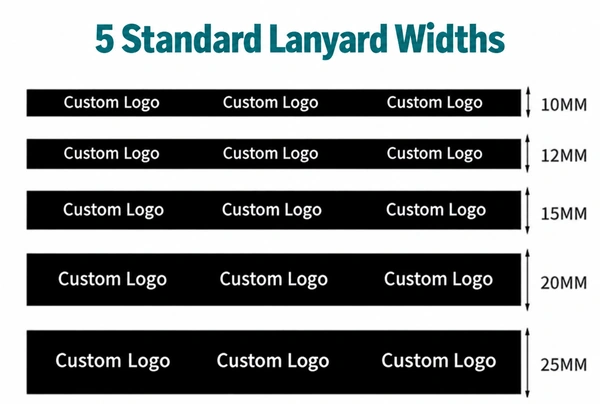
Many custom polyester lanyards use widths between 10mm and 25mm. Other widths can be manufactured for suitable designs and materials.
The correct width depends on printing requirements, comfort, application, hardware and the intended appearance.
| Width | Approx. Inches | Typical Application | Artwork Consideration |
|---|---|---|---|
| 10mm | 0.39″ | Lightweight promotional lanyards and simple identification. | Limited space for small text or complex logos. |
| 12mm | 0.47″ | Compact custom branding and narrow lanyard designs. | Simple repeated artwork is generally easier to accommodate. |
| 15mm | 0.59″ | Staff IDs, company events and general promotional use. | Practical for many standard logos and text designs. |
| 20mm | 0.79″ | Corporate IDs, conferences, exhibitions and full-color branding. | Good starting point for larger logos and more detailed artwork. |
| 25mm | 0.98″ | Premium merchandise, detailed artwork and prominent event branding. | Offers a wider visual area but uses more webbing material. |
Our practical recommendation: For many business and promotional projects, 15mm or 20mm is a useful starting point. A 25mm strap may be preferred when the artwork requires more space, while narrower widths may be suitable when lightweight wear or a subtle appearance matters more.
For detailed comparisons of logo readability, wide vs. narrow webbing and printing methods, read our complete lanyard width selection guide.
3. Standard Lanyard Lengths: What Do 34, 36 and 40 Inches Mean?
Adult lanyard length references are frequently expressed in inches, centimeters or millimeters. A supplier may quote a 36-inch lanyard, a 900mm lanyard or an approximately 45cm folded length.
These descriptions can refer to similar product proportions, but they are not automatically identical technical specifications.
Common Length References
| Nominal Flat-Length Reference | Metric Equivalent | Approximate Geometric Half-Length | Buying Consideration |
|---|---|---|---|
| 30 inches | 762mm | 381mm | Shorter custom reference; verify the actual finished fit. |
| 34 inches | 864mm | 432mm | Shorter adult reference in some supplier catalogs. |
| 36 inches | 914mm | 457mm | Common adult neck-lanyard reference. |
| 40 inches | 1,016mm | 508mm | Longer custom reference. |
The geometric half-length values above are arithmetic references only. They do not include adjustments for folded sewing sections, special hardware, buckle placement or other construction details.
For example, 36 inches is approximately 914mm, not exactly 900mm. Suppliers may round dimensions when describing common products, but production drawings should use the approved actual measurements.
Is a 900mm Lanyard Really 450mm Long?
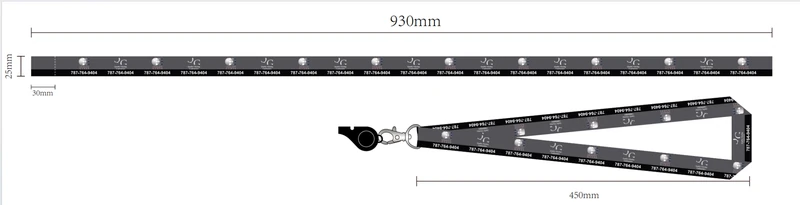
For a simple symmetrical strap loop, half of a 900mm straight length is 450mm. This explains why manufacturers often use 900mm total length and 450mm folded length when discussing standard adult lanyards.
However, the final product may not measure exactly 450mm from the top of the neck loop to the attached hook or badge.
Fold-back stitching, assembly overlap and attachment components must be considered. The finished dimensions should be confirmed using an approved production drawing or physical sample.
Should Children or Younger Users Have Shorter Lanyards?
Some projects may require shorter lanyards for younger users, but length alone does not establish suitability or safety.
For schools and children, review the intended age group, activity, local requirements and the suitability of neck-worn products. Where appropriate, specify a suitable breakaway construction and obtain any necessary safety documentation.
Do not treat an adult lanyard shortened to a particular dimension as automatically safe for children.
4. Factory Examples: Why Cutting Length and Finished Drop Are Different
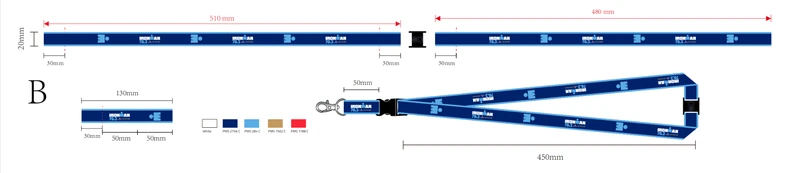
The following four examples are based on actual LOVECOLOUR lanyard production artwork. They demonstrate how different constructions can use different printed webbing dimensions while showing similar nominal finished lengths.
The values are taken from the provided manufacturing drawings. They are drawing references, not independent measurements of completed products worn by a person.
Example A: 20mm Lanyard with Multiple Webbing Sections
The first production drawing shows a 20mm wide lanyard with two main printed webbing sections measuring 510mm and 480mm, giving a combined main layout length of 990mm.
The drawing also shows a separate 130mm printed section associated with the accessory assembly, along with a nominal finished span marked at 450mm.
This illustrates why a detachable or multi-component lanyard cannot always be accurately described using only one total length figure.
The main printed sections and additional component should be listed separately when calculating total webbing consumption and preparing the production specification.
Example B: 20mm Lanyard with an 840mm Main Webbing Layout
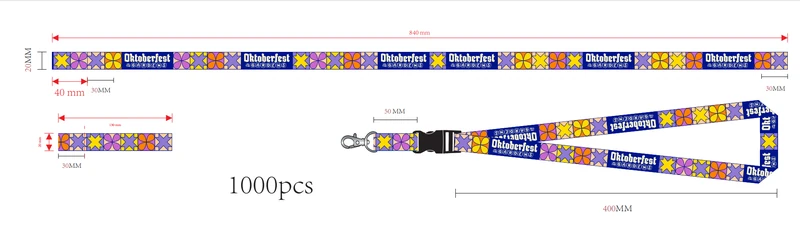
The second production drawing shows a 20mm wide printed lanyard with a main webbing layout marked at 840mm and a nominal finished span of 400mm.
A separate 130mm printed component is also illustrated as part of the accessory arrangement.
This example demonstrates that the main webbing dimension alone does not necessarily represent all textile components used in the completed lanyard.
When quoting or manufacturing a design like this, the production team should confirm each separate webbing section, the required assembly and the finished measurement points.
Inspect the main loop in the specified condition, then inspect the joined assembly with the lower piece and hook installed. A finished reference drawn beside the main loop must not be relabelled as the total drop to the hook or badge. Use the actual joined component geometry when specifying the lower attachment position.
Example C: 25mm Lanyard with a 930mm Webbing Layout
The third production drawing shows a 25mm wide lanyard with a printed webbing layout of 930mm and a nominal finished span of 450mm.
For a construction made from one main strip, such as the arrangement illustrated in reference C, identify the areas turned back or overlapped at the lower attachment before estimating the cut. Those areas are part of the material requirement even when they are not part of the visible loop span. Confirm which folds and attachment points the approved drawing actually uses.
The 930mm dimension should therefore be understood as the length specified on this particular production layout, rather than a universal cutting requirement for every lanyard with a 450mm finished drop.
Example D: 20mm Lanyard with a 990mm Webbing Layout
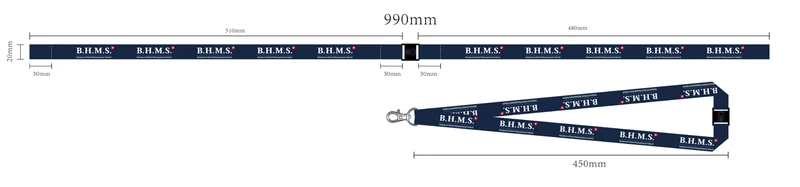
The fourth drawing shows a 20mm wide lanyard with a printed webbing layout of 990mm and a nominal finished span of 450mm.
Although this example and Example C share the same 450mm reference, their marked webbing dimensions are different.
Where a connector interrupts the main strap, as illustrated in reference D, identify the cut ends and the way each end is retained. Mark any change in logo direction or visible artwork at the joint. Record whether the dimensional check is made with the connector fastened. Do not infer a release specification or safety rating from the connector’s appearance.
Comparison of Four LOVECOLOUR Manufacturing Drawings
| Reference | Webbing Width | Main Layout Dimension | Nominal Finished Reference | Additional Detail |
|---|---|---|---|---|
| Example A | 20mm | 510mm + 480mm = 990mm | 450mm | Separate 130mm component shown. |
| Example B | 20mm | 840mm | 400mm | Separate 130mm component shown. |
| Example C | 25mm | 930mm | 450mm | Different lower attachment construction. |
| Example D | 20mm | 990mm | 450mm | Different buckle and assembly layout. |
Important interpretation: These dimensions come from different production drawings. The numerical difference between a layout length and twice the nominal finished span must not automatically be classified as sewing waste. Some examples include separate webbing pieces, different attachment arrangements and different measurement references.
These are useful examples of manufacturing variation, not a controlled experiment in which only the accessory was changed.
What Do These Examples Teach Wholesale Buyers?
Three important lessons can be drawn from these production layouts:
- Two lanyards with the same nominal finished span can require different webbing layouts.
- A lanyard with a detachable or multi-component assembly may require separately measured webbing pieces.
- The correct cutting specification should be based on the actual construction drawing, not calculated from a generic finished length alone.
For bulk custom lanyard orders, provide the approved construction and specify which dimension is the manufacturing cutting length and which is the finished product measurement.
5. How Much Extra Webbing Is Needed for Fold-Back Sewing?
During lanyard assembly, the webbing is often folded back around a hook, buckle or connecting component before being stitched.
This folded section consumes webbing that may not contribute directly to the visible hanging length of the completed product.
In the confirmed example, the 20 mm dimension specifies the width of the webbing.
In the confirmed example, the 30 mm dimension specifies the length of webbing folded back for sewing.
These describe different measurements: width across the strap and length along the section turned back for sewing. Keep them as separate fields on the specification. Do not treat the width dimension as extra cutting length, or apply the confirmed fold-back value to every joint or lanyard construction.
Why You Should Not Apply One Sewing Allowance to Every Lanyard
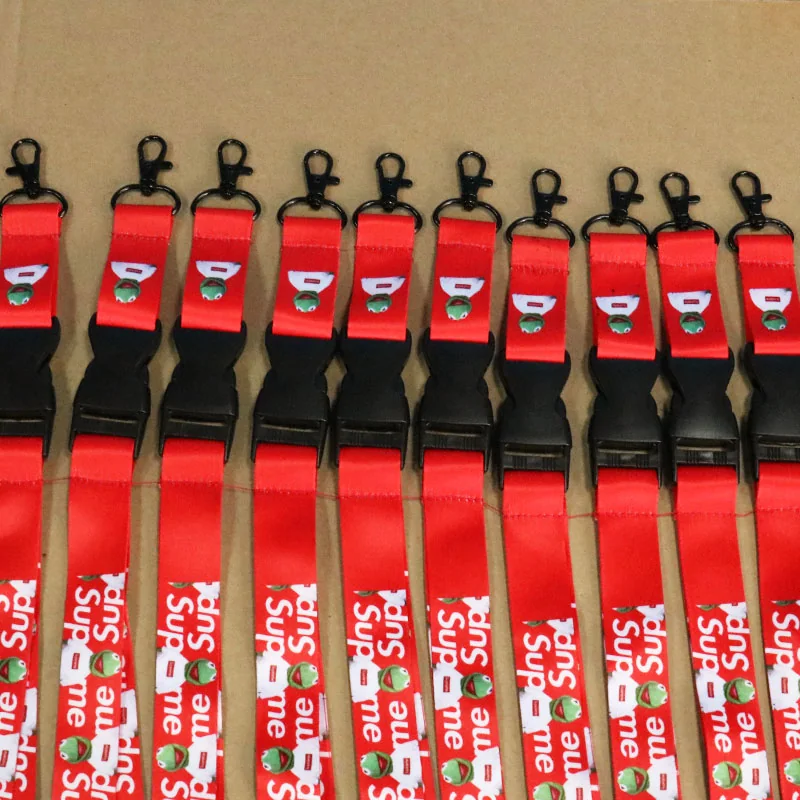
Consider the difference between a lanyard with a straightforward sewn hook attachment and a model with a detachable buckle, an auxiliary strap section or additional connecting hardware.
The two products may have different numbers of cut pieces and different folded sections. They may also use different reference points for the finished dimension.
A Practical Estimation Principle
For a simple symmetrical lanyard made from one continuous piece of webbing, an approximate relationship can be written as:
Visible textile loop length ≈ cut webbing length − material taken up by folds and overlaps.
If the two sides form a reasonably symmetrical loop, the approximate fabric drop can then be estimated from half of the effective loop length.
This simplified relationship is not sufficient for designs containing detachable sections, extra webbing tabs, unusual buckle positions or different measurement endpoints.
The accurate manufacturing dimensions must be defined on the actual production drawing and verified by the approved sample.
Why Fold-Back Allowances Also Affect Artwork Position
Sewing allowances are important not only for material consumption but also for logo positioning.
If an important company logo or text is placed inside an area that will be folded back or covered by a buckle, part of the design may become hidden on the finished lanyard.
Use the construction drawing to keep key text and logos away from areas that will be folded, sewn or covered by fittings. For a printed design, request a layout showing the intended cut and fold positions. For a woven design, have production confirm the relationship between the repeat and the specified joints. Record the inspection stage; do not assume a print-layout measurement is the final assembled measurement.
For a detailed explanation of the manufacturing stages, see our custom lanyard production process guide.
6. How Do Hooks, Buckles and Badge Reels Affect the Finished Lanyard Length?
Accessories change how a lanyard is assembled and how the attached item hangs. This is why buyers should confirm the finished product rather than looking only at the printed strap dimensions.
Standard Metal Hooks
For hooks, rings and buckles, identify the actual component or approved reference. Consider how much it extends beyond the textile attachment and where adjacent components overlap or nest. Adding the full catalogue length of every fitting can double-count part of the assembled connection.
Detachable Quick-Release Buckles
A detachable buckle allows the user to remove the lower section without taking the entire neck strap off.
The buckle itself has a physical length and may require separate webbing sections, folded connections or an additional lower strap.
As demonstrated by the manufacturing artwork examples above, detachable designs should be specified using the actual component dimensions rather than one assumed total webbing length.
Safety Breakaway Connectors
Safety breakaway connectors are used in selected lanyard applications where a release function is required.
The connector position and attachment design can influence the finished construction. Its safety function and any specified release performance must be evaluated separately from the dimensional requirements.
Retractable Badge Reels
A retractable badge reel adds another component between the lanyard and the attached ID card. It may be connected through a metal hook, ring or suitable sewn structure.
The reel housing, connecting hardware and end attachment can all affect the resting position of the card.
The retractable cord length determines how far the badge can extend during use, not the fixed hanging length of the neck strap.
Learn more in our retractable badge reel and lanyard buying guide.
7. Badge Position: How Low Should an ID Card Hang?
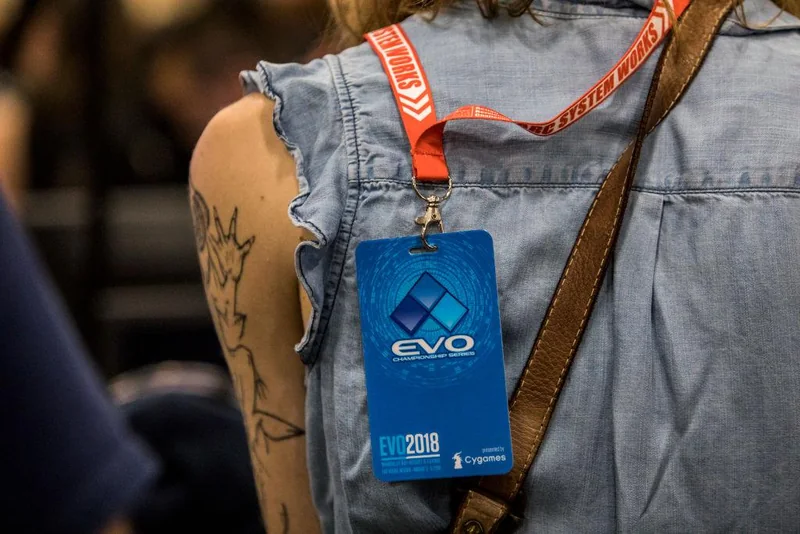
The correct badge hanging position depends on the user’s height, clothing, workplace, access-control system and attached components.
There is no universal rule requiring every employee ID, conference badge or event pass to hang at one exact body position.
For many everyday staff and event applications, the buyer may prefer a comfortable front-of-torso position that keeps the credential visible without causing unnecessary movement or interference.
For access-control applications, the card should also be conveniently reachable for the intended scanner or reader.
Understanding the Full Hanging Assembly
For practical product evaluation, consider the complete chain from the neck to the credential:
Neck reference point → finished textile section → buckle or hook extension → badge holder attachment → badge position.
To determine the position of the top or bottom of a badge, the relevant attachment geometry and holder dimensions must also be considered.
For a straight, vertically aligned assembly, a useful conceptual estimate is:
Approximate badge-top drop = finished textile drop + effective connector extension + distance from holder attachment to badge top.
This is only a measurement framework. Actual wearing position varies with body shape, strap angle, badge orientation and component movement.
Why a 450mm Lanyard May Not Put the Badge at 450mm
If a lanyard drawing specifies a 450mm textile or finished reference, the actual badge may hang lower once a metal hook, detachable buckle or badge holder is attached.
The final badge position must be checked against the fully assembled product.
Recommended Fit Check Before Bulk Production
- Prepare the intended lanyard material and finished construction.
- Attach the actual hook, buckle or badge reel.
- Connect the intended ID holder or event badge.
- Place the complete product on a representative wearer or suitable fitting form.
- Check visibility, comfort, movement and access to the card.
- Record the agreed finished measurement points and approve the sample.
For uniforms, schools, medical environments and industrial workplaces, follow the organization’s actual wearing and safety requirements rather than relying only on a generic length recommendation.
8. Badge Holder Dimensions: Outer Size Is Not the Same as Card Size
Choosing the correct lanyard length is only part of designing a complete employee ID or event credential system.
The attached badge holder can change the overall appearance, weight and hanging position of the product. Buyers should understand the difference between the card size, internal holder dimensions, visible window size and external holder size.
Example A: Illustrated Badge Holder with a Large Display Window
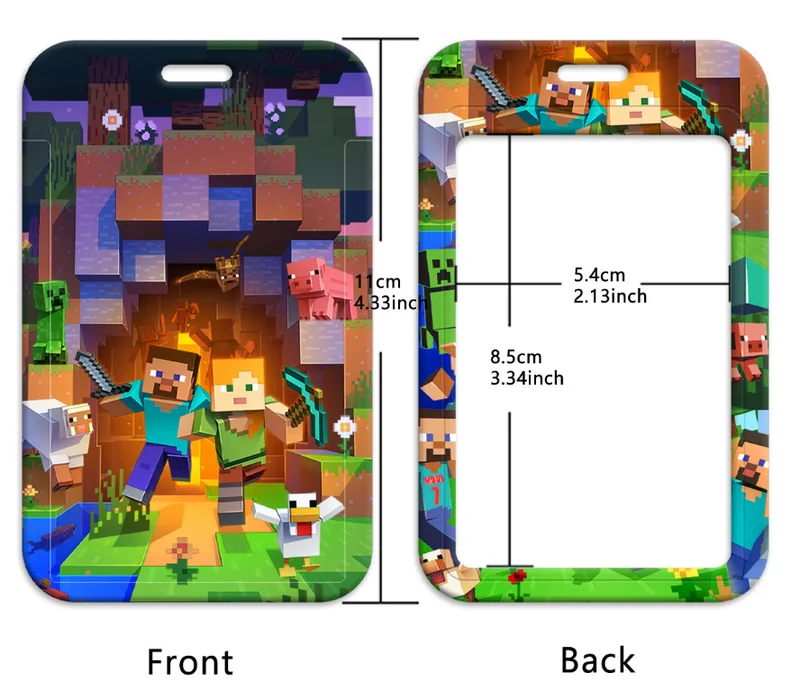
One illustrated badge holder reference supplied for this guide shows an overall height of approximately 110mm and a visible opening marked at 85mm × 54mm.
These dimensions describe different parts of the holder. The window opening should not automatically be treated as the maximum compatible card size.
For a correctly fitting card, the internal pocket dimensions, opening structure and material tolerance must also be confirmed.
Example B: Horizontal and Vertical Clear Badge Holders
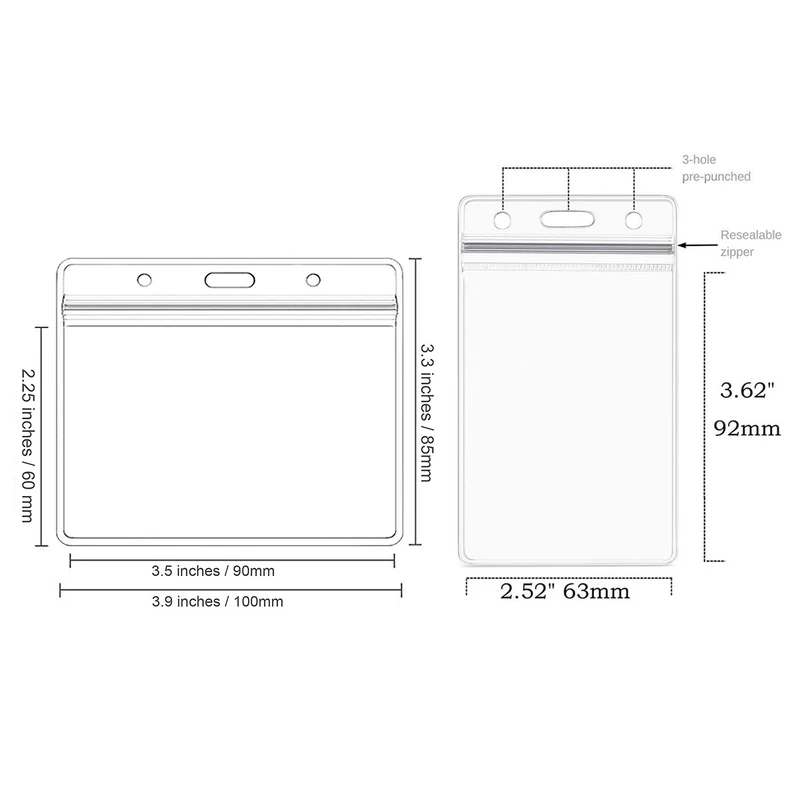
Another supplied reference shows two transparent badge holder constructions with different dimensions and attachment arrangements.
The horizontal holder drawing marks an outer size of approximately 100mm × 85mm and a smaller internal or display-area reference of approximately 90mm × 60mm.
The vertical holder drawing marks an outer size of approximately 63mm × 92mm, with a three-hole attachment arrangement and resealable opening.
These are example model dimensions rather than universal badge holder standards. Buyers must confirm the usable card space for the exact model.
Example C: PU Leather Card Holder
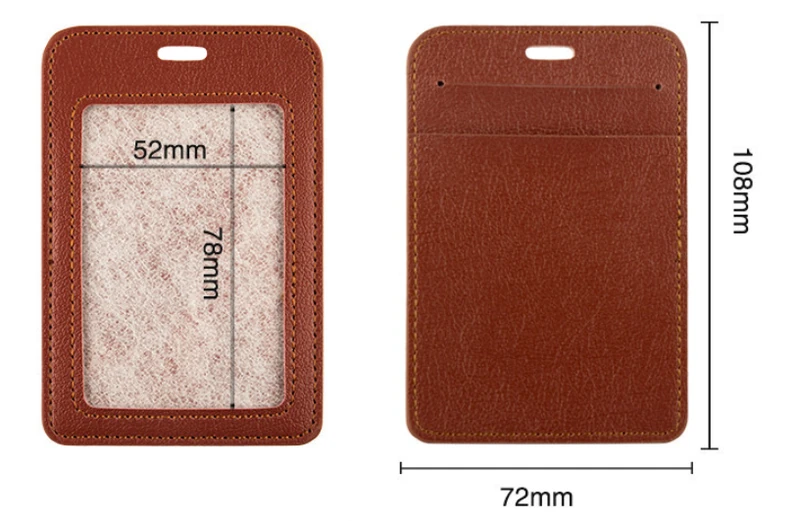
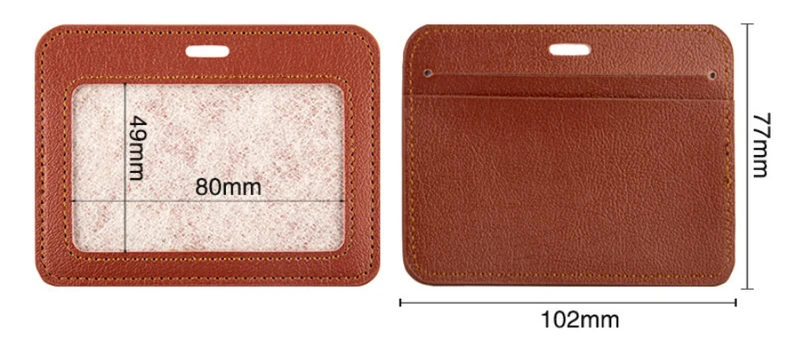
The PU leather holder reference supplied for this guide shows an outer size of approximately 72mm × 108mm, with a visible window marked at 52mm × 78mm.
The visible window is smaller than the external holder because of the surrounding material, stitching and overall construction.
However, the window dimensions do not automatically define the internal card pocket size.
For an employee identification project, the correct card dimensions should be checked against the actual holder’s usable compartment.
Badge Holder Measurement Checklist
| Measurement | What It Means | Why It Matters |
|---|---|---|
| Card Size | Actual physical width, height and thickness of the inserted card. | Determines whether the card fits. |
| Internal Holder Size | Usable card compartment dimensions. | Must accommodate the intended card. |
| Visible Window | Area through which card details can be viewed. | Affects artwork visibility and information display. |
| Outer Holder Size | Overall finished width and height. | Affects appearance and the hanging assembly. |
| Attachment Position | Hole, slot or connecting hardware location. | Influences compatibility and badge position. |
| Orientation | Portrait or landscape. | Must match the intended credential layout. |
The most reliable selection process is to confirm the physical card first, choose a compatible holder second and then evaluate the complete holder-and-lanyard combination.
For more technical information, read our ID badge holder size and selection guide or explore our custom badge holders and retractable reels.
9. How to Choose Custom Lanyard Sizes for Different Applications
Different purchasing projects require different combinations of strap width, length, hardware and attached items.
Instead of assuming that one standard size fits every use, begin with the intended application and finished wearing requirements.
| Application | Suggested Starting Point | Important Size Consideration |
|---|---|---|
| Corporate Employee ID | 15–20mm printed polyester with compatible badge holder. | Check daily wearing comfort and actual card position. |
| Trade Shows & Conferences | 15–25mm according to logo and badge requirements. | Badge dimensions, hook selection and visibility. |
| Schools & Universities | Custom dimensions according to the institution’s requirements. | User age, access needs, safety policy and attachments. |
| Healthcare Administration | Role-appropriate neck lanyard or alternative badge attachment. | Facility policy, hygiene requirements and safe placement. |
| Promotional Giveaways | 10–20mm depending on design and budget. | Logo readability, material use and target cost. |
| Premium Event Merchandise | 20–25mm or another approved custom width. | Artwork presentation and finished appearance. |
| Access-Control Programs | Compatible lanyard, holder and optional badge reel. | Reader reach, attachment geometry and credential position. |
These are product-selection starting points rather than standardized industry requirements.
Buyers should also consider the weight of the attached product, especially when the lanyard carries multiple cards, a badge reel, keys or promotional accessories.
10. How Does Lanyard Size Affect Logo Printing and Production Cost?
Width and cutting length directly influence material consumption. They can also affect printing setup, artwork spacing, production planning and the final product’s appearance.
Wider Webbing Uses More Material
When material type, thickness and construction are otherwise comparable, a wider strap generally consumes more textile material per unit length.
However, material cost is also affected by yarn specifications, webbing construction, production efficiency and the required finish.
Longer Cutting Lengths Affect Material Consumption
A lanyard requiring a longer cut length may consume more webbing than a shorter construction, even when the two products have similar nominal hanging dimensions.
For detachable and multi-component lanyards, suppliers should include all required webbing sections in their material calculations.
Hardware and Sewing Affect Assembly Cost
A basic metal hook, detachable buckle, special attachment or badge reel can require different components and assembly work.
For accurate quotations, the buyer should identify the complete construction rather than comparing two products based only on a strap width and approximate finished length.
Artwork Layout Can Also Influence Production Efficiency
Heat transfer designs need to account for the printing area, logo repeat length, cutting positions and any artwork hidden by folding or sewing.
A good artwork layout should balance visual appearance with practical manufacturing requirements.
Learn more about custom heat transfer lanyard printing and screen printed polyester lanyards with safety and detachable accessories.
11. How to Write an Accurate Custom Lanyard Size Specification
For a purchasing specification, keep a cutting record for production and a finished-assembly record for acceptance. Connect both records to the same drawing revision. This separates the material the factory needs to prepare from the result the buyer needs to receive.
For a custom lanyard project, we recommend confirming the following details.
Recommended RFQ Specification Table
| Specification | Example Information to Provide |
|---|---|
| Product Type | Custom printed neck lanyard. |
| Material | Polyester, nylon, rPET or other agreed webbing. |
| Webbing Width | 20mm, 25mm or a required custom size. |
| Required Finished Measurement | State the target dimension and exact start/end points. |
| Cutting Length | Manufacturer to confirm according to the approved assembly, unless otherwise specified. |
| Number of Webbing Pieces | One continuous strap or a multi-component construction. |
| Fold-Back Allowance | Defined in the approved production drawing. |
| Logo Method | Heat transfer, screen printing, jacquard or another process. |
| Hardware | Actual hook, buckle, breakaway or badge reel model. |
| Card Holder | Type, external dimensions and compatible card size. |
| Sample Approval | Finished dimensions, assembly, artwork and actual fit. |
| Order Quantity | Total quantity and quantity per design or size. |
| Shipping Destination | Country, postal code and required delivery date. |
| Drawing and Artwork Revision | Identify the drawing or marked sample reference, artwork file and revision. |
| Assembly Condition | Name the measurement endpoints and unit, and state whether connectors are fastened and separate sections are fitted. |
| Unconfirmed Dimensions | Leave tolerances and unconfirmed allowances explicitly pending approval. |
| Approval and Change Record | Identify the sample and drawing that govern the order, the recorded measurements and the person responsible for resolving discrepancies. Record changes in a revised approval. |
Example of a Better Lanyard Size RFQ
Instead of writing: “We need 1,000 lanyards, 20mm × 900mm, with metal hooks.”
A more useful inquiry would be:
We require 1,000 custom polyester lanyards with 20mm webbing, full-color logo printing and a specified swivel hook. Our preferred nominal finished strap drop is approximately 450mm, measured between the agreed points shown in the attached reference. Please confirm the required webbing cutting length, fold-back sewing allowance, finished hardware dimensions and badge holder compatibility before preparing the production artwork.
This specification helps the manufacturer identify the intended result while allowing the cutting dimensions to be determined by the actual construction.
12. How to Check Finished Lanyard Dimensions During Sample Approval
For new constructions or orders with specific size requirements, we recommend reviewing the physical sample before mass production.
The sample should be measured using the same reference points that will be used for production inspection.
First, identify the drawing revision, sample and attached components. Set up the product in the agreed condition: joined or detached, connector fastened or open, and reel at rest where relevant. Use a flat support for the specified flat check and arrange the textile without twisting or deliberately stretching it. If a controlled load or another condition is required, record it rather than inventing one.
Step 1: Check Webbing Width
Measure the actual webbing width at suitable points and compare it with the approved specification and any agreed tolerance.
Step 2: Check the Finished Textile Length
Next, show the measurement endpoints on a photograph or annotated drawing. Record the unit, the reference value, the observed result and the measuring method for each required dimension. Keep the production cutting record separate from these finished-sample observations.
Do not compare a raw cutting-length requirement with a finished-loop measurement as if they were identical.
Step 3: Check Buckle and Hardware Dimensions
Confirm the correct attachment model, its position and the dimensions that influence the final assembled product.
Step 4: Attach the Actual Badge Holder
Use the intended card holder and card, especially when the buyer has specified a preferred badge position or access-control requirement.
Step 5: Check the Complete Wearing Position
Evaluate the assembled product on a representative wearer or suitable fitting form and confirm that the credential hangs in an acceptable location.
Resolve differences against the drawing before approval. An acceptable deviation needs an agreed product-specific tolerance; do not substitute a generic tolerance from another strap or catalogue.
Step 6: Record the Approved Sample Specification
Record the finished dimensions, measurement points, attachment models, approved artwork and any agreed tolerances for reference during bulk production and repeat orders.
For consistent wholesale supply, these details are more reliable than relying only on a general description such as “standard adult lanyard.”
For a repeat order, reference the previously approved configuration and identify every requested change. If a component, artwork position or construction changes, ask production which dimensions and checks need reconfirmation. Do not assume a matching product name means the same assembly.
13. Common Lanyard Sizing Mistakes Buyers Should Avoid
Mistake 1: Confusing Cutting Length with Finished Drop
A 900mm cutting reference and a 450mm finished reference may describe related aspects of a lanyard, but they are not interchangeable technical measurements.
Mistake 2: Ignoring Fold-Back Sewing Allowances
Webbing consumed by folded stitching and assembly must be accounted for when preparing cutting instructions.
Mistake 3: Assuming Every 450mm Lanyard Uses the Same Cutting Length
As shown by the LOVECOLOUR production drawings, different constructions may show the same nominal finished span while using different webbing layouts.
Mistake 4: Forgetting Separate Webbing Components
Some detachable or specialty designs contain auxiliary strap sections. These must be included when calculating total material consumption.
Mistake 5: Measuring the Lanyard Without Its Hardware
The final badge position depends on the complete assembly, not just the printed textile strap.
Mistake 6: Treating the Badge Holder’s Outer Size as the Card Size
The card, visible window, inner compartment and external holder dimensions can all be different.
Mistake 7: Using a Generic Standard Without Confirming the Application
Different users, industries and environments may require different dimensions, hardware and wearing arrangements.
Mistake 8: Approving Only a Flat Artwork Image
Flat production artwork does not always demonstrate the final hanging position, sewing arrangement or hardware extension. Physical sampling is useful when these details matter.
14. Frequently Asked Questions About Lanyard Sizes
What is the standard lanyard size for adults?
A common adult neck lanyard reference is approximately 900mm of flat webbing length, with widths such as 15mm or 20mm frequently used for corporate and event applications. However, the finished dimensions depend on the construction and measurement method.
Is a 900mm lanyard the same as a 450mm lanyard?
Not necessarily. In a simple symmetrical loop, 900mm divided by two gives a geometric half-length of 450mm. Folded sewing sections, buckles, hooks and different measurement references can change the actual finished dimensions.
How long is a standard 36-inch lanyard in millimeters?
36 inches equals approximately 914mm. Some catalogs describe adult lanyards using a rounded 900mm reference, but production drawings should specify the actual required measurement.
How much extra webbing is needed for sewing a lanyard?
A sewing allowance belongs to a defined fold or joint. It is not a standard amount to add once to every neck lanyard. Identify the affected component, the fold position and the agreed overlap on the drawing. Do not calculate a universal allowance by subtracting twice a nominal finished span from a different drawing’s main layout length.
Why does a lanyard with a 450mm finished reference sometimes require more than 900mm of webbing?
The cutting layout may need additional material for folded stitching, overlaps, buckle connections or other components. A nominal finished reference may also use different measurement endpoints. The correct requirement must be determined from the approved construction drawing.
What is the difference between a 15mm and 20mm lanyard?
A 20mm webbing strap provides more visual space for logos and graphics than a 15mm strap. The best choice depends on artwork complexity, product appearance, comfort and the intended application.
Does a detachable buckle change the required cutting length?
It can. A detachable construction may require additional webbing sections, different fold-back arrangements or specific buckle positions. The cutting specification should be developed for the actual hardware configuration.
Does the length of a metal hook affect the badge position?
Yes. A hook or connecting component may extend the badge below the textile connection point. The amount depends on the hardware model and assembly geometry.
Ask production to confirm whether the existing cutting instruction still meets the intended finished dimension.
How should I measure a lanyard with a badge reel?
Measure the finished strap using the agreed points, then evaluate the reel housing and attachment as part of the complete assembled product. The retractable cord extension is a separate functional specification.
What is the best lanyard length for an ID badge?
The suitable length depends on the intended wearing position, user’s body proportions, access requirements and badge holder configuration. We recommend checking the complete sample rather than relying on one universal dimension.
Are badge holder dimensions the same as ID card dimensions?
No. The external holder size, visible window, internal compartment and actual card dimensions can be different. Buyers should confirm the usable card space for the selected holder model.
Can I order custom lanyards in different widths and lengths?
Yes. LOVECOLOUR supports custom lanyard dimensions according to materials, printing methods, hardware and order requirements. Provide your artwork, preferred finished measurements, quantity and intended use for evaluation.
Can the existing drawing supply the production tolerance?
Only if a tolerance applicable to that dimension and construction is actually specified and approved. A dimension label or artwork ruler alone does not establish an allowable deviation.
What if there is no approved sample yet?
Use the drawing and component list to prepare a quotation and a review request. Keep unresolved dimensions and acceptance conditions visible. Agree the review process and responsible approver before treating the configuration as ready for production.
15. Final Lanyard Size Checklist Before Bulk Ordering
Before approving a custom lanyard order, confirm the following:
- Required material and actual webbing width.
- Whether the specified length refers to raw cutting length, flat strap length or finished drop.
- The exact measurement start and end points.
- The number and dimensions of separate webbing components.
- The required fold-back sewing and assembly allowances.
- The selected hook, buckle, breakaway or badge reel.
- The intended card holder dimensions and attachment position.
- The approved artwork and cutting layout.
- The actual finished sample and agreed dimensional tolerances.
- Quantity, packaging requirements and delivery destination.
Correct specifications reduce misunderstandings between the buyer, artwork team, production team and final inspection process.
Custom Lanyard Sizes from a Factory-Direct Manufacturer
LOVECOLOUR is a Guangzhou-based custom lanyard manufacturer with dedicated lanyard production experience since 2014.
Our manufacturing workflow includes in-house webbing weaving, transfer-paper printing, heat transfer, cutting, sewing, hardware assembly and packaging.
We support custom polyester, nylon, rPET and suitable specialty lanyard constructions for international B2B buyers, promotional product distributors, corporate purchasing programs, event organizers and private label brands.
Whether you need a standard printed lanyard, a shorter finished drop, a detachable buckle design or a complete ID badge set, our team can review the artwork and required product dimensions to recommend an appropriate manufacturing solution.
Send your intended use, existing drawing or sample reference, artwork revision, attachment selection, requested quantity and destination. Mark the finished dimensions you need and the points used to measure them. Ask the product specialist to confirm component cut lengths, allowances and unresolved acceptance conditions before the final quotation and approval.
Request a Custom Lanyard Size & Manufacturing Quote
Explore related products and resources: Custom Wholesale Lanyards | Lanyard Customization Options | Lanyard Width Guide | ID Badge Holders.
About This Guide
This guide combines general lanyard sizing references with manufacturing insights and production artwork supplied by LOVECOLOUR in Guangzhou, China. The four manufacturing examples illustrate different production layouts and accessory arrangements. They should not be interpreted as universal sizing standards or independently measured finished-product test results.
All custom dimensions, sewing allowances, hardware specifications and acceptance tolerances should be confirmed using the actual approved product design.