RPET webbing is increasingly considered by buyers who need recycled polyester materials for printed lanyards, branded straps, keychains and promotional textile accessories. But a purchasing decision should involve more than finding a supplier advertising “eco-friendly webbing.” Buyers need to know what the material contains, whether the recycled-content claim is supported, how it performs during printing and whether the manufacturer can supply consistent material for repeat orders.
This guide explains how to evaluate recycled polyester webbing, understand GRS and RCS documentation, select widths and roll packing, test sublimation compatibility, reduce manufacturing waste and prepare an accurate wholesale request for quotation.
It also includes practical manufacturing considerations from Guangzhou Lovecolour Garment Accessories Co., Ltd., a Guangzhou-based factory-direct supplier involved in webbing weaving, transfer paper printing, heat transfer, cutting, sewing and lanyard assembly.
Quick Answer: What Should You Check Before Buying RPET Webbing?
Confirm the recycled polyester content and available evidence, identify whether GRS or RCS certification is actually required, choose the correct width and thickness, test the material under your sublimation conditions, and agree on acceptable roll joints, surface cleanliness, length and dimensional tolerances. For bulk orders, compare total usable material cost and supply consistency rather than relying on price per meter alone.
1. What Is RPET Webbing?
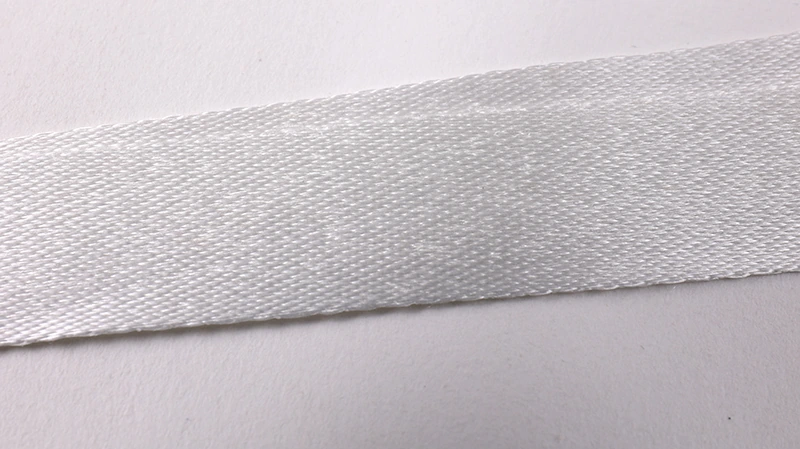
RPET stands for recycled polyethylene terephthalate. In textile applications, it is commonly described as recycled polyester. RPET webbing is a narrow woven textile material made using recycled polyester feedstock, which may originate from qualifying recycled PET sources depending on the supplier and manufacturing process.
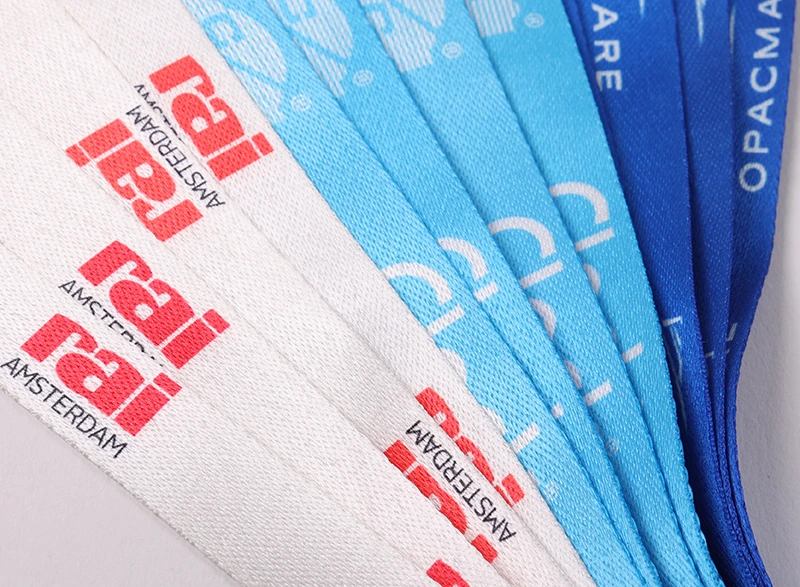
RPET webbing can be manufactured into different widths, constructions, thicknesses and colors. White RPET webbing designed for dye sublimation is especially relevant to businesses producing full-color printed lanyards, wrist straps, key straps and promotional textile products.
The term “RPET” describes a recycled material category; it does not by itself establish a certified recycled-content percentage, environmental impact, or chain-of-custody status. Those claims require appropriate supporting evidence.
Is RPET the Same as Recycled Polyester?
In common textile sourcing terminology, RPET refers to recycled PET polyester. However, a supplier should still identify the actual fiber composition and recycled-content details when the buyer has formal procurement or product labeling requirements.
Does RPET Always Come From Plastic Bottles?
No. Recycled PET feedstock can come from different qualifying material streams. Post-consumer PET bottles are one possible source, but buyers should not assume every RPET webbing product is manufactured from recycled bottles unless that origin is supported by the supplier’s records and relevant certification documentation.
2. Why Do B2B Buyers Choose Recycled Polyester Webbing?
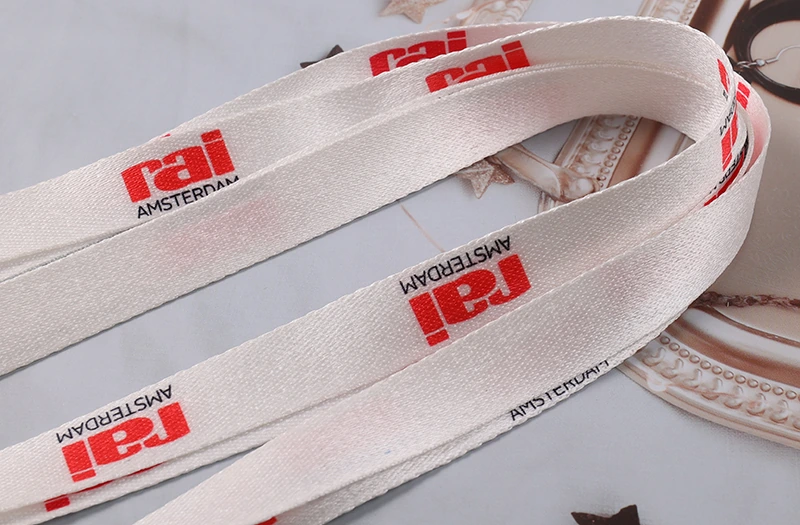
For some apparel brands, promotional merchandise companies and corporate purchasing teams, recycled polyester is part of an established material sourcing specification. RPET webbing gives them an alternative to conventional polyester when an approved recycled-content material is required.
For printing companies and lanyard manufacturers, RPET may also be requested by customers who want branded accessories manufactured from recycled polyester rather than conventional polyester.
Nevertheless, recycled content should not be confused with automatic proof of lower environmental impact. Environmental performance depends on multiple factors, including material source, production energy, chemical processing, product durability, transport and end-of-life treatment.
A responsible supplier should describe the material accurately and provide evidence for specific claims rather than promise that every RPET product is universally more sustainable.
3. GRS vs. RCS: What Is the Difference?
Certification is one of the most important subjects in RPET purchasing because brands and distributors may need documentary evidence before approving material claims.
The Global Recycled Standard (GRS) and Recycled Claim Standard (RCS) are standards developed by Textile Exchange to address recycled material content and chain-of-custody requirements. They are related, but their scope and additional requirements differ.
| Comparison | GRS | RCS |
|---|---|---|
| Full Name | Global Recycled Standard | Recycled Claim Standard |
| Primary Purpose | Verify recycled content and chain of custody, with additional processing requirements | Verify recycled content and chain of custody |
| Additional Requirements | Includes additional social, environmental and chemical processing criteria | Focused on recycled content and material traceability |
| Typical Procurement Use | Programs specifying GRS certification and its applicable requirements | Programs requiring recycled-content verification under RCS |
| Product Claims | Subject to applicable certification, content, chain-of-custody and claim rules | Subject to applicable certification, content, chain-of-custody and claim rules |
Important: A supplier saying “GRS material available” is not the same as providing proof that your particular webbing shipment can be sold as GRS-certified goods. The buyer must verify the applicable scope, transaction evidence and product claim requirements.
For the official standard and claims framework, consult Textile Exchange and its published recycled material standards and claims policies.
4. Scope Certificate vs. Transaction Certificate
Two commonly discussed documents in certified recycled material supply chains are the Scope Certificate (SC) and Transaction Certificate (TC). They serve different functions and should not be confused.
What Is a Scope Certificate?
A scope certificate identifies an organization and the products, processes, facilities or activities covered by an applicable certification. It should be checked for the certified entity, scope, issuing certification body and validity.
For example, a yarn supplier may have a valid scope certificate for certain certified activities. That does not automatically certify every webbing manufacturer purchasing its yarn or every finished product subsequently made from that yarn.
What Is a Transaction Certificate?
A transaction certificate is used to document eligible certified goods in a particular transaction within the applicable chain-of-custody system. It provides evidence linked to a specific certified shipment or transaction and its reported material details.
Where a buyer requires certified goods, the transaction evidence must align with the product, certified content and parties involved. A generic certificate image from another transaction is not sufficient proof for a new purchase.
How Should Buyers Verify RPET Certification Claims?
- Identify whether the purchasing specification requires GRS, RCS or another specific evidence standard.
- Obtain the relevant certificate and verify the legal name of the certified organization.
- Review the document validity period, listed facilities, activities and product scope.
- Confirm the declared recycled-content percentage and source classification where required.
- Check whether the specific ordered goods are eligible for the requested certified claim and transaction documentation.
- Verify certificate details with the appropriate certification body or official verification service when available.
- Ensure product labels, website statements and customer declarations do not claim more than the evidence supports.
LOVECOLOUR has RPET material documentation available for buyer review. The exact certificate type and coverage should be evaluated for each project. Buyers should not interpret material documentation alone as automatic GRS certification of the finished webbing or completed lanyard.
5. Is 100% RPET the Same as 100% GRS Certified?
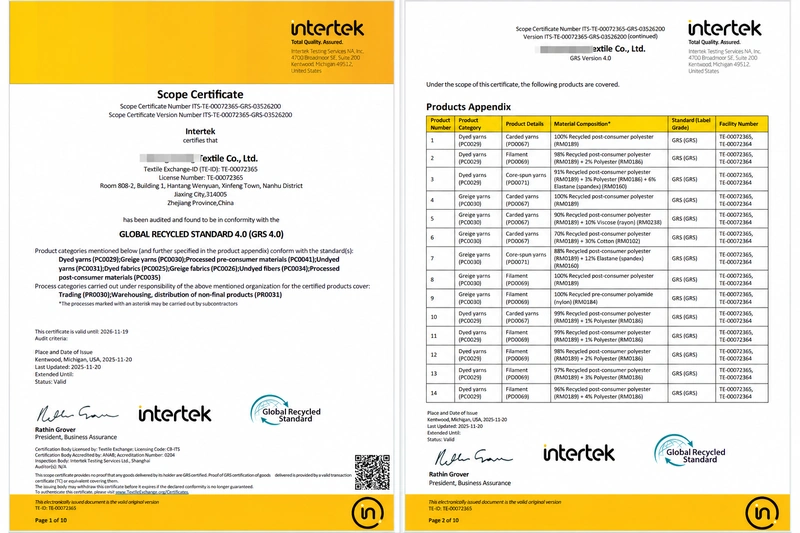
No. “100% RPET” describes a material composition claim, while a certified-content statement describes the scope of an applicable certification and chain-of-custody system.
A webbing product may be described as made entirely from recycled polyester based on its verified composition without necessarily being eligible for a GRS-certified product claim. Conversely, a certification claim must follow the relevant standard, content thresholds, documentation requirements and labeling rules.
For buyers, the correct approach is to specify both the required material composition and any required certification separately in the RFQ. Do not assume that a supplier’s general material description answers both questions.
6. Can RPET Webbing Be Used for Sublimation Printing?
Yes, appropriately constructed RPET webbing can be suitable for dye sublimation printing because it is based on polyester chemistry. White recycled polyester webbing is therefore a practical option for buyers who want to combine recycled material requirements with detailed, full-color printed graphics.
However, conventional polyester and RPET webbing should not automatically be treated as having identical printing performance. Yarn characteristics, weave density, finishing, dimensional stability and process settings may differ between materials and production batches.
For a printing company, the most useful confirmation is a sample printed on the actual production equipment using the intended transfer paper, ink and machine settings.
Recommended RPET Sublimation Test
- Record the webbing material, width, approximate thickness and sample identification.
- Measure a marked sample length and width before heat transfer.
- Print representative artwork including solid colors, fine text, gradients and repeated patterns.
- Run the transfer using the equipment and settings intended for bulk production.
- Allow the printed webbing to cool under a consistent testing procedure.
- Inspect print clarity, color uniformity, ghosting, wrinkles and surface appearance.
- Measure the same marked sample to assess dimensional change.
- Test downstream cutting, sewing and hardware assembly where required.
- Record the results and retain the approved reference sample for repeat purchases.
What Temperature Should Be Used for RPET Sublimation?
There is no universal setting that can be guaranteed for every RPET webbing, transfer paper, ink system or machine. Sawgrass publishes a general polyester fabric reference of approximately 205°C (400°F), 45 seconds and medium pressure for suitable flat heat press applications, while emphasizing that testing and equipment-specific recommendations are necessary.
These figures are not a validated specification for LOVECOLOUR RPET webbing or for industrial continuous roll-to-roll printing. Always establish approved conditions through actual testing.
Technical reference: Sawgrass Sublimation Heat Press Settings.
7. How to Choose the Right RPET Webbing Width and Thickness
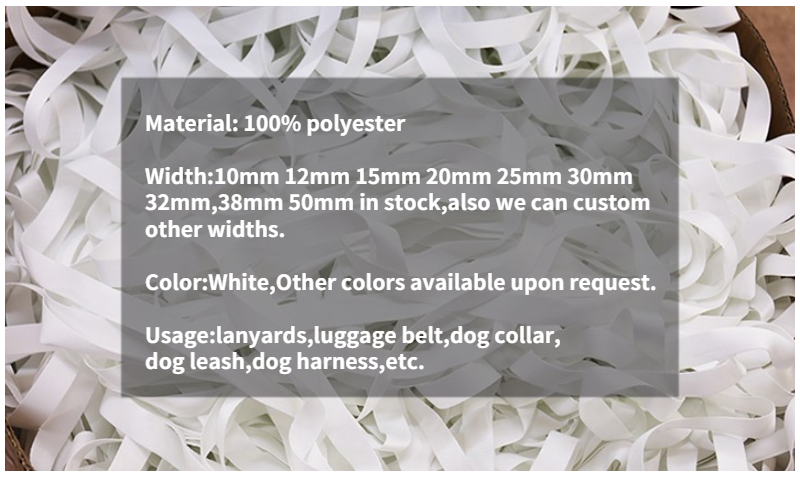
When sourcing blank RPET webbing for lanyards and related accessories, buyers must consider print area, material handling, finished appearance, hardware compatibility and downstream manufacturing requirements.
LOVECOLOUR maintains regular blank white RPET webbing stock in seven widths, with an approximately 0.6mm standard thickness: 10mm, 15mm, 20mm, 25mm, 30mm, 38mm and 50mm.
| Width | Typical Applications to Evaluate | Purchasing Consideration |
|---|---|---|
| 10mm | Narrow printed straps and small accessories | Limited print area |
| 15mm | Slim ID lanyards and short key straps | Suitable artwork size and hardware |
| 20mm | Corporate and event lanyards | Print visibility and equipment compatibility |
| 25mm | Wider branded lanyards | Larger artwork and matching fittings |
| 30mm | Wide promotional straps | Printing and cutting equipment |
| 38mm | Wide textile accessories | Finishing and attachment design |
| 50mm | Wide branded straps and suitable luggage accessories | Required strength and end-use testing |
For common promotional lanyard projects, 15mm, 20mm and 25mm are useful widths to consider. However, the correct specification depends on the finished product and approved sample rather than a universal recommendation.
For load-bearing or safety-related products, width and polyester composition alone do not establish suitability. Request the appropriate strength and product performance evidence.
Review our webbing materials and manufacturing options or ask about available RPET widths.
8. Why Do Roll Joints Matter in RPET Webbing Printing?
Frequent webbing joints can affect production continuity, especially for printing businesses using automated or roll-to-roll equipment. A joint may require an operator to stop the machine, remove material, adjust webbing tension or discard a printed section.
For this reason, bulk buyers should compare suppliers based on roll continuity as well as price, material composition and certification documents.
At LOVECOLOUR, our webbing preparation and winding practices focus on reducing unnecessary joints. When an application requires specific continuity standards, buyers should define the maximum acceptable number of joints per roll or request a particular joint-handling arrangement before confirming an order.
Do not treat the general phrase “low-joint webbing” as a verified zero-joint specification unless it has been explicitly agreed.
9. Why Are Surface Cleanliness and Pre-Ironing Important?
White RPET webbing is commonly used as a printable base. Dirt, stains, oil marks and visible surface defects may interfere with appearance and create waste after sublimation transfer.
Material defects discovered after transfer can be more expensive than defects identified beforehand because the buyer may already have consumed transfer paper, ink, machine time and labor.
LOVECOLOUR emphasizes clean webbing handling and prepares regular material by ironing and flattening before winding. These production practices are intended to support downstream handling and reduce avoidable material loss.
However, pre-ironing should not be represented as a laboratory guarantee of zero shrinkage under every printing condition. Buyers should validate dimensional stability through an agreed test procedure and acceptance tolerance.
10. How to Measure RPET Webbing Shrinkage
Dimensional stability is important when printed artwork must align with repeated cutting marks, sewing positions or finished product dimensions.
To evaluate shrinkage, use a representative sample, mark a measured length, apply the intended heat transfer process and remeasure after cooling. The test should use consistent measuring and handling conditions.
Length change percentage = (Length after processing – Original length) / Original length × 100.
For example, if a 1,000mm sample measures 994mm after printing, the measured length change is -0.6%. This is an illustrative calculation and not a measured result for any specific LOVECOLOUR RPET product.
For production approvals, it is better to define an acceptable change percentage and a repeatable test method than to use unsupported claims such as “completely shrink-proof.”
11. RPET vs. Virgin Polyester Webbing: Which Is Better?
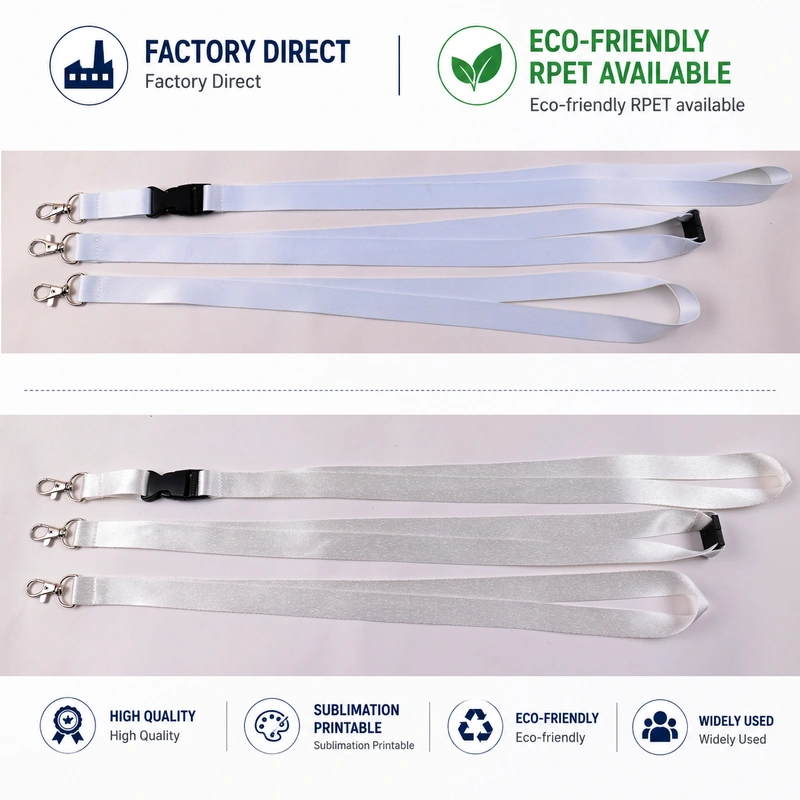
Recycled polyester and conventional polyester can both serve lanyard and promotional textile markets. The right choice depends on the purchasing requirement, product design, material evidence, printing compatibility, cost and repeat supply conditions.
| Factor | Conventional Polyester | RPET |
|---|---|---|
| Material Source | Conventional polyester feedstock | Recycled polyester feedstock |
| Procurement Priority | Function, price, availability and quality | Function, recycled-content evidence, price and quality |
| Sublimation | Test with actual printing conditions | Test separately with actual printing conditions |
| Material Documentation | Technical specifications as required | Technical specifications and recycled-content evidence |
| Environmental Claims | Must be substantiated | Must be substantiated; recycled content alone does not prove overall impact |
| Cost | Depends on actual specification and order | Depends on recycled material, evidence and order requirements |
RPET should not automatically be described as stronger, softer, safer or better at sublimation than conventional polyester. Those characteristics should be assessed using representative samples and the appropriate technical tests.
For buyers without a recycled-content requirement, conventional polyester may be suitable. For brands requiring verified recycled inputs, RPET may be the appropriate sourcing option when the available documentation meets their procurement policy.
12. What Is the Real Cost of Wholesale RPET Webbing?
When comparing RPET webbing quotations, buyers should calculate the effective cost of usable material rather than relying only on the quoted price per meter.
The total purchasing cost may include raw material price, sample testing, documentation requirements, roll joints, defects, freight, import charges and losses during printing or assembly.
Example: Supplier A sells 10,000 meters at $0.12 per meter, but 400 meters are lost because of material-related issues. Its effective material cost is $1,200 / 9,600 usable meters, or $0.125 per usable meter.
Supplier B sells the same quantity at $0.122 per meter, with 100 meters lost. Its effective material cost is $1,220 / 9,900 usable meters, or approximately $0.1232 per usable meter.
In this hypothetical example, Supplier B has a higher nominal price but a lower cost per usable meter. These are illustrative numbers only, not actual LOVECOLOUR prices or measured defect rates.
Certified-content documentation requirements may also influence purchasing cost and lead time. Buyers should define these requirements early rather than requesting additional documents after production or shipment.
13. Choosing 100-Yard vs. 100-Meter RPET Webbing Rolls
Webbing buyers may purchase by meters, yards or rolls. One yard equals exactly 0.9144 meters, so 100 yards equals 91.44 meters.
A 100-meter roll contains approximately 109.36 yards. Therefore, quotations for 100-yard rolls and 100-meter rolls cannot be compared directly as if they contained the same length.
LOVECOLOUR offers regular RPET webbing packing of 100 yards or 100 meters per roll, with other roll packing arrangements available for review.
When purchasing in bulk, confirm the measured length, acceptable joints, total number of rolls, roll labels, carton quantities and any special export packing requirements.
14. Common RPET Sublimation Problems and Troubleshooting
| Problem | Possible Causes | Recommended Action |
|---|---|---|
| Faded Colors | Incorrect transfer settings, ink system or material compatibility | Test transfer conditions and color management |
| Ghosting | Movement of paper or material during transfer | Check positioning, tension and separation |
| Uneven Print | Pressure, temperature, surface or feeding variation | Inspect equipment and compare material samples |
| Dimensional Change | Heat response or material tension | Measure shrinkage and approve process tolerances |
| Visible Stains | Material contamination or transfer-related defects | Inspect blank webbing before printing |
| Repeated Stops | Joints or unstable winding | Check roll continuity and feeding conditions |
| Unclear Certification Status | Missing product scope or transaction evidence | Verify certification requirements before labeling goods |
A useful quality investigation should separate material defects from printing equipment issues. Buyers can provide photos, process settings, reference samples and batch information to help identify the most likely cause.
15. How to Evaluate an RPET Webbing Manufacturer in China
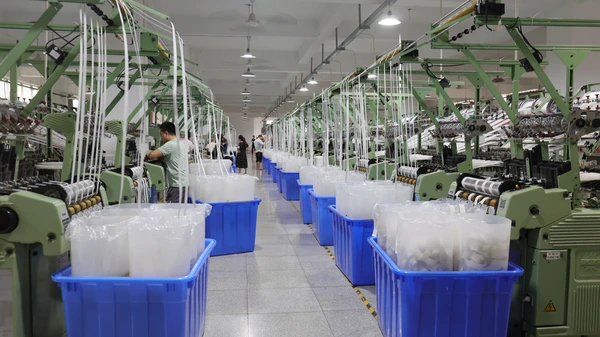
When purchasing recycled polyester webbing from China, professional buyers should verify both the manufacturing capability and the material evidence.
Factory-direct sourcing may help buyers communicate directly with the team responsible for weaving, roll preparation, printing and quality control. However, factory ownership alone does not establish certification eligibility or guarantee a particular performance standard.
Manufacturer Evaluation Checklist
- Confirm whether the supplier operates actual webbing weaving equipment.
- Request photos or video of relevant production processes.
- Check the available RPET widths, thickness and inventory.
- Ask for material composition information and relevant certificates.
- Verify any requested certified product claim and transaction documents.
- Request a representative sample for heat transfer testing.
- Confirm acceptable roll joints and visual quality standards.
- Review packaging, shipment terms, lead time and repeat-order management.
- Check whether the supplier can also provide printing, sewing or compatible accessories.
- Agree on quality acceptance and issue-resolution procedures before bulk ordering.
Guangzhou RPET Webbing Manufacturing Experience
Guangzhou Lovecolour Garment Accessories Co., Ltd. is a factory-direct webbing and lanyard supplier in Guangzhou, Guangdong Province, China. The company operates more than 50 weaving machines across its webbing manufacturing operations and maintains regular white polyester and RPET webbing ranges.
Our wider manufacturing workflow includes transfer paper printing, heat transfer, cutting, sewing and lanyard hardware assembly. This allows customers to discuss blank webbing, printed material, partial processing or completed lanyards with the same manufacturing partner.
We place particular emphasis on clean roll preparation, reduced unnecessary joints, pre-ironing and material consistency, because these details can affect the customer’s subsequent printing and assembly operations.
Learn more about LOVECOLOUR’s Guangzhou manufacturing background and our OEM/ODM customization capabilities.
16. Sourcing RPET Webbing for the USA, UK, Europe, Middle East and Other Markets
International buyers should specify both technical requirements and the applicable commercial and documentary conditions for their destination market. Recycled-content claims, product labeling and import procedures can vary by country and buyer program.
United States and Mexico
Buyers in the USA and Mexico may request recycled polyester webbing rolls for local sublimation printing, promotional merchandise and lanyard manufacturing. Widths may be discussed in millimeters or converted to inches, while packing can be specified in meters or yards.
United Kingdom, Spain and Poland
UK and European procurement teams may have customer-specific recycled-content verification requirements. Buyers should identify the relevant standard, documentation expectations and product claim requirements before approving a supplier.
Saudi Arabia and the UAE
Printing workshops and promotional suppliers in Saudi Arabia, Dubai and other UAE markets can source blank webbing, compatible hardware and additional finishing services according to their project requirements. Documentation and shipment arrangements should be agreed for each purchase.
Australia
Australian importers and local printing companies may evaluate RPET webbing for customized lanyards and branded textile products. Regular stock widths and roll packing can help with recurring purchasing programs.
Brazil, Chile and Ecuador
Buyers in Latin America should confirm material specifications, total shipment quantities, customs responsibilities and required purchasing documents before ordering bulk recycled polyester webbing.
Philippines, India and Vietnam
Regional printing companies and lanyard factories can assess RPET material for local printing and assembly, particularly where customers specify recycled polyester inputs.
LOVECOLOUR has broader international experience supplying white webbing and related accessories to these markets and additional countries. This should not be interpreted as proof that every market listed has purchased RPET material specifically. The destination, applicable trade requirements and documentation for each order must be confirmed individually.
Discuss RPET Webbing Export Requirements with Our Guangzhou Factory
17. RPET Webbing Wholesale RFQ Checklist
Before asking a manufacturer for pricing, prepare a complete RFQ so quotations can be compared on the same basis.
- Material: Recycled polyester / RPET, with the required composition.
- Certification: Required standard, scope, transaction evidence and intended product claim.
- Width: 10mm, 15mm, 20mm, 25mm, 30mm, 38mm, 50mm or custom.
- Thickness: Approximately 0.6mm or the required specification.
- Quantity: Total meters, yards or rolls, separated by width.
- Roll Length: 100 yards, 100 meters or custom.
- Joint Limits: Acceptable number and treatment of joints.
- Visual Quality: Cleanliness, edge condition and acceptable defects.
- Printing Requirements: Equipment, process, artwork and testing needs.
- Dimensional Stability: Accepted measurement and test tolerance.
- Additional Components: Hooks, rings, buckles, connectors or other accessories.
- Destination: Country, delivery location and proposed trade terms.
- Timing: Sample approval, required shipment date and repeat order plans.
A detailed RFQ reduces the risk of comparing two products that have different compositions, certification eligibility, roll quantities or quality standards.
18. Frequently Asked Questions About RPET Webbing
What does RPET stand for?
RPET stands for recycled polyethylene terephthalate, commonly known as recycled polyester in textile sourcing.
Is RPET webbing made from plastic bottles?
Some RPET may originate from recycled PET bottles, but the actual source must be verified. RPET can come from different qualifying recycled material streams.
What is the difference between GRS and RCS?
Both address recycled material content and chain of custody. GRS includes additional requirements concerning processing practices, while RCS focuses on recycled-content verification and traceability.
Does a GRS-certified yarn supplier mean the final webbing is GRS certified?
Not automatically. Certification eligibility depends on the applicable chain-of-custody requirements, certified operations and transaction documentation for the goods.
What is an RPET material scope certificate?
A scope certificate identifies the certified organization and its applicable products, processes or activities. Its coverage and validity must be reviewed rather than assumed.
Do I need a transaction certificate for every RPET order?
A transaction certificate may be necessary when purchasing goods under a certified chain-of-custody program. The exact requirements depend on the standard and intended claim. Not every ordinary RPET purchase is automatically a certified transaction.
Can RPET webbing be sublimation printed?
Yes, suitable RPET webbing can be used for dye sublimation. Printing should be validated with the buyer’s equipment, ink, paper and production settings.
Is RPET webbing more expensive than polyester webbing?
Not necessarily in every transaction. Price depends on material sourcing, recycled-content requirements, specifications, certification documentation, quantity and supplier conditions. Compare actual quotations rather than assuming a fixed premium.
What RPET webbing widths are available from LOVECOLOUR?
Our regular white RPET range includes 10mm, 15mm, 20mm, 25mm, 30mm, 38mm and 50mm, with approximately 0.6mm standard thickness.
Can I order RPET webbing in 100-meter rolls?
Yes. Our regular packing options include 100 meters and 100 yards per roll. Custom packing can also be discussed.
Can I purchase RPET webbing together with metal hooks and plastic buckles?
Yes. LOVECOLOUR supplies related lanyard components and can review compatible combinations for local assembly or finished product manufacturing.
Can you manufacture finished RPET lanyards?
We support printing, cutting, sewing and assembly. Material claims and certification documentation for the finished product should be confirmed separately from the raw webbing specification.
How do I reduce waste when printing RPET webbing?
Start with clean, consistent material, check roll joints, test dimensional stability and validate the heat transfer process before bulk printing. Document defects so their causes can be investigated.
How can I verify a recycled polyester supplier in China?
Review the supplier’s manufacturing operations, material specifications, certification documents, sample quality, roll continuity, commercial terms and repeat-order capability. Ask for specific evidence rather than relying on generic environmental claims.
19. Final Buyer Recommendations
Successful RPET webbing procurement requires three separate approvals: the recycled material claim must meet the buyer’s documentary requirements, the webbing must perform correctly in the intended manufacturing process, and the supplier must be able to maintain the agreed specification across repeat orders.
Do not substitute a certificate image for material testing, and do not substitute good printing performance for proof of recycled content. Both are important, but they answer different purchasing questions.
For large-volume programs, establish an approved reference sample, a written technical specification, an appropriate documentation process and an agreed procedure for handling quality issues.
Guangzhou Lovecolour Garment Accessories Co., Ltd. supplies regular blank white RPET webbing in seven widths, approximately 0.6mm thick, with 100-yard or 100-meter roll packing. Our Guangzhou manufacturing operation also supports webbing weaving, sublimation printing, cutting, sewing and compatible lanyard accessories.
Planning a wholesale RPET webbing order? Send us your required width, total quantity, roll length, destination, printing requirements and any recycled-material certification specifications.
Request RPET Webbing Material Information, Samples and Wholesale Pricing
About This Guide and Sources
This guide is published for professional RPET webbing buyers by Guangzhou Lovecolour Garment Accessories Co., Ltd. Company-specific statements reflect our reported manufacturing and material supply practices. Technical test methods and cost calculations are general purchasing guidance; numerical examples are illustrative and should not be interpreted as independently tested product performance.
Standards and certification reference: Textile Exchange – Textile Standards and Claims.
Sublimation technical reference: Sawgrass – Sublimation Heat Press Settings.
Related LOVECOLOUR resources: Webbing Materials | Custom Lanyards | Customization Services | About Our Factory | Request a Quote.